
Boston’s Swan Boats Are Turning 150. The Story Behind Them Is Better Than You Think
Boston’s Swan Boats Are Turning 150
They began with an opera, a bicycle and a Boston boat builder. Then a young widow kept the whole thing alive.
There are some things in Boston we almost stop seeing because they feel as though they have always been there—the Common and Public Garden, the ducklings, and those slightly improbable white swans carrying boatloads of people around the lagoon.
If you grew up around Boston, the Swan Boats can become part of the scenery. You know they’re there. You walk past them. You bring visiting relatives. You take the kids. You may not stop to ask how a pedal-powered boat disguised as a giant swan became one of the city’s most enduring traditions.
But somebody had to invent them.
And the story of how they survived may be even better than the story of how they began.
In 2027, Boston’s Swan Boats will celebrate their 150th season in the Public Garden. Even more remarkable, the same family that started them in 1877 is still running them.
It Started With an Opera
The story begins with Robert Paget, a boat builder who had received a City of Boston license to operate boats for hire on the Public Garden lagoon. Boating was already popular there in the 1870s, when people rented small rowboats and took them onto the water on summer days and evenings.
Paget came up with something different.
He and his wife, Julia, were opera lovers, and one of the stories they knew was Richard Wagner’s Lohengrin, based on the medieval legend of a knight who arrives in a boat drawn by a swan. Robert combined that romantic image with another innovation becoming increasingly popular at the time: the bicycle.
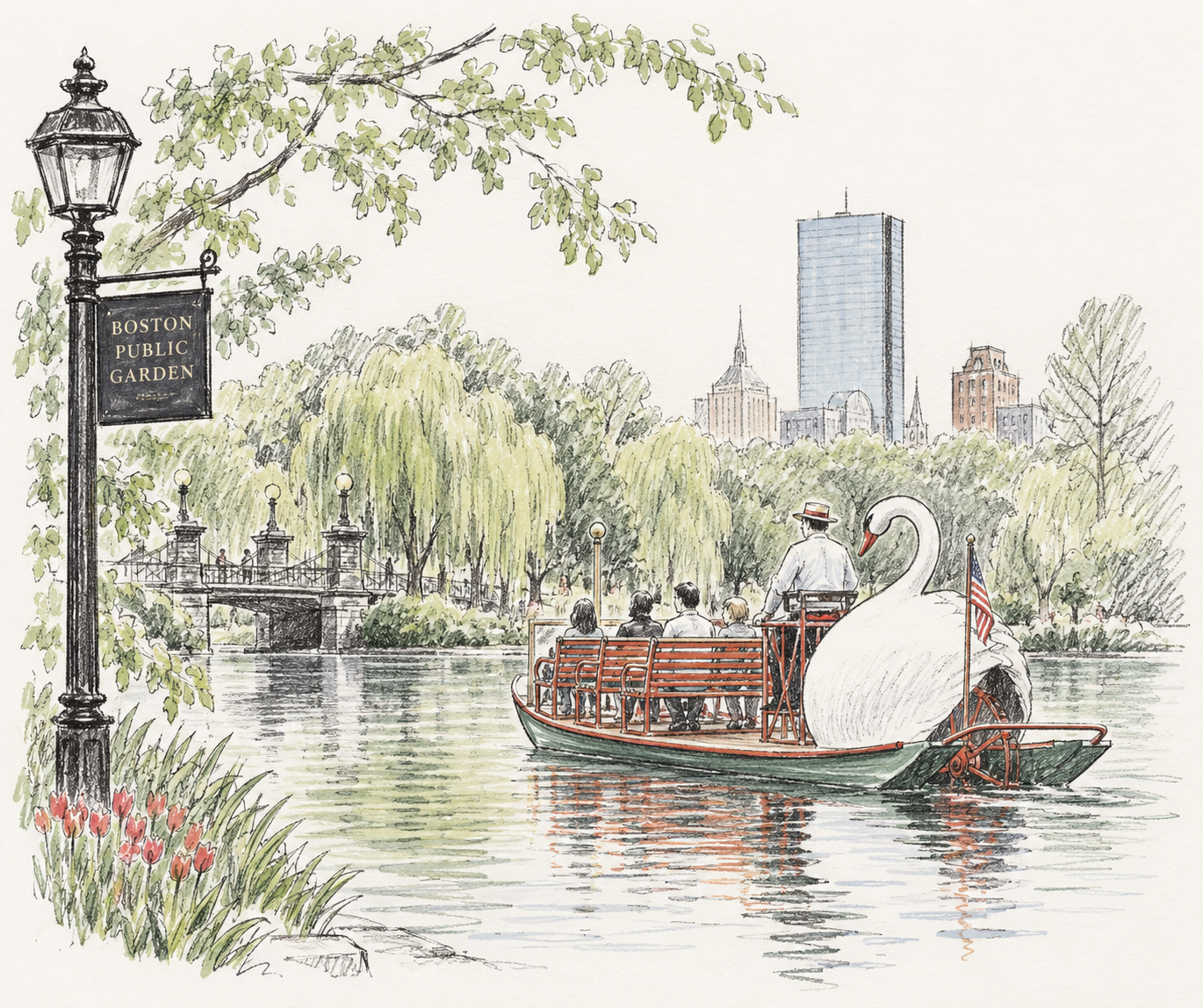
In 1877, he introduced a catamaran-style boat built on two pontoons. Passengers sat on benches while a driver behind them pedaled a paddle wheel using a mechanism much like a bicycle. Robert concealed the machinery with a large swan, so from a distance it looked as though the bird itself were carrying passengers across the lagoon.
It was odd, romantic and clever.
In other words, very Boston.
But Robert Paget barely lived long enough to see what he had created.
The Woman Who Kept the Swan Boats Alive
Robert died in 1878, just one year after introducing the Swan Boats. He was 42.
Julia was left with four young children and a fledgling family business at a time when women running businesses were unusual enough to attract scrutiny. She reportedly had to gather signatures of support from male business owners in the Back Bay to demonstrate that she was capable of continuing the operation.
She continued anyway.
For more than three decades, Julia Paget managed the Swan Boats while raising her family, and that matters because one of Boston’s most enduring traditions owes its survival not only to the man who invented it, but to the woman who refused to let it disappear after he died.
Without Julia, the Swan Boats might have become one of those curious little Boston footnotes: For a brief period in the 1870s, visitors to the Public Garden could ride in unusual pedal-powered boats decorated with swans.
Instead, generations of Pagets followed her.
The Same Family, Nearly 150 Years Later
Julia’s youngest son, John, and his wife, Ella, eventually carried the business forward. As ridership grew, the boats grew too. Later came their son Paul and his wife, Marilyn, who operated the Swan Boats for more than 50 years.
Today the boats are managed by fourth-generation cousins Lyn Paget and Phil Paget, and members of a fifth generation have already worked there.
That kind of continuity is remarkable in a city that has changed almost beyond recognition around them. Highways came and went. Skyscrapers rose. Entire parts of Boston were reshaped.
Through all of it, one family kept pedaling people around the same lagoon.
One of the Boats Is More Than a Century Old
The Swan Boats are not modern reproductions made to look historic. The current fleet consists of six boats, and the oldest dates to 1910.
The design has evolved over the decades, but the basic idea remains wonderfully uncomplicated: pontoons, benches, a paddle wheel, a person pedaling and an enormous swan concealing the works.
There is no motor roaring underneath and no high-tech propulsion system. Someone pedals you around the pond, in Boston, in the 21st century.
Perhaps that is part of why the Swan Boats have lasted.
They never needed to become something else.
Then Came the Ducklings
The Swan Boats became woven even more tightly into Boston culture in 1941, when Robert McCloskey published Make Way for Ducklings.
Mr. and Mrs. Mallard search Boston for a place to raise their family and eventually settle in the Public Garden. The Swan Boats appear in the story, helping introduce generations of children far beyond Massachusetts to this peculiar little Boston tradition.
Today, Nancy Schön’s bronze Make Way for Ducklings statues are among the most photographed residents of the Public Garden.
So we now have ducks commemorating a book about ducks that featured boats disguised as swans.
Boston can be wonderfully strange.
They Belong to the Garden
The Swan Boats are also part of the historic identity of the Public Garden itself.
The Boston Public Garden was established in 1837 and became the nation’s first public botanical garden. When the Garden was designated a Boston Landmark in 1977, the Swan Boats’ centennial year, the landmark study recognized the boats as part of the character of the protected landscape.
That distinction matters because the Swan Boats are not simply a tourist business that happens to operate inside a historic park.
After nearly 150 years, they belong to the place.
And if you grew up in Boston, they belong to the mental map of the city too. You know where they are. You know what season it is when they appear. They are one of those small signals that Boston has turned another page on the calendar.
Boston Wants Your Swan Boat Story
Now the Paget family is preparing for the Swan Boats’ 150th anniversary in 2027 by asking Boston to help tell the story.
They are collecting memories from Bostonians, former Bostonians and visitors. Maybe your parents took you when you were little. Maybe it was a school trip. Maybe you worked there one summer. Maybe you brought someone from out of town because you could not imagine showing them Boston without taking them through the Public Garden.
Maybe you rode as a child and came back decades later with your own children or grandchildren.
That is how places like this become more than attractions. They get folded into family stories.
The family is inviting people to contribute photographs, audio recordings and videos to help build a collection of those memories. It feels appropriate, because after 150 years, the history of the Swan Boats is no longer only the Paget family’s history.
It is Boston’s.
Go Ride Them
The Swan Boats closed for the 2026 season on Labor Day and are scheduled to return in April 2027 for their 150th season.
When they do, go ride them.
Not because they are thrilling. They are not. They travel around the lagoon at about the speed Boston could probably use a little more of.
Go because there are not many places left where you can do almost exactly what a Boston family could have done in 1877: sit on a bench, glide beneath the trees and watch the Public Garden pass slowly by while somebody else does the pedaling.
In a city that is constantly rebuilding itself, there is something rather wonderful about that.
If you have a Swan Boat memory of your own, the Paget family is collecting stories for the 150th anniversary at SwanBoats.com.
And if you love Boston—the history, the neighborhoods, the institutions and the wonderfully strange stories hiding in plain sight—join me on the GoBoston Substack. There is always another Boston story worth telling.