
How Does Boston Invent a New Sports Tradition?
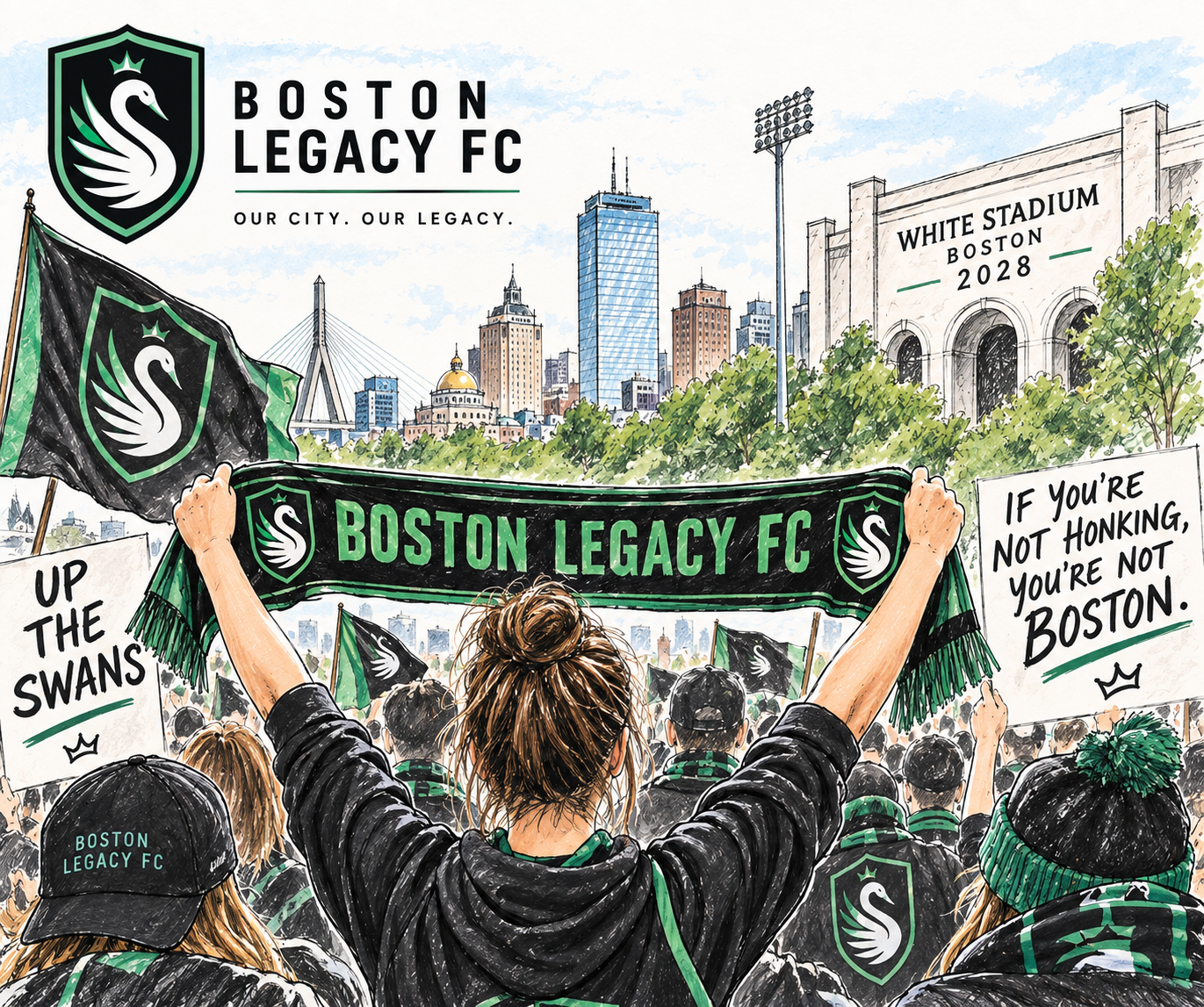
Boston Legacy FC — The Swans
The Red Sox, Bruins and Celtics inherited generations of fans. Boston Legacy FC has to build its traditions from scratch—and we get to watch it happen.
Boston knows how to inherit a sports tradition.
You learn when to boo the Yankees before you completely understand why. You know what a Bruins crowd sounds like when somebody drops the gloves. Celtics banners hang overhead carrying names and numbers from decades before some of the people in the seats were born.
Our sports culture comes with history attached.
But what happens when Boston gets a team with almost none?
That's what makes Boston Legacy FC interesting even if you haven't watched a minute of professional women's soccer. We are getting the rare chance to watch a Boston sports culture being invented while it happens.
The chants are new. The scarves are new. The jokes are new. Even the grudges are still being worked out.
And apparently, there is honking.
First, Who Is Boston Legacy FC?
If you just said, Wait, who?, you're probably not alone.
Boston Legacy FC is Boston's new professional women's soccer team, playing its first season in 2026 in the National Women's Soccer League, or NWSL, the top level of women's professional soccer in the United States.
This isn't Boston's first experience with professional women's soccer. The Boston Breakers were one of the original NWSL teams and also played in earlier women's professional leagues, but they folded after the 2017 season. For nearly a decade, a city with one of the strongest sports identities in America had no top-level women's professional soccer team.
Legacy is the return.
The club is women-founded and women-led, with Jennifer Epstein as its controlling owner. Its first head coach is Filipa Patão, who came to Boston after a highly successful run with Benfica in Portugal.
Eventually, Boston Legacy is supposed to have a very Boston home: a rebuilt White Stadium in Franklin Park.
Getting there has been considerably more complicated.
The White Stadium project became the subject of political fights, neighborhood concerns and a long court battle over the public-private redevelopment of the city-owned stadium. The Massachusetts Supreme Judicial Court cleared the legal path for construction to continue, but Legacy isn't expected to move there until 2028.
For now, this new Boston team is a bit of a nomad. It has played its inaugural season between Gillette Stadium in Foxborough and Centreville Bank Stadium in Pawtucket, Rhode Island, and will play its 2027 home schedule in Pawtucket.
It's difficult to build a hometown tradition when you're still waiting for your hometown stadium.
The fans decided not to wait.
They Organized Before They Had a Team to Cheer For
The Boston Independent Supporters' Association, or Boston ISA, began organizing after the NWSL announced in 2023 that Boston would receive an expansion franchise.
At that point, there wasn't much to support yet.
No roster. No mascot. No established traditions. For a while, not even a permanent name.
Still, the supporters began organizing, meeting with people involved with the club and thinking about what Boston women's soccer fandom should look and sound like when the players finally arrived.
By the time Legacy played its inaugural match at Gillette Stadium on March 14, 2026, they were ready.
More than 30,000 people came to that first game.
Members of the ISA marched in behind a Boston Public Schools marching band, raised their “Up the Swans” scarves and unfurled a huge banner depicting a flying swan in a black-and-green scarf with the words:
Our Legacy Takes Flight.
Then came the drums, flags and chants.
Boston had another professional team.
More interestingly, it was beginning to have another sports culture.
Boston Nearly Botched the Whole Thing Before the First Kick
There is already an origin story fans will probably be telling years from now, although the team might prefer to forget it.
Before Boston Legacy FC was Boston Legacy FC, the ownership group announced in 2024 that the team would be called BOS Nation FC.
That wasn't even the worst part.
The accompanying marketing campaign used the slogan “Too Many Balls.”
Yes. Really.
The rollout was widely criticized, including by the very women's soccer fans the new franchise needed most. Eventually the organization scrapped the name and branding and started over.
This time, supporters had a voice.
Members of Boston ISA participated in focus groups and gave feedback about what had gone wrong and what they wanted the new identity to represent. The eventual result was Boston Legacy FC, with a swan incorporated into the club's identity.
And the swan isn't simply decorative.
The club's official crest features a white swan inside a black-and-green shield. The team says the bird represents integrity, grit and style, along with the territorial nature of swans. There are eight feathers in the wing, representing the eight original NWSL teams—including the Boston Breakers—and their angles echo the cables of the Zakim Bridge.
Green connects the identity to Boston's parks and to Franklin Park, the team's eventual home.
That's a lot of Boston packed into one bird.
And anyone who has ever gotten too close to an actual swan knows they're not nearly as serene as they look from across the water.
They can be aggressive.
As it turns out, that fits this team rather well.
The Swans Have Attitude
Legacy hasn't exactly eased politely into the NWSL.
The team has struggled in the standings during its expansion season, but it has also developed a reputation for physical play. Through early September, Boston led the league in yellow cards.
Goalkeeper Casey Murphy summed up the desired atmosphere after an early-season game: visiting teams should hate coming here.
That sentiment should sound familiar to anyone who has spent much time around Boston sports.
The supporters have embraced it too, but with their own peculiar sense of humor.
When Murphy sends the ball booming up the field, fans have dubbed the moment “Dropkick Murphy,” an obvious nod to the Dropkick Murphys and I'm Shipping Up to Boston.
Then there's the honking.
One of the supporters' chants begins:
“If you're not honking, you're not Boston.”
And then people honk.
Like swans.
Repeatedly.
It is intentionally annoying, which somehow makes it even more Boston.
This Is How Traditions Actually Begin
We tend to look at old sports traditions as though they arrived fully formed.
They didn't.
Somebody sang the song the first time. Somebody brought the sign. Somebody came up with the nickname that stuck. Somebody started doing something ridiculous after a victory, and eventually thousands of people decided that this was simply what we do.
Then children learn it from their parents, who learned it from theirs, and somewhere along the way nobody remembers exactly when it started.
Boston Legacy gives us the unusual opportunity to see the beginning.
Right now, fans are deciding which chants survive and which disappear. They're creating flags and painting banners. They're gathering for tailgates and away-game watch parties. They're attaching Boston references to players who only recently arrived here.
Some of it will last.
Some of it will probably be forgotten by next season.
But a few things being shouted behind the goal in Pawtucket or Foxborough right now may still be shouted at White Stadium 20 years from now.
That's the part I find fascinating.
Boston Has Been Here Before
There is also something important underneath all the fun.
Boston didn't simply gain a women's professional soccer team in 2026. It got one back.
When the Boston Breakers folded in 2018 after playing their final season in 2017, the loss was abrupt. Fans who had invested years in the team were suddenly left without one.
Some of those people are now among the supporters building Legacy.
Others are discovering women's professional soccer for the first time.
That gives this new fan culture an unusual mixture of memory and invention. For some people, Legacy represents a beginning. For others, it is the return of something Boston should never have lost.
Someday They'll Have a Home
White Stadium is supposed to change everything.
The stadium, which opened in Franklin Park in 1949, is being comprehensively rebuilt through a partnership between the City of Boston and Boston Legacy. It will remain city-owned and continue serving Boston Public Schools athletics while also becoming the permanent home of the professional team.
The project has been expensive, controversial and litigated, and its story deserves scrutiny of its own.
But imagine the other side of it.
In 2028, if the schedule holds, supporters who spent the team's first two seasons hauling drums, scarves and flags between Foxborough and Pawtucket will finally march into a stadium in Boston and call it home.
By then, they won't be inventing everything anymore.
They'll already have traditions.
We Don't Usually Get to Watch This Part
That's what makes Boston Legacy worth paying attention to now.
Twenty years from now, perhaps a kid will walk into White Stadium wearing a Legacy scarf because her mother always wore one. Maybe thousands of people will automatically start honking without having the slightest idea who first thought it was funny. Maybe “Dropkick Murphy” will disappear the moment Casey Murphy leaves Boston, or perhaps it will somehow mutate into something nobody can predict.
That's how sports culture works.
Boston is very good at protecting its old traditions. We put numbers on walls, statues outside ballparks and championship banners in rafters.
But every old Boston tradition was new once.
With Boston Legacy FC, we don't have to read about the beginning years later.
We're here for it.
If you love Boston—the neighborhoods, history, institutions, sports and wonderfully strange traditions that make this city what it is—join our GoBoston community on Substack.
Come tell us what you think, share your own Boston stories and help us discover the next one.
Sources
Boston Legacy FC — official club history, crest and White Stadium information
Boston Independent Supporters' Association — supporter history and traditions
City of Boston — White Stadium redevelopment
The Guardian — reporting on Boston Legacy supporters and the development of the club's fan culture