
After a decade of building a regulated cannabis industry, Massachusetts voters are being asked to dismantle much of it. What happened, who is behind the repeal effort, and what would it mean for Boston businesses, taxpayers, and medical marijuana patients?
October 28, 2026 | GoBoston.com
In 2016, Massachusetts voters made history by approving the legalization of recreational marijuana. It was a major policy change, supported by nearly 54% of voters, and it took years to build the industry that followed.
The Commonwealth established a regulatory commission, developed licensing and testing requirements, created new tax systems, and encouraged entrepreneurs to invest in an entirely new legal marketplace.
Boston went further, establishing programs intended to give people and communities disproportionately harmed by previous marijuana enforcement an opportunity to participate in the new industry.
Businesses opened. Employees were hired. Storefronts were renovated. Investors committed capital. Municipalities began collecting tax revenue.
And consumers who previously purchased marijuana through an underground market could buy tested, labeled products from licensed establishments.
Now, just ten years after legalization, Massachusetts voters face another ballot question that could reverse much of that work.
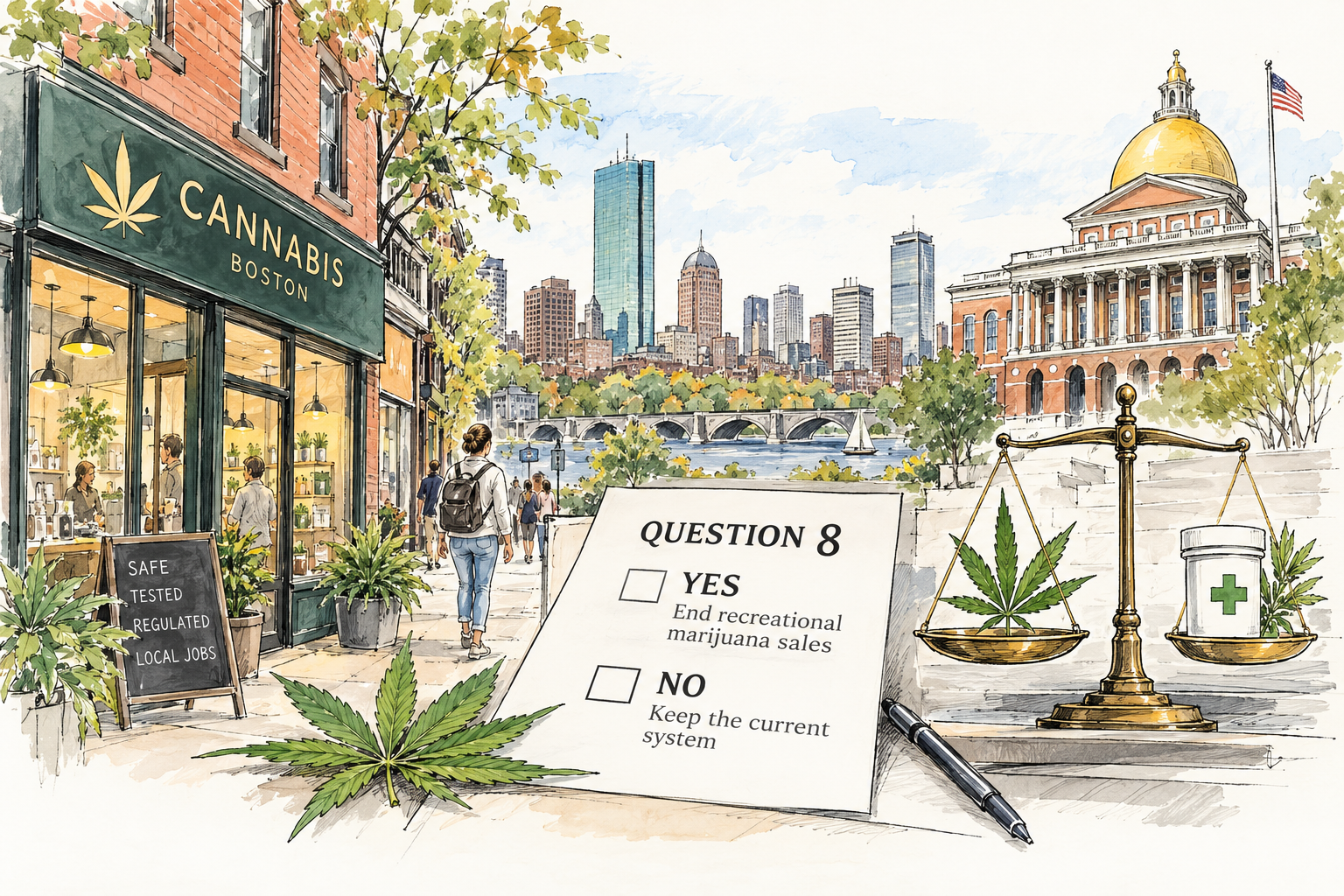
Question 8 on the November 3 ballot would eliminate legal recreational marijuana sales in Massachusetts while preserving the medical marijuana program.
The proposal raises a fundamental question: After spending a decade creating and regulating this industry, what would Massachusetts gain—or lose—by shutting down its recreational retail market?
How Massachusetts Got Here: A Decade of Legalization
The state's marijuana policies evolved over nearly two decades.
In 2008, Massachusetts voters decriminalized possession of small amounts of marijuana, replacing criminal penalties with civil fines.
In 2012, voters approved medical marijuana, allowing qualifying patients to obtain cannabis through a regulated medical program.
Then came November 8, 2016.
Massachusetts voters approved Question 4, legalizing marijuana for adults 21 and older and authorizing a regulated recreational marketplace.
The state established the Cannabis Control Commission in 2017 to oversee licensing and regulation.
The first recreational marijuana stores opened in Northampton and Leicester in November 2018.
Boston's first adult-use dispensary followed in 2020.
What emerged was not simply a collection of stores selling marijuana. It was an extensive network of cultivators, manufacturers, independent testing laboratories, delivery businesses, retailers, regulators, and municipal licensing authorities.
Massachusetts also introduced one of the country's earliest statewide cannabis social equity programs.
By September 2026, adult-use marijuana businesses had generated more than $10 billion in cumulative gross sales, according to the Massachusetts Cannabis Control Commission.
The Commission reported nearly 800 operating licensed cannabis businesses statewide in October 2026.
This is the system voters are now being asked to reconsider.
So Why Is Marijuana Back on the Ballot?
The legalization debate never entirely disappeared.
While Massachusetts built its regulated cannabis industry, opponents continued to raise concerns about marijuana potency, youth exposure, impaired driving, addiction, and mental health.
Those concerns eventually developed into an organized effort to repeal recreational retail legalization.
The principal organization supporting Question 8 is the Coalition for a Healthy Massachusetts, which argues that commercial marijuana legalization has created public-health and social costs that outweigh the benefits of regulated sales.
But the campaign is not merely a spontaneous Massachusetts grassroots movement.
An October 8 investigation by GBH found that the coalition had raised more than $3 million, with the overwhelming majority of its funding coming from the fundraising arm of Smart Approaches to Marijuana (SAM), a Virginia-based organization that advocates against commercial marijuana legalization.
Much of that money supported signature gathering, campaign consulting, and advertising.
That distinction matters because Massachusetts voters are being asked to reconsider a policy they approved themselves, through an initiative financially supported largely by an organization based outside the Commonwealth.
Supporters began gathering signatures in 2025 for a proposed law called An Act to Restore a Sensible Marijuana Policy.
The campaign gathered enough signatures to advance through the state's ballot initiative process. It also survived legal challenges, including an objection alleging that voters had been misled during signature collection.
The Legislature reviewed the proposal, holding a public hearing on March 23, 2026.
On May 4, a majority of the Special Joint Committee on Initiative Petitions recommended that lawmakers take no action on the measure.
The committee expressed concerns about regulatory uncertainty, the disruption of existing businesses, reduced public revenue, and possible unintended public-health consequences.
Under Massachusetts' initiative petition process, the failure of the Legislature to enact the measure did not end the effort. With the additional required signatures collected, the proposal qualified for the November ballot.
That is how Massachusetts arrived at Question 8.
What Would Question 8 Actually Do?
The proposal is not a complete prohibition on possessing marijuana.
Instead, it would repeal the state's legal framework for recreational cultivation, distribution, retail sales, and taxation.
If approved, beginning January 1, 2028:
Licensed recreational marijuana retailers would lose the legal authority to continue selling cannabis for adult recreational use.
Adults 21 and older could still legally possess up to one ounce of marijuana, including no more than five grams of concentrate.
Adults could give another adult up to one ounce without payment, subject to the proposed restrictions.
Possession of more than one ounce but no more than two ounces would carry a $100 civil fine and forfeiture.
The existing legal framework for nonmedical home cultivation would be repealed.
The Cannabis Control Commission would continue operating, but its authority would shift to regulating the medical marijuana program.
A particularly important distinction: Possessing marijuana would remain legal within the new limits, but purchasing it from a recreational dispensary would no longer be legal.
That creates an obvious practical question.
Where would adults who are legally permitted to possess marijuana obtain it?
The proposal permits limited gifts between adults but eliminates licensed recreational retail sales. It does not establish a replacement regulated marketplace for recreational consumers.
Critics argue that this could push some customers back toward unlicensed sellers.
Supporters maintain that eliminating commercial sales would reduce the availability and promotion of cannabis products.
Both outcomes deserve examination, particularly because eliminating legal retail sales does not necessarily eliminate demand.
What Happens to Medical Marijuana Patients?
For Massachusetts residents who rely on medical marijuana, this may be the most important part of Question 8.
Medical marijuana would remain legal.
Massachusetts approved medical cannabis in 2012, four years before recreational legalization, and Question 8 explicitly preserves the medical program under Chapter 94I of state law.
Qualifying patients would still be able to obtain cannabis through licensed medical marijuana treatment centers.
The Cannabis Control Commission would remain responsible for overseeing the medical program, including licensing and product testing.
Existing recreational businesses would also be allowed to apply through an expedited process to become medical marijuana establishments.
They could sell remaining recreational inventory to licensed medical marijuana treatment centers as part of the transition.
But there is a difference between preserving the medical program in law and guaranteeing that patients will experience no disruption.
Not every recreational business would necessarily qualify for a medical license, obtain approval, or find it financially practical to make the transition.
Patients who currently purchase products from stores operating only under recreational licenses could lose those shopping options unless the businesses successfully convert.
Medical dispensaries might also face changes in demand, competition, product availability, and distribution as the recreational marketplace closes.
The ballot measure does not guarantee that every recreational retailer will become a medical dispensary.
It also does not guarantee that every product currently available to recreational customers would remain available through the medical program.
Medical patients would retain their legal access, but the number and location of dispensaries available to serve them could change.
For people using medical cannabis to manage chronic symptoms, this uncertainty is more than an abstract business question.
Reliable access, consistent products, reasonable travel distances, and continuity of care all matter.
What About People Who Use Marijuana Without a Medical Card?
Many adults purchase marijuana for relaxation, sleep, discomfort, or other personal reasons without participating in the state's medical marijuana program.
They are currently permitted to shop at licensed recreational dispensaries simply by showing identification proving they are at least 21.
That option would disappear if Question 8 passes.
A person would not automatically qualify for the medical program simply because they had previously purchased recreational marijuana.
Medical access would continue to require eligibility under the state's medical marijuana rules.
The distinction between medical and recreational consumers could therefore become far more consequential.
And while possession of small amounts would remain lawful, the question of a dependable, regulated source would be unresolved for adults outside the medical program.
Boston Has Invested in More Than Dispensaries
For Boston, Question 8 has particular significance because the city deliberately used cannabis legalization as an opportunity to address longstanding economic inequalities.
In 2019, Boston adopted an ordinance establishing the Boston Cannabis Board, the Boston Cannabis Equity Program, and the Boston Equity Fund.
The city wanted to create opportunities for entrepreneurs from communities that had experienced disproportionate enforcement of marijuana laws.
The goal was not simply to permit cannabis businesses. It was to encourage participation by people who had previously faced barriers to business ownership and access to capital.
That required an extensive administrative effort involving local licensing, community review, state approvals, business development, financing, and regulatory compliance.
Boston's first adult-use dispensary opened in 2020.
Since then, the city's cannabis marketplace has become part of the local small-business economy.
A repeal would affect more than retailers.
There are employees working in stores, security, management, cultivation, manufacturing, testing, transportation, and related professional services.
There are landlords leasing commercial spaces, contractors who completed renovations, and investors who financed expensive licensing and startup processes.
For owners who participated in Boston's equity initiatives, the potential loss of their recreational business licenses raises a particularly difficult issue.
What happens to the investment Boston encouraged people to make when the legal market it helped create is dismantled?
Some businesses might convert to medical operations. Others might not.
The consequences could differ substantially between a financially established company and a small independent operator still working to recover its initial investment.
How Much Tax Revenue Is at Stake?
The financial consequences extend well beyond individual cannabis businesses.
According to the official Massachusetts voter information guide, recreational marijuana taxation generated approximately:
$280 million in state revenue and $50 million in local revenue in fiscal year 2025.
That is approximately $330 million in combined annual state and municipal revenue for that fiscal year.
Recreational cannabis sales contribute tax revenue through the state's cannabis excise tax, sales tax, and applicable local taxes.
The state uses general revenue to support public services, including education, local aid, and other government operations. Cannabis revenue also supports designated programs under state law.
Boston and other municipalities that collect local cannabis taxes would face reduced revenue if recreational sales ended.
The precise loss for Boston would depend on its taxable sales and local revenue arrangements; the statewide $50 million figure represents all Massachusetts municipalities, not Boston alone.
Supporters of repeal argue that the social and public-health costs associated with marijuana exceed the tax revenue collected.
Opponents argue that eliminating licensed retailers would sacrifice substantial public revenue without necessarily eliminating consumption or its associated risks.
These are different questions that voters need to consider separately.
How much revenue does the industry generate?
What costs are associated with cannabis use?
And how would those costs change if licensed retail sales disappeared?
The answers matter more than the revenue figure alone.
The Public Health Debate: Regulation Versus Commercialization
Public health is at the center of the campaign.
Supporters of Question 8 cite concerns about high-potency cannabis products, adolescent exposure, psychiatric symptoms, impaired driving, workplace safety, and the commercialization of marijuana.
These concerns warrant serious attention.
Cannabis is not risk-free. High-THC products can cause adverse reactions, and frequent use can present particular risks for adolescents and some vulnerable adults.
Driving while impaired by cannabis is unsafe and remains illegal.
But another important question is whether ending licensed recreational sales would reduce those harms or change where consumers obtain marijuana.
Massachusetts currently requires licensed businesses to comply with regulations governing testing, packaging, labeling, and sales to adults.
An unregulated seller operates outside that system.
Opponents of Question 8 argue that dismantling the legal recreational market would remove an important layer of consumer protection.
Supporters respond that the existence of a regulated commercial market has increased availability and normalized products that carry health risks.
Both sides are addressing public-health concerns, but they disagree about the appropriate policy response.
The debate is not simply whether marijuana can cause harm.
It is whether Massachusetts should continue regulating its recreational sale or eliminate the legal commercial marketplace.
Haven't We Had This Debate Before? Alcohol, Prohibition, and Cannabis
There is an important historical comparison missing from much of the debate over Question 8.
America tried prohibiting the legal manufacture, transportation, and sale of alcohol beginning in 1920. Prohibition lasted until 1933, when the 21st Amendment repealed the national ban.
The country ultimately returned to a system of legal alcohol sales, taxation, licensing, and government regulation.
Alcohol remained a serious public-health problem.
It still is.
According to the Centers for Disease Control and Prevention, excessive alcohol consumption caused approximately 178,000 deaths annually in the United States during 2020–2021, including deaths associated with chronic disease, injuries, and other alcohol-related conditions.
Alcohol contributes to liver disease, several cancers, impaired driving, accidental injuries, and violence.
Yet Massachusetts does not propose eliminating licensed liquor stores, restaurants, or bars whenever concerns about excessive drinking arise.
Instead, it regulates alcohol sales, restricts purchases by age, taxes the industry, and enforces laws against impaired driving.
Cannabis carries its own risks, particularly with high-potency products, frequent use, adolescent exposure, and impaired driving. But cannabis and alcohol do not have identical health effects, and their public-health consequences should be evaluated using comparable evidence.
Cannabis also has recognized therapeutic applications. The National Academies have identified evidence supporting certain uses of cannabis or cannabinoids, including treatment of chemotherapy-related nausea and some forms of chronic pain and multiple sclerosis spasticity.
This raises a legitimate question about the consistency of our regulatory approach.
If Massachusetts regulates alcohol despite its well-documented harms, what makes eliminating licensed recreational cannabis sales a preferable approach to strengthening cannabis regulation?
Supporters of Question 8 argue that preventing commercial expansion would reduce cannabis-related health risks. Opponents argue that eliminating legal stores could shift consumers toward unregulated sellers.
There is another historical dimension to the discussion: language itself.
The plant's scientific name is cannabis. The word marijuana became entrenched in American drug policy during an era when anti-cannabis campaigns frequently employed racialized and anti-Mexican rhetoric.
Today, the terms are often used interchangeably, and Massachusetts law continues to use marijuana in its official language.
But the history behind the terminology is worth remembering.
Question 8 is ultimately about more than a plant or a retail industry.
It asks Massachusetts voters to reconsider an enduring public-policy dilemma: When a substance presents potential harms, does society protect public health more effectively by prohibiting its commercial sale or by controlling its production, distribution, and consumption through regulation?
What Did Massachusetts Lawmakers Say?
The Legislature's Special Joint Committee on Initiative Petitions reviewed the repeal proposal during the spring of 2026.
Its majority report did not recommend adopting the measure.
Among the committee's concerns were the absence of sufficiently detailed transition and enforcement provisions, uncertainty about regulatory responsibilities, potential disruption to established businesses, and the loss of tax revenue.
Lawmakers also questioned how removing existing commercial regulations might affect public-health protections, including product testing and labeling.
The committee did not conclude that every concern about recreational cannabis was unfounded.
Instead, its report focused on whether the proposed law adequately addressed the practical consequences of repealing an existing regulatory structure.
That distinction is important.
A voter can have serious concerns about cannabis use while also questioning whether the particular law proposed in Question 8 is an effective response.
Ten Years of Investment, One More Decision
Massachusetts has spent a decade creating a complicated system of legal cannabis production, testing, licensing, taxation, and retail distribution.
Boston has added its own regulatory and economic equity programs.
Entrepreneurs invested money based on those laws. Workers built careers. Consumers learned to navigate a legal system. Municipalities incorporated cannabis revenue into their finances.
Now voters are being asked to reconsider the underlying policy.
Supporters of Question 8 believe commercial recreational marijuana sales have produced unacceptable harms and that Massachusetts should retreat from retail legalization.
Opponents believe repealing the regulated marketplace would undermine consumer protections, eliminate businesses and jobs, and return some purchases to an underground economy.
Medical marijuana would remain legal, but the transition could still reshape the industry and the options available to patients.
The fundamental question is not whether Massachusetts should address the risks associated with marijuana. It is whether eliminating legal recreational sales would address those risks more effectively than reforming the system the state has already built.
That is the decision before voters on November 3.
Massachusetts Question 8: How to Vote
Question 8 asks whether Massachusetts should prohibit the legal retail sale of recreational marijuana.
A YES vote: Approves the repeal of legal recreational marijuana sales and changes the state's rules governing possession.
A NO vote: Keeps the current marijuana laws in place.
If the question passes, the proposed changes would take effect January 1, 2028.
Important Boston voting dates:
Friday, October 30: Last day of in-person early voting. Boston City Hall's Haymarket Room is open from 9 a.m. to 5 p.m.
Tuesday, November 3: Election Day. Polls are open from 7 a.m. to 8 p.m. at assigned polling places.
Boston voters may use any designated city early-voting location during its scheduled hours, but on Election Day they must vote at their assigned precinct.
Find official information here:
Massachusetts Question 8 — Full Ballot Summary and Proposed Law
Boston Early Voting Locations and Hours
Massachusetts Voter Information and Polling Place Lookup
Join the Conversation
Question 8 raises important questions about public health, consumer protection, local businesses, and the consequences of reversing an established state policy.
What do you think Massachusetts should do? Is the better approach to preserve and reform its regulated cannabis industry, or end recreational retail sales while keeping medical marijuana legal?
Join our community on GoBoston Substack to share your perspective and take part in the conversation about the issues shaping Boston and Massachusetts.
For more local news, election information, and events, explore What's Happening in Boston.