
The Boston Stadium Hidden Inside an Olmsted Park Is About to Begin a Second Life
White Stadium has served Boston kids for generations. Now a $325 million rebuild, professional women’s soccer and a fight over public space are transforming one of the city's most unusual sports landmarks.
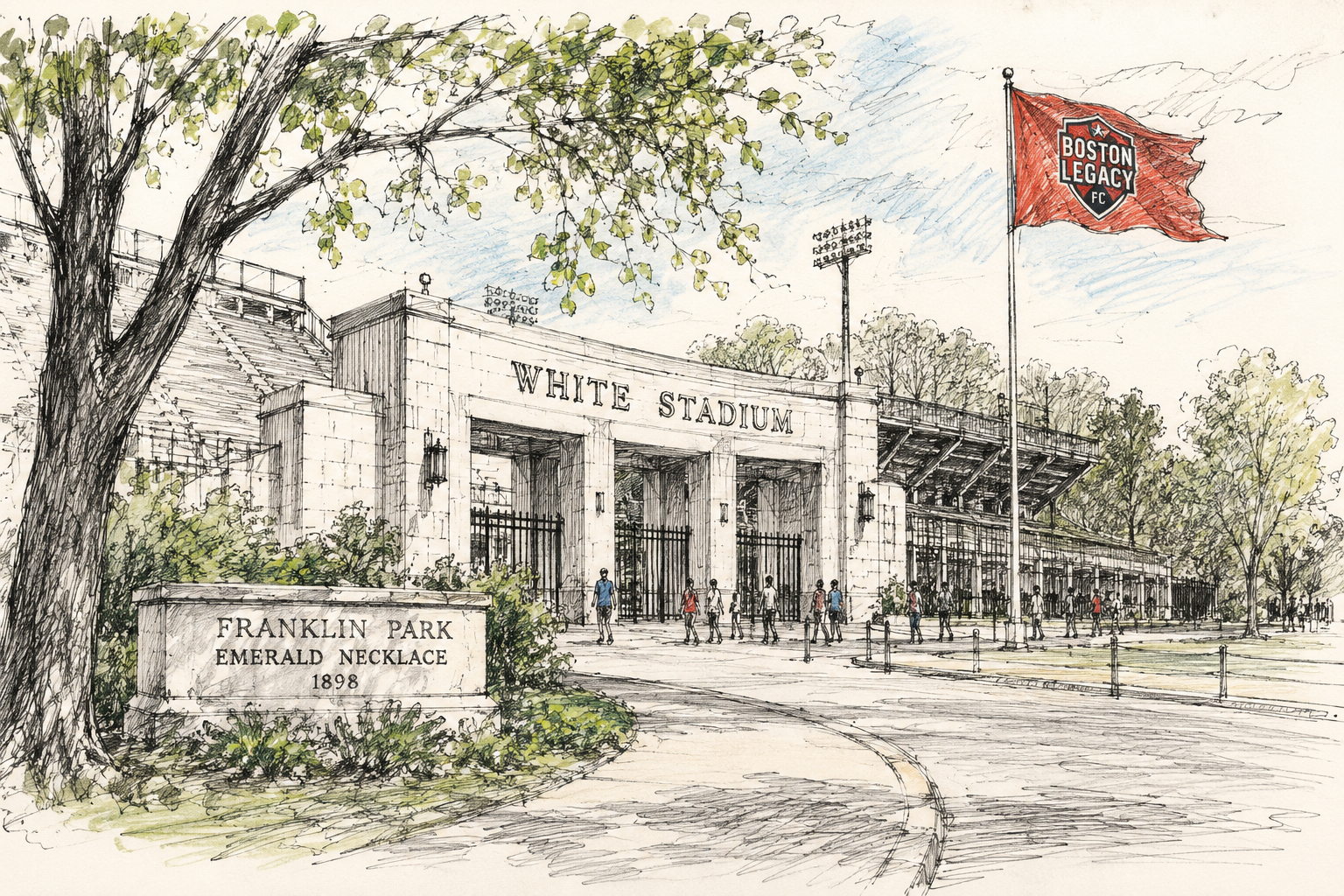
White Stadium, Franklin Park, Boston, Massachusetts
There is a 10,000-seat stadium hidden inside one of Boston's great parks.
If you didn't grow up around Franklin Park, you could be forgiven for not knowing it was there.
White Stadium isn't Fenway. It doesn't appear on many Boston sightseeing lists. Generations of tourists have come and gone without ever seeing it.
But generations of Boston kids knew it well.
They ran track there. Played football there. Graduated there. Sat in the stands. Went to concerts and community events there.
White Stadium was constructed in the 1940s and dedicated in 1949, tucked into the Playstead of Franklin Park, the sprawling landscape designed by Frederick Law Olmsted as the southern anchor of Boston's Emerald Necklace.
Now, more than three-quarters of a century later, that old stadium is being rebuilt.
The price tag is roughly $325 million. A professional women's soccer team is coming. Boston Public Schools is getting a dramatically upgraded athletic complex.
And on August 19, 2026, Massachusetts' highest court removed one of the biggest remaining obstacles to making it happen.
The Supreme Judicial Court unanimously rejected a legal challenge brought by the Emerald Necklace Conservancy and residents opposed to the redevelopment.
Construction can continue.
But a court ruling can't answer the most interesting question about White Stadium:
What happens when a public stadium inside one of Boston's most historic parks becomes the home of a professional sports team?
That's where this story gets complicated.
Before the Stadium, There Was Olmsted
To understand why people care so much about what happens to White Stadium, you have to start with Franklin Park.
Planning for the park began in the 1880s as part of Frederick Law Olmsted's Emerald Necklace, the extraordinary chain of parks and waterways winding through Boston and Brookline.
Franklin Park was its largest piece.
And Olmsted didn't imagine all of it as untouched wilderness.
The Playstead, developed beginning in 1888, was intended for recreation, athletics and large public gatherings. Tennis courts arrived in the 1890s. Golf followed.
Eventually, so did White Stadium.
The original stadium was designed for roughly 10,000 spectators, with two grandstands holding about 5,000 people each.
That's worth remembering.
Professional soccer isn't arriving on a patch of untouched Olmsted meadow. A large stadium has occupied this ground for generations.
But that doesn't mean every new use of it is automatically the right one.
And therein lies the fight.
Fenway Had the Red Sox. White Stadium Had Boston's Kids.
White Stadium became part of Boston life without becoming one of Boston's famous sports landmarks.
Fenway had the Red Sox.
Boston Garden had the Celtics and Bruins.
White Stadium had Boston's kids.
It became a center of Boston Public Schools athletics, particularly football and track, while also serving the surrounding community.
Its history stretched well beyond school sports. The stadium hosted graduations, concerts, festivals, political gatherings and community celebrations.
Then the place began to fall apart.
A major fire damaged the East Grandstand in the 1990s. Years of deterioration followed. Attempts to renovate the stadium came and went.
Eventually, the deficiencies became impossible to ignore.
There was inadequate indoor training space. Parts of the facility lacked running water or heat. Drainage was poor. Accessibility and athletic facilities fell far short of what we would expect a city to provide its students today.
And there it sat.
A substantial public stadium inside Boston's largest park, slowly deteriorating while everyone agreed something should be done and nobody quite figured out how to pay for doing it.
Then women's professional soccer came to town.
Suddenly, Everybody Wanted to Talk About White Stadium
In 2023, Boston was awarded a franchise in the National Women's Soccer League.
The club that became Boston Legacy FC needed a permanent home.
White Stadium offered something extraordinarily difficult to find in Boston: an existing stadium site, relatively close to the heart of the city, large enough for professional soccer and already devoted to athletics.
At the same time, Boston had been looking for a private partner to help rebuild White Stadium.
Those two needs found each other.
Boston Unity Soccer Partners, the ownership group behind the team, became the city's partner.
Suddenly, a stadium Boston had struggled to repair for decades had access to enormous private investment.
It also had something else.
A controversy big enough to put White Stadium in the headlines.
So Who Is Paying for This?
The redevelopment is now expected to cost approximately $325 million.
Boston's publicly funded construction share is about $135 million. Boston Legacy says the private construction investment will exceed $190 million.
For that money, this won't simply be an old stadium with nicer bleachers.
Plans call for rebuilt grandstands, a professional grass field, an eight-lane track, modern locker rooms, sports-medicine and strength-and-conditioning facilities, indoor athletic and community space, classrooms, public bathrooms and major accessibility improvements.
And here's an important distinction:
Boston Public Schools will still own White Stadium. Boston Legacy FC isn't buying it.
The professional team will lease portions of the public facility.
Boston Legacy can hold no more than 20 games per year, including playoff games, along with limited team practices connected with those games. The city says more than 90 percent of the stadium's programmable hours will remain for Boston Public Schools and community use.
That's the bargain.
Supporters see a neglected public stadium finally receiving a generational investment while Boston students get facilities the city couldn't otherwise provide at this scale.
Opponents see public money, public land and a public institution being reshaped partly around the needs of a private professional sports business.
Both are looking at the same stadium.
Who Gets to Use a Public Park?
This is the part of the White Stadium fight that shouldn't be reduced to soccer fans versus people who hate development.
Many opponents agree that White Stadium needs to be rebuilt.
Their argument is that Boston could have rebuilt a smaller, entirely public facility without embedding a professional sports franchise inside Franklin Park.
The Emerald Necklace Conservancy and neighborhood opponents have raised concerns about cost, traffic, parking, park access, the project's scale and the precedent created when a private business receives substantial use of a public facility inside a historic park.
The debate has stretched across years of community meetings and hundreds of submitted comments. The city says public feedback produced changes to the design and agreements, including protections involving trees, park views, game times, lighting, noise and transportation.
Underneath all of those arguments is a deceptively simple question:
How much private use is too much when the private investment is helping pay for the public thing?
Boston's answer is that the public gets far more than it gives up.
Opponents' answer is that some public places shouldn't require that bargain in the first place.
Then a 21st-Century Stadium Fight Turned Into a 1940s Land Case
This is where the story becomes wonderfully Boston.
To decide whether a professional women's soccer team could play in a rebuilt stadium in the 2020s, Massachusetts judges had to go digging through decisions about what Boston was doing with the land in the 1940s and 1950s.
The Emerald Necklace Conservancy and residents known as the Franklin Park Defenders challenged the project on several grounds, including Article 97 of the Massachusetts Constitution, which provides significant protections for certain public lands used for conservation and recreation.
White Stadium presented an unusual problem.
The land had once been part of Franklin Park. But the site had been used for school athletics for generations, under a legal history stretching back decades before Article 97 existed.
On August 19, the Supreme Judicial Court rejected the challengers' claims, including the argument that the redevelopment required Article 97 approval.
The court wasn't deciding whether the project was wise, beautiful, too expensive or good for Franklin Park.
It was deciding whether Boston could legally do it.
The answer was yes.
Now Boston Has to Figure Out How to Get Everybody There
Winning the court case doesn't solve another very practical problem.
White Stadium isn't Fenway.
There isn't a Green Line stop waiting outside the gate.
Thousands of soccer fans will be arriving at a stadium surrounded by a park and residential neighborhoods.
So Boston and the team have come up with an unusually restrictive transportation plan.
Legacy spectators won't be allowed to park in Franklin Park or on surrounding neighborhood streets on game days.
Fans are expected to use public transportation, walking, biking, rideshare and shuttle buses. Free shuttles are planned from Forest Hills, Ruggles and JFK/UMass stations, along with satellite parking locations.
Boston Legacy is responsible for the game-day transportation program and associated enforcement.
On paper, it's an interesting solution.
In real life?
We'll find out when thousands of soccer fans all try to get to Franklin Park at the same time.
And What Does Boston Get?
Quite a lot, if everything in the agreements happens as promised.
Beyond the rebuilt school athletic facilities, Boston Legacy has committed to operating and maintaining the stadium, paying rent, sharing revenue and funding community benefits.
Those commitments include an annual community fund beginning at $500,000, money for Franklin Park tied to ticket sales, investment in the park's tree canopy, and scholarships, internships and mentorship opportunities for BPS students.
The project is expected to create more than 500 construction jobs.
Boston is also aiming high environmentally. City officials say the redevelopment is being designed to make White Stadium one of only a handful of carbon-neutral stadiums in the country.
But some of the improvements I find most interesting are considerably less glamorous.
Bathrooms. Water fountains. Heat. Indoor training space. A track people can use seven days a week.
The city says public access will expand to as much as 15 hours a day, seven days a week, when the stadium isn't reserved for events.
Sometimes the measure of a great public project isn't the luxury box.
It's whether the bathroom is open.
White Stadium at a Glance
Where: 450 Walnut Avenue in Franklin Park
Dedicated: 1949
Owner: Boston Public Schools
Redevelopment cost: Approximately $325 million
Capacity: Approximately 10,000
Professional tenant: Boston Legacy FC of the National Women's Soccer League
Professional games: Up to 20 per year, including playoffs
Public access: Generally 6 a.m. to 9 p.m. when the facility isn't reserved
Game days: No Legacy spectator parking in Franklin Park or surrounding neighborhood streets
Completion: Construction is underway. The City of Boston currently lists the completion date as “to be determined.”
Something Else Is Happening Here
For all the fighting over money, traffic and parkland, there's another part of this story that shouldn't get lost.
Boston is making a major investment partly because of women's professional sports.
Think about that for a moment.
For most of White Stadium's life — and most of Boston's sports history — the idea that a professional women's team could be the financial catalyst for rebuilding a major city stadium would have sounded improbable.
Now Boston Public Schools girls could run track and play soccer in the same complex where professional women athletes compete before thousands of fans.
That matters.
Not because it settles the argument over White Stadium.
It doesn't.
But it changes what the stadium represents.
The Real Test Comes After the Ribbon Cutting
Boston has always layered new lives on top of old places.
Fenway Park survived while the neighborhood around it transformed. Faneuil Hall has been a marketplace, meeting hall, political stage and tourist destination. Much of Boston has been rebuilt again and again without completely erasing what came before.
Now it's White Stadium's turn.
A school stadium that has served Boston since the 1940s survived generations of games, concerts, rallies and graduations, a damaging fire and decades of deterioration.
Now it is becoming something Boston has never quite had before:
a public-school athletic complex, community facility and professional women's soccer stadium occupying the same ground.
Maybe the partnership becomes a model for how cities can use private money to rescue aging public facilities.
Maybe Boston discovers that some of the critics' fears were justified.
Most likely, as happens with complicated city projects, the answer will be some of both.
The Supreme Judicial Court couldn't decide that part.
We will.
Can Boston move thousands of people through Franklin Park without overwhelming its neighbors? Will ordinary residents really get the access they've been promised? Will Boston Public Schools athletes remain at the center of the facility? Will the private partner still be fulfilling its promises ten or fifteen years from now?
And there's one question I keep coming back to.
Twenty years from now, will a Boston kid walking into White Stadium still feel that it belongs to them?
If the answer is yes, Boston may have pulled off something remarkable.
After more than three-quarters of a century, White Stadium isn't just getting rebuilt.
It's getting a second life.