
What Is Storrowing? Have You Ever Been Storrowed?
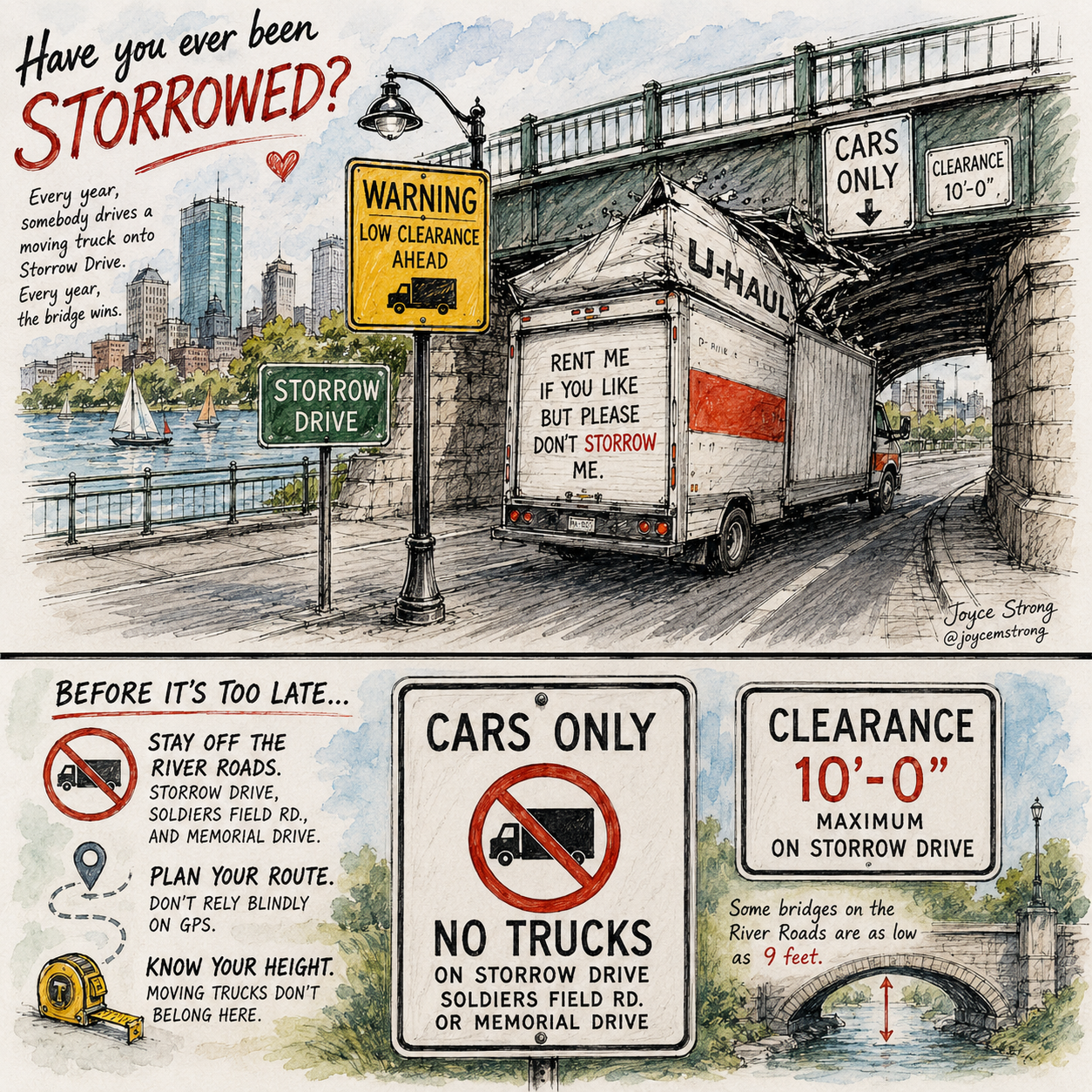
Getting Storrowed on Storrow Drive in Boston, Massachusetts
Boston has spent years warning drivers not to take moving trucks onto Storrow Drive. Every September, somebody apparently decides the signs are meant for somebody else.
Have you ever been Storrowed?
Have you ever been Storrowed?
Have you ever tried?
If you know the old Olivia Newton-John song Have You Never Been Mellow, you probably heard that question in exactly the same rhythm I did when it popped into my head.
And now I may never be able to hear the song correctly again.
That's what Boston does to you.
We take the name of a perfectly respectable parkway, turn it into a verb, and use it to describe the moment somebody drives a moving truck into a bridge and peels the roof off like the lid of a can.
Welcome to Storrowing season.
First, What Does It Mean to Get Storrowed?
Storrow Drive runs along the Charles River on the Boston side, and parts of it pass beneath bridges with very low clearances.
It is not a road for moving trucks.
This is not a secret.
Massachusetts has gone to extraordinary lengths to make this clear. There are CARS ONLY signs, height warnings, message boards and special warnings around moving season. Some of the hanging signs are positioned so the top of an oversized vehicle will hit the warning before it hits the bridge.
Think of that as Boston's last gentle suggestion.
If the top of your U-Haul hits a sign telling you not to continue, don't continue.
Yet every year somebody does.
The result is a Storrowing.
The truck roof gets crushed, ripped or peeled open. Traffic backs up. Police and road crews arrive. The bridge may need to be inspected.
And somewhere else in Boston, thousands of people see the picture and think:
Of course.
The Bridge Always Wins
I think that's part of why Storrowing has become such a Boston thing.
There is no suspense.
Nobody sees a box truck approaching one of those bridges and thinks, This could go either way.
It isn't going either way.
The bridge was there before your rental truck arrived.
The bridge will be there after your rental truck leaves, although perhaps not until it has been inspected because you just whacked it with everything you own.
The bridge wins.
The problem isn't limited to Storrow Drive, either. Drivers of oversized vehicles also need to watch the restrictions on Soldiers Field Road and Memorial Drive across the river.
The simplest rule is still the best one:
If you're driving a moving truck, stay off the River Roads.
Your GPS Has No Idea What You're Driving
This is where modern technology manages to make an old Boston problem even more interesting.
You type your new address into your phone.
Your phone finds a route.
Your phone does not necessarily know that this morning you traded your Honda for a twelve-foot box truck containing your bed, sofa, television, kitchen table and everything else you were unwilling to throw away.
So the phone sends you the way it would send a car.
Maybe that way is Storrow Drive.
The navigation system has done its job.
You still have to do yours.
Know the height of the truck. Look at the route before you start moving. Pay attention to signs even when your phone tells you to keep going.
Especially then.
Why Does Half of Boston Move on September 1?
This is the other part that must look completely insane if you didn't grow up around here.
As August ends, moving trucks seem to reproduce overnight.
Furniture starts appearing on sidewalks. Apartment buildings empty and refill. Parents carry boxes up narrow staircases and discover that the third-floor apartment their child described as "really cute" is apparently accessible only by Sherpa.
Boston.com reported this week that estimates of September 1 lease turnover range as high as nearly 80 percent in Boston. Whatever exact number you use, an enormous portion of the rental market turns over at essentially the same time.
Students are a huge part of today's madness, but they didn't invent it.
Boston newspaper archives contain a reference to September 1 as "moving day" in 1899. A 1925 account described furniture being loaded onto vans all over Greater Boston and noted that May 1 had once been the traditional moving date.
September eventually made more sense as people increasingly spent summers away from the city and returned before school and winter.
So if you've been blaming Boston University freshmen for this entire mess, you owe them a partial apology.
We've been doing it for more than a century.
And Then We Invented Allston Christmas
A mass moving day creates another problem.
Stuff.
Lots of stuff.
Couches that aren't making the trip. Lamps nobody wants. Desks that won't fit through the new apartment door. Chairs of uncertain origin and equally uncertain structural integrity.
Historically, much of it landed on the sidewalk.
Other people came along and decided some of it looked pretty good.
And thus Boston gave the world Allston Christmas.
One person's moving-day trash becomes somebody else's free furniture.
I wouldn't recommend bringing home an upholstered mystery couch without thinking very carefully about what else might be living in it, but that's another article.
Boston Really Is Trying to Help You
If you're moving here, Boston isn't asking you to memorize every low bridge in the city.
Just plan ahead.
Know the height of your truck. Don't blindly follow a passenger-car GPS route. Stay off Storrow Drive, Soldiers Field Road and Memorial Drive if your vehicle doesn't belong there.
If you're moving within Boston, you can also reserve curb space for a moving truck through the city.
Do that ahead of time.
Successfully getting your truck all the way to your new apartment only to discover there is nowhere remotely near the building to put it would be a very Boston way to ruin the second half of your day.
Have You Ever Been Storrowed?
I suppose that's the question.
Most of us haven't.
But most of us have seen the pictures.
A moving truck sitting under a bridge with its roof folded backward. Traffic stretching behind it. The unfortunate driver probably wishing there were some sort of sign that could have prevented this.
There was.
Probably several.
And yet Storrowing survives.
That's why I don't think the word is disappearing anytime soon. It has become part of the strange vocabulary of living here, right alongside Allston Christmas and all the other expressions that require an explanation when somebody new comes to town.
September 1 is almost here.
The moving trucks are coming.
The students are coming back.
The couches are heading for the sidewalk.
If you're new to Boston, welcome. Explore the city. Walk the Charles. Figure out the T. Find your favorite neighborhood and your favorite Dunkin'.
And if somebody hands you the keys to a moving truck, remember one thing.
You really don't want to find out firsthand what it feels like to get Storrowed.
Love Boston? I write about the history, places, people and wonderfully strange things that make this city Boston. Join me on the GoBoston Substack at @goboston.
Sources
Massachusetts Department of Conservation and Recreation — Storrowing and River Roads safety information
City of Boston — Moving permits and moving-day information
Boston.com — Why Does Everyone in Boston Move on September 1?, August 29, 2025
Boston.com — Boston September 1 moving coverage, August 27, 2026