
Before Dolly Sang “9 to 5,” Boston Women Started a Movement
Remembering Dolly Parton — and the remarkable Boston story behind one of her most enduring songs
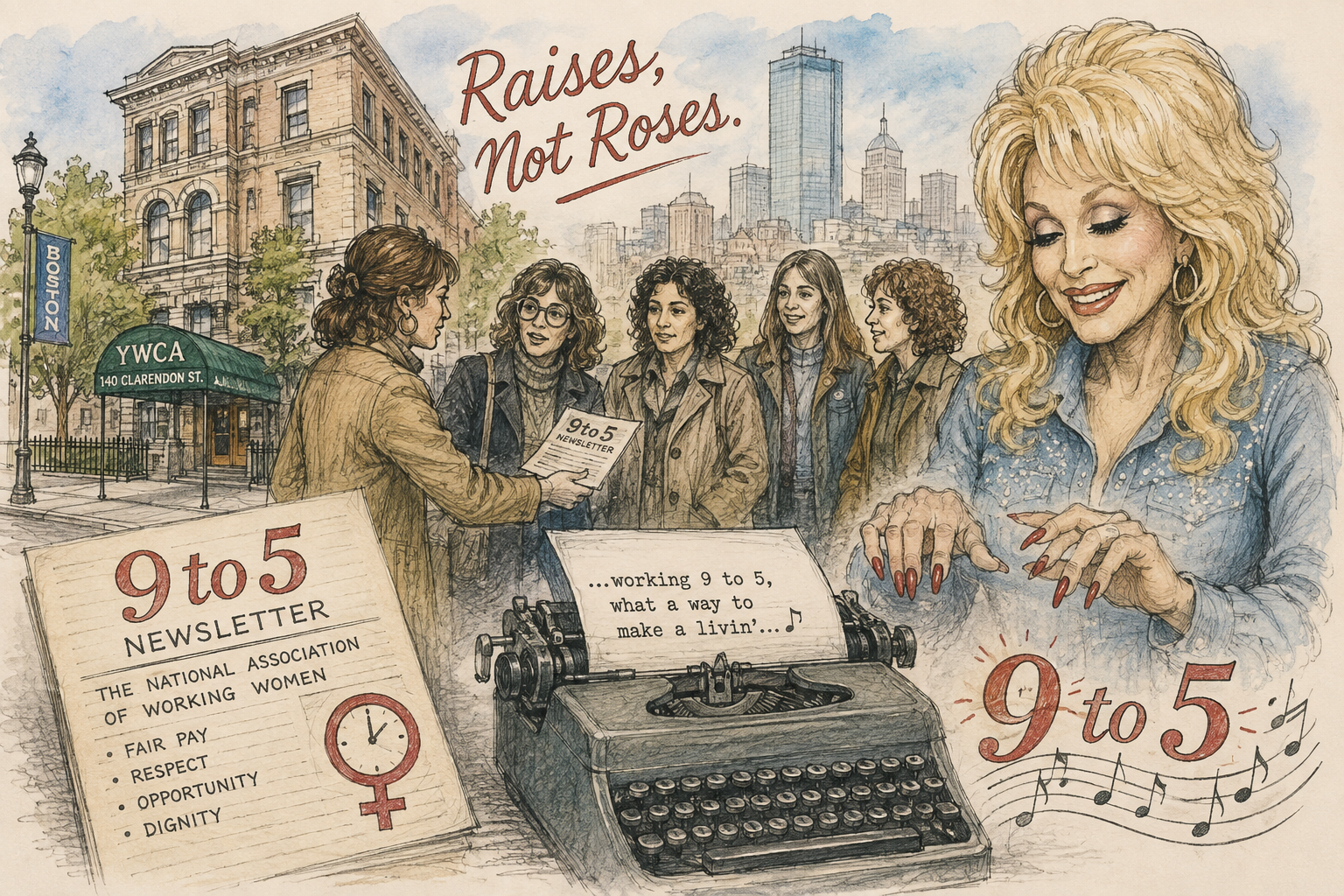
Dolly Parton, 9 to 5, Boston Movement, Raises, Not Roses
The world lost Dolly Parton this week.
It's difficult to reduce what we've lost to a list of songs. Dolly was a songwriter, musician, actor, philanthropist and storyteller whose work crossed generations and genres. She could be funny without being frivolous, sentimental without being false, and remarkably sharp about the lives of ordinary people.
She also had a gift for taking something people lived every day and putting words and music around it so perfectly that afterward it seemed as though the song had always existed.
9 to 5 was one of those songs.
Written for the 1980 movie that marked Dolly's film debut alongside Jane Fonda and Lily Tomlin, the song was funny, defiant and instantly recognizable. Dolly even created its famous typewriter-like rhythm by clicking her acrylic fingernails together.
It became an anthem for working women.
But the story behind it had begun years earlier, hundreds of miles from Hollywood.
It began in Boston.
And it began small.
It Started at Harvard
In 1972, Karen Nussbaum and Ellen Cassedy were secretaries at the Harvard Graduate School of Education.
They were educated women doing the kind of office work millions of women were doing at the time: typing, filing, answering phones, making coffee and often performing personal errands for male bosses.
The pay was lousy. Advancement was limited. Women could keep an office running and still discover there was almost nowhere for them to go within it.
Sexual harassment was common enough that it was often simply treated as part of having a job.
Women were getting tired of it.
Nussbaum and Cassedy began talking with other office workers.
Eventually, a group of about ten Boston women started something deceptively simple.
A newsletter.
They called it 9to5.
Ten Women and a Newsletter
In December 1972, women went out into downtown Boston and handed copies of the newsletter to office workers coming through subway stations.
Think about what organizing looked like then.
No social media.
No email list.
No viral video.
Ten women, pieces of paper and Boston subway stations.
And a message other women immediately understood.
Bad pay. No respect. Few opportunities for promotion. Being expected to fetch coffee and run personal errands that had nothing to do with the jobs they had been hired to perform.
Boston women recognized themselves in those pages.
The little newsletter began turning into something much larger.
“Raises, Not Roses”
By 1973, 9to5 had an office at the Boston YWCA at 140 Clarendon Street in Back Bay.
The group published a Bill of Rights for women office workers. Its meetings grew. By early 1974, nearly 300 women were attending a monthly meeting.
And these women learned how to make noise.
They organized demonstrations and public hearings. They surveyed office workers. They confronted employers. They used the press. They publicly challenged companies that didn't particularly enjoy having their employment practices discussed outside the executive suite.
One of the group's major campaigns targeted discrimination in Boston's insurance industry and helped make Massachusetts the first state to regulate discriminatory employment practices by insurance companies against women and minority workers.
Their slogan said almost everything that needed saying:
Raises, not roses.
They weren't asking to be appreciated once a year.
They wanted to be paid.
Then Hollywood Found Them
By the end of the decade, what had begun with a handful of Boston office workers had grown into a national movement.
9to5 organizations appeared around the country. A union followed. The frustrations those Boston women had begun talking about were being recognized by millions of women.
Jane Fonda was paying attention.
As the movie 9 to 5 was being developed, Fonda and the filmmakers talked with women involved in the movement and heard their stories about harassment, dead-end jobs, impossible bosses and workplaces where women did much of the work while men held most of the power.
Those experiences helped shape the movie.
Then Dolly Parton joined the cast.
It was her first movie.
While working on the film, Dolly began tapping her long acrylic fingernails together.
They sounded like a typewriter.
She built a rhythm around that sound and wrote the song that would become one of the most recognizable working-woman anthems ever recorded.
But the lives inside that song had been playing out for years.
Including right here in Boston.
You Can Still Stand Where It Happened
One of the best things about Boston history is how often we walk straight past it.
The old YWCA building at 140 Clarendon Street is still there.
The historic Back Bay building has since been redeveloped into affordable apartments, including supportive housing for people who had experienced homelessness. It also remains home to YW Boston and the Lyric Stage Company.
There isn't a giant sign outside announcing:
THE MOVEMENT BEHIND “9 TO 5” WORKED HERE.
Maybe there should be.
Because tucked inside the history of that building is an extraordinary Boston story.
A couple of secretaries started talking.
Ten women started organizing.
They handed newsletters to women coming through Boston subway stations.
Other women recognized their own lives in those pages.
The movement spread.
Hollywood listened.
And Dolly Parton did what Dolly Parton could do like almost nobody else: she took the frustrations, humor, anger and resilience of working women and turned them into a song the whole world could sing.
Now that we've lost her, those opening clicks sound a little different.
They are Dolly's fingernails.
They are a typewriter.
And, if you know the story, they can also sound like thousands of women working in Boston offices who had finally decided they would no longer quietly accept the way things were.
Dolly gave their struggle a soundtrack.
Boston helped give it a voice.
Go see where part of the story happened: 140 Clarendon Street, Back Bay, Boston.
Love Boston? I write about the history, places, people and wonderfully strange stories that make this city what it is.
Join me on the GoBoston Substack at @goboston.
Sources
Harvard Radcliffe Institute, Schlesinger Library — Records of 9 to 5, National Association of Working Women
PBS Independent Lens — 9to5: The Story of a Movement
Massachusetts Women's History Center — From Roses to Raises: Women's Fight for Just and Equal Pay in Massachusetts
Harvard Crimson — Raises, Not Roses
YW Boston — History
City of Boston — 140 Clarendon Street