
The Union Oyster House Turns 200 — and Gets a New Owner
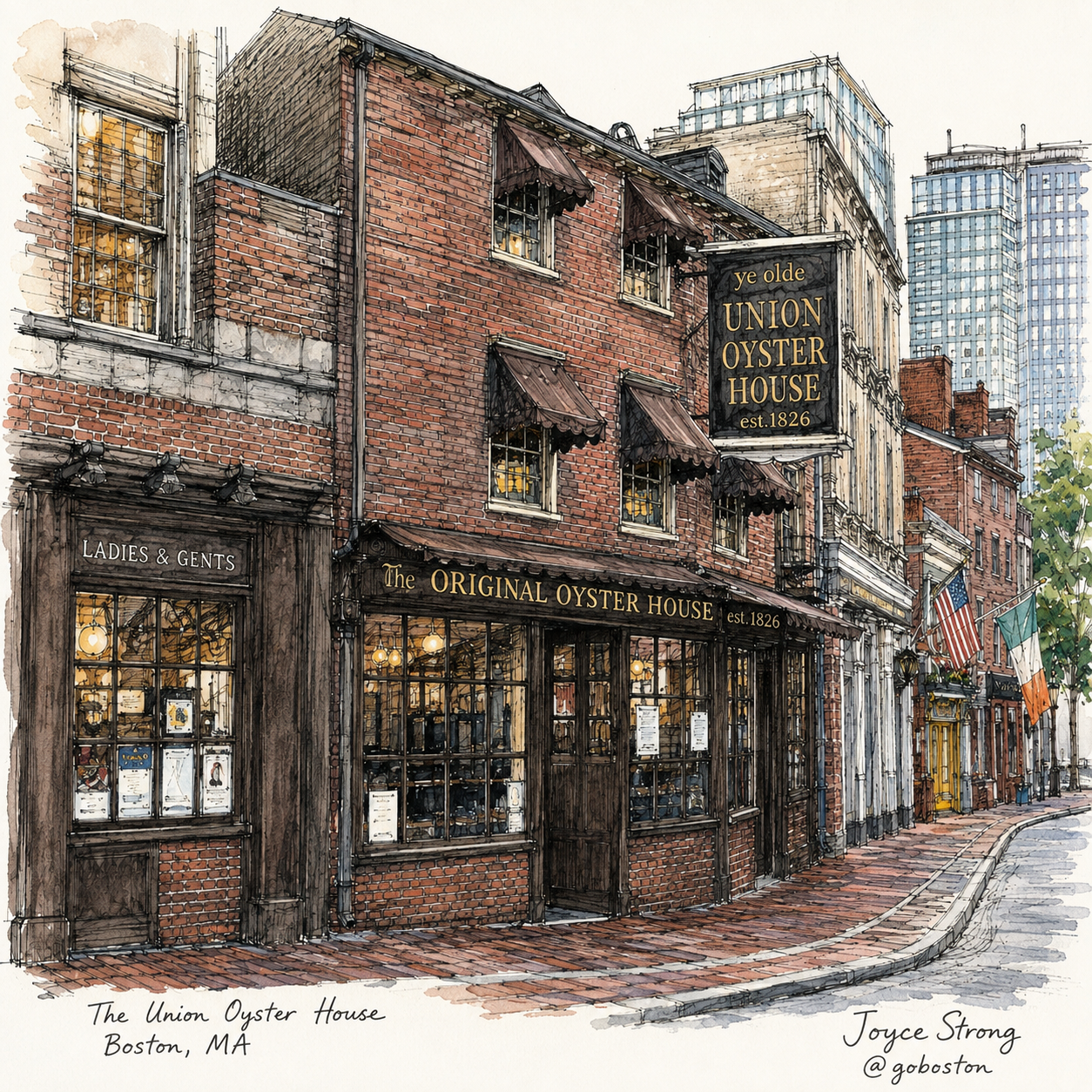
Union Oyster House, Boston, Massachusetts Gets a New Owner and Turns 200
Boston’s oldest restaurant has survived wars, Prohibition, urban renewal, the Big Dig and COVID. Now, in its 200th year, somebody from Texas owns it.
The Union Oyster House has been sitting on Union Street so long that calling it “historic” almost feels inadequate.
The restaurant opened in 1826, which means it turns 200 this year. The building itself is older than the country. And just as the place reaches that remarkable birthday, it has been sold.
The Milano family, which has owned the Union Oyster House for more than half a century, is selling it to the Fertitta family of Texas, the restaurant and hospitality family behind Landry’s. The new owners say they don’t plan to change it.
Good.
There are plenty of Boston restaurants that could use updating. The Union Oyster House is probably not one of them.
The building had a life before the oysters
The first thing I always forget about the Union Oyster House is that the restaurant is only part of the story.
The building dates to the early 1700s. By 1742, a merchant named Hopestill Capen was selling clothing and dry goods there under the terrific old Boston name At the Sign of the Cornfields.
Boston looked very different then. The waterfront was much closer. Goods arriving by ship could be brought almost directly into this part of town.
Then Boston did what Boston does best and became politically troublesome.
Printer Isaiah Thomas used an upper floor of the building to publish The Massachusetts Spy, an anti-British newspaper, before the Revolution. A few years later, Ebenezer Hancock, John Hancock’s brother, reportedly used the building while serving as deputy paymaster general of the Continental Army.
So, yes, you can go there today and order clam chowder in a building where the Revolution was once part of the day’s business.
That is Boston.
Oh, and a future King of France lived upstairs
This may be my favorite part.
In the 1790s, Louis Philippe of France lived upstairs while he was in exile. He reportedly supported himself partly by teaching French.
He later went home and became King of France.
There are cities where someone tells you George Washington slept there.
Boston gives you, “The future King of France lived upstairs and taught French before we turned the place into an oyster house.”
Then came the oysters
The restaurant opened in 1826, originally as Atwood & Bacon Oyster House, and oysters made perfect sense in Boston then.
They were not luxury food.
They were ordinary food.
Oysters were plentiful, relatively cheap and eaten in quantities that would probably horrify anyone looking at a restaurant bill today. Oyster houses were everywhere, and they were gathering places as much as restaurants.
Daniel Webster was one of the Union Oyster House’s famous regulars. According to the stories that have followed him through history, Webster would sit at the oyster bar with brandy and water and consume plate after plate of oysters.
The usual number given is six plates of six.
Thirty-six oysters.
Apparently nobody was counting cholesterol yet.
Then JFK got a booth
More than a century later, another Massachusetts political name became attached to the place.
John F. Kennedy reportedly liked to eat upstairs when he was in Boston, and his favorite booth is still identified as the Kennedy Booth. He is said to have been particularly fond of the lobster stew.
And that is part of the fun of the Union Oyster House.
You aren’t walking through a museum looking at a recreation of Boston history behind glass.
You can sit in it and order lunch.
Think about what this place has watched happen
This is where the 200 years really starts to sink in.
The Civil War happened. Boston filled in the Back Bay. Horses gave way to cars. Electric lights arrived. The elevated trains went up and came down. Prohibition came and went.
Boston tore itself apart during urban renewal. The Central Artery went up. Then we spent years and billions of dollars putting it underground again.
Faneuil Hall became one of the biggest tourist destinations in the city.
Neighborhoods changed. Restaurants disappeared. Generations of Bostonians came and went.
And people kept walking through the door of the Union Oyster House.
Then came COVID, which did what wars, depressions and political upheaval had failed to do to many old Boston restaurants. Some closed and never came back.
The Union Oyster House came back.
And now it has made it to 200.
Which brings us, somehow, to Texas
After more than two centuries as a Boston institution, the Union Oyster House is changing hands again, this time to the Fertitta family of Texas.
There is something slightly funny about that sentence.
Boston has spent several hundred years being suspicious of outsiders, and now one of the most Boston restaurants imaginable belongs to a Texas restaurant family.
The reassuring part is that the new owners appear to understand what they bought.
They say the staff will remain and they don’t plan major changes.
That may be the smartest possible decision.
If you buy a restaurant that has survived for 200 years, maybe the first thing you should ask yourself is whether it actually needs your help.
Yes, tourists go there. Go anyway.
I know.
The Union Oyster House is on the Freedom Trail. It is practically next door to Faneuil Hall. Tour groups walk past it. Visitors take pictures of the sign.
That causes some Bostonians to put it into the category of places we assume are “for tourists.”
But sometimes tourists are standing in line because there is actually something worth seeing.
There simply aren't many places in America where you can sit down for lunch in a restaurant that has been serving people continuously since John Quincy Adams was president.
So if you’re visiting Boston, put it on the list.
And if you live here and haven’t been inside for years, maybe the 200th anniversary is a pretty good excuse to go back.
Sit at the oyster bar if you can. Look around the room for a minute before you look at the menu.
The building was standing before the Revolution. A future King of France lived upstairs. Revolutionary newspapers were printed there. Daniel Webster ate oysters there. JFK had a favorite booth there.
And two hundred years after someone decided this would be a good place to open an oyster house, people are still walking through the same door looking for lunch.
Now somebody from Texas owns it.
They say they aren't going to change anything.
For once in Boston, I suspect almost everybody can agree:
Leave it alone.
More Boston
GoBoston is about the places that make Boston Boston — the famous ones, the forgotten ones and the ones we sometimes stop noticing because they have been here forever.
For more Boston stories, places worth seeing and ideas for exploring the city and everything around it join me at @GoBoston on Substack for the stories happening right now.
Boston has been collecting stories for nearly 400 years.
I’m just trying to keep up.