
Is Faneuil Hall Finally Coming Back?
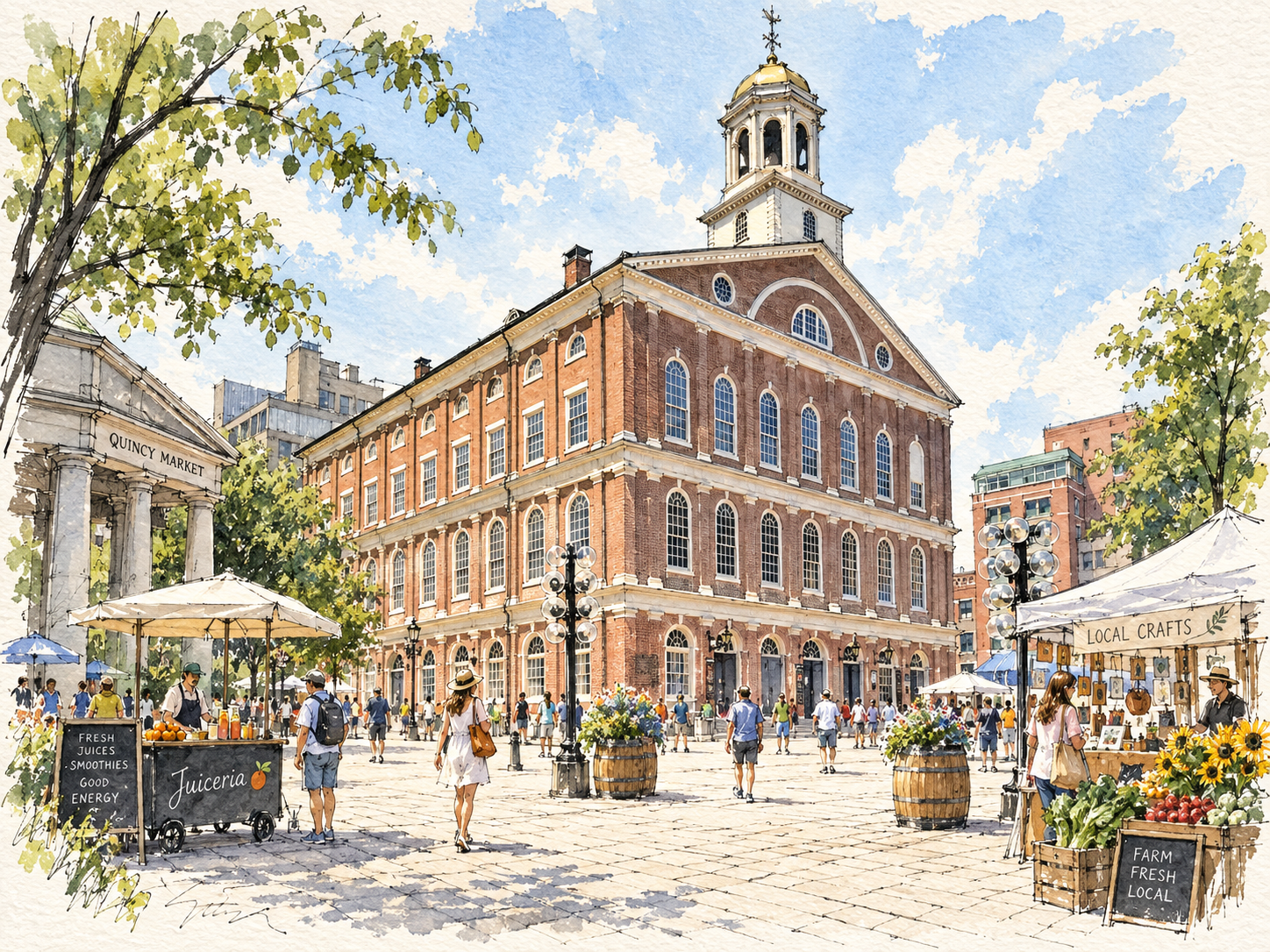
Fifty years after Boston reinvented a dying marketplace, the city is trying to figure out how to make Bostonians want to go there again.
I remember Faneuil Hall before there really was a Faneuil Hall Marketplace.
Not before the buildings existed, obviously. Before the place we came to know was finished.
I spent a lot of time down there in the 1970s, when Quincy Market was coming back to life and much of the rest of the complex was still under construction. There were carts. Craftspeople. A handful of places to eat. You walked around partly to see what had opened since the last time you were there.
I remember Juiceria, selling fresh fruit drinks at a time when a place devoted to fresh juice was still a novelty. Today, juice bars and smoothie shops are everywhere. Back then, the whole concept felt new.
I remember the scrimshaw too, intricate little designs carved or drawn into imitation ivory. There were artisans making and selling things you weren't going to find at a department store.
It was bare bones.
It was unfinished.
And it was the place to go.
Because something was happening there.
We were watching Boston change
What I remember most clearly now is that it wasn't only Faneuil Hall.
The waterfront itself suddenly seemed to be changing.
For years, much of that part of Boston had been somewhere you passed through or worked around rather than somewhere you deliberately went to spend an afternoon. The old wholesale market district had deteriorated badly as food businesses moved elsewhere. Buildings stood empty. The market complex had come close to demolition.
Then things began opening.
People started walking down there just to walk around.
You could watch one part of Boston becoming something entirely different while it was happening.
And what made it even more interesting was that old Boston was still right there beside it.
Haymarket was still thriving, loud and crowded, with open-air vendors selling piles of fresh fruit and vegetables, fish, meat and whatever else people needed to bring home. That part of Boston still felt practical and working-class. People were there to buy food, bargain and get on with their day.
Walk a little farther and you were in the North End.
So within a few blocks, you could see several Bostons at once: the old open-air market, the Italian neighborhood, the waterfront and this brand-new experiment taking shape inside historic buildings.
That was part of the excitement.
Boston wasn't erasing its history.
It was building something new right in the middle of it.
It is difficult to appreciate now how radical that felt.
Today we expect old industrial buildings, warehouses and markets to be restored into restaurants, shops, apartments and public spaces.
In the 1970s, Faneuil Hall Marketplace helped invent that idea.
The first comeback
The revival was led by architect Benjamin Thompson, developer James Rouse and Mayor Kevin White.
Quincy Market reopened on August 26, 1976, exactly 150 years after the original market opened. South Market followed in 1977 and North Market in 1978.
The project became what was called a festival marketplace, a model that would later be copied in cities around the country.
But it did not begin as a guaranteed success.
Just two months before Quincy Market opened, only about half the permanent space had been leased.
So Rouse's team went looking for small merchants.
They traveled around New England recruiting artists, craftspeople and entrepreneurs. The marketplace opened with 43 pushcarts, deliberately giving small independent sellers a chance to try an idea without opening a conventional storefront.
The carts weren't decoration.
They helped make Faneuil Hall work.
And they helped create the feeling I remember.
You didn't know exactly what you would find.
Juiceria, scrimshaw and the strange little businesses
An early marketplace tenant map lists Juiceria — Fresh Fruit Drinks.
That simple description takes me right back there.
Fresh fruit drinks.
That was enough to make it interesting.
There were bakers, food stalls, small restaurants and vendors selling handmade goods. Contemporary descriptions of the marketplace mention pottery, scrimshaw, antiques, clothing, books, yogurt, live lobsters and other specialty foods.
Some of it sounds ordinary now.
It wasn't ordinary then.
That was part of the attraction.
Faneuil Hall wasn't trying to recreate a suburban shopping mall in old buildings. Thompson wanted small owner-operated businesses and things you couldn't necessarily find everywhere else.
Even the pushcarts were groundbreaking. Faneuil Hall Marketplace describes the program today as America's first retail specialty-cart program.
Boston was experimenting.
And Bostonians showed up to watch.
This wasn't originally a tourist attraction
This may be the most important part of Faneuil Hall's history to remember now.
In its early years, the marketplace wasn't primarily for tourists.
A 1977 study found that only about 15 percent of visitors were tourists. Two-thirds were arriving from home or work.
Think about that.
Faneuil Hall was where Bostonians went.
By 1977, the first two completed buildings already contained roughly 116 pushcarts, boutiques and restaurants.
The reopening had become an enormous success almost immediately.
Thousands of people flooded into the market. Street performers filled the walkways. People came downtown simply to see what was happening.
It was fun.
It felt like Boston had discovered a part of itself again.
Then locals stopped going
Somewhere along the way, the relationship changed.
Faneuil Hall remained one of Boston's most recognizable destinations. Visitors walked the Freedom Trail through it. School groups came through. Tourists bought lobster rolls and Boston sweatshirts and watched performers outside.
But many people who actually live here stopped thinking of Faneuil Hall as a place they went.
That distinction matters.
This year, Mayor Michelle Wu has spoken openly about the need to recapture the spirit of the 1970s.
Businesses have described a marketplace that still draws visitors but needs, as one owner put it, “a shot of adrenaline.”
There have been empty storefronts and disputes between the current management and tenants. J. Safra Real Estate, which took over management in 2024, has sued several current and former tenants over more than $2 million in allegedly unpaid rent and related charges.
At the same time, there are signs that things may finally be moving in the other direction.
The numbers are getting better
J. Safra says ground-floor retail occupancy has risen from 76 percent in 2024 to 85 percent in 2026.
The first phase of a larger improvement project was completed this summer, including cleaning the historic exteriors and glass structures, resetting granite pavers and tackling deferred repairs.
New businesses have been coming in.
Recent additions have included Mona Sweets, Captain Candy, Iris Galerie, Smashed by BRED, The Maharaja, Azul Mexican Kitchen and Cognitive Surplus. Tree House Brewing Company also operated a summer pop-up at Quincy Market.
Today the marketplace says more than 80 businesses occupy the complex.
Those are encouraging signs.
But occupancy isn't really the question.
Does it feel alive?
You can fill storefronts without creating a place people care about.
Faneuil Hall's original success wasn't simply that every available space eventually had a tenant.
It was discovery.
You went because there might be something there you hadn't seen before.
The juice stand mattered.
The scrimshaw seller mattered.
The person trying to make a living from a little pushcart mattered.
The baker mattered.
The street performer mattered.
The fact that things were still under construction almost added to the excitement.
The place hadn't been packaged yet.
It was becoming something.
Quincy Market just turned 200
The timing for another reinvention could hardly be better.
Quincy Market turned 200 years old on August 26, 2026.
It opened in 1826 because Boston had outgrown the original marketplace around Faneuil Hall.
Then, 150 years later, Boston reinvented it because the old market district had nearly died.
And now, at 200, we're asking another version of the same question.
What should this place be next?
Boston doesn't need to invent an identity for Faneuil Hall.
It already has one.
The problem may be that we forgot part of it.
Give Bostonians a reason to go back
Tourists are going to keep coming to Faneuil Hall.
It's on the Freedom Trail. It's next to the North End and Government Center. The waterfront is steps away. Quincy Market itself is part of the Boston experience.
The harder challenge is getting someone who lives here to say:
Let's go down to Faneuil Hall.
Maybe the answer isn't a massive new concept.
Maybe it looks more like the original one.
Give a Boston artist a cart.
Give someone making food we haven't tried before a small stall.
Give a young entrepreneur enough room to try something strange.
Make some of the spaces affordable enough that the person with the interesting idea can actually get in.
Give us things we can't find at every other shopping destination.
When Faneuil Hall first came back, we went partly because we didn't know what we would find.
I can still picture those early years — the construction, the carts, Juiceria selling fresh fruit drinks, the craftspeople, Haymarket still bustling nearby and the sense that the waterfront itself was waking up around us.
We weren't visiting a completed attraction.
We were watching Boston reinvent part of itself.
Maybe that's what Faneuil Hall needs again.
Come explore Boston with me
GoBoston is about the Boston underneath the postcards — the places that change, the places that survive and the stories you can still see if you know where to look.
Sources
Faneuil Hall Marketplace, historical records and Quincy Market Bicentennial materials.
Architectural Record and period architectural reporting on the 1976–1978 redevelopment.
The Washington Post, contemporary 1977 and 1979 reporting on the marketplace's reopening, pushcart program and early visitors.
TIME, contemporary reporting on Benjamin Thompson, James Rouse and the original marketplace concept.
Historic New England and City of Boston materials on Haymarket and the historic market district.
Boston.com and Boston-area reporting on Faneuil Hall's current vacancies, tenant disputes and redevelopment discussions.
Faneuil Hall Marketplace/J. Safra Real Estate, 2026 occupancy and improvement-plan information.