
One Mile, Two Bostons
My son once lived in a noisy South Boston three-decker with three roommates, a dumpster outside the window and a rat who stole pizza. What happened to that kind of Boston apartment may tell us something about what is happening to Boston itself.
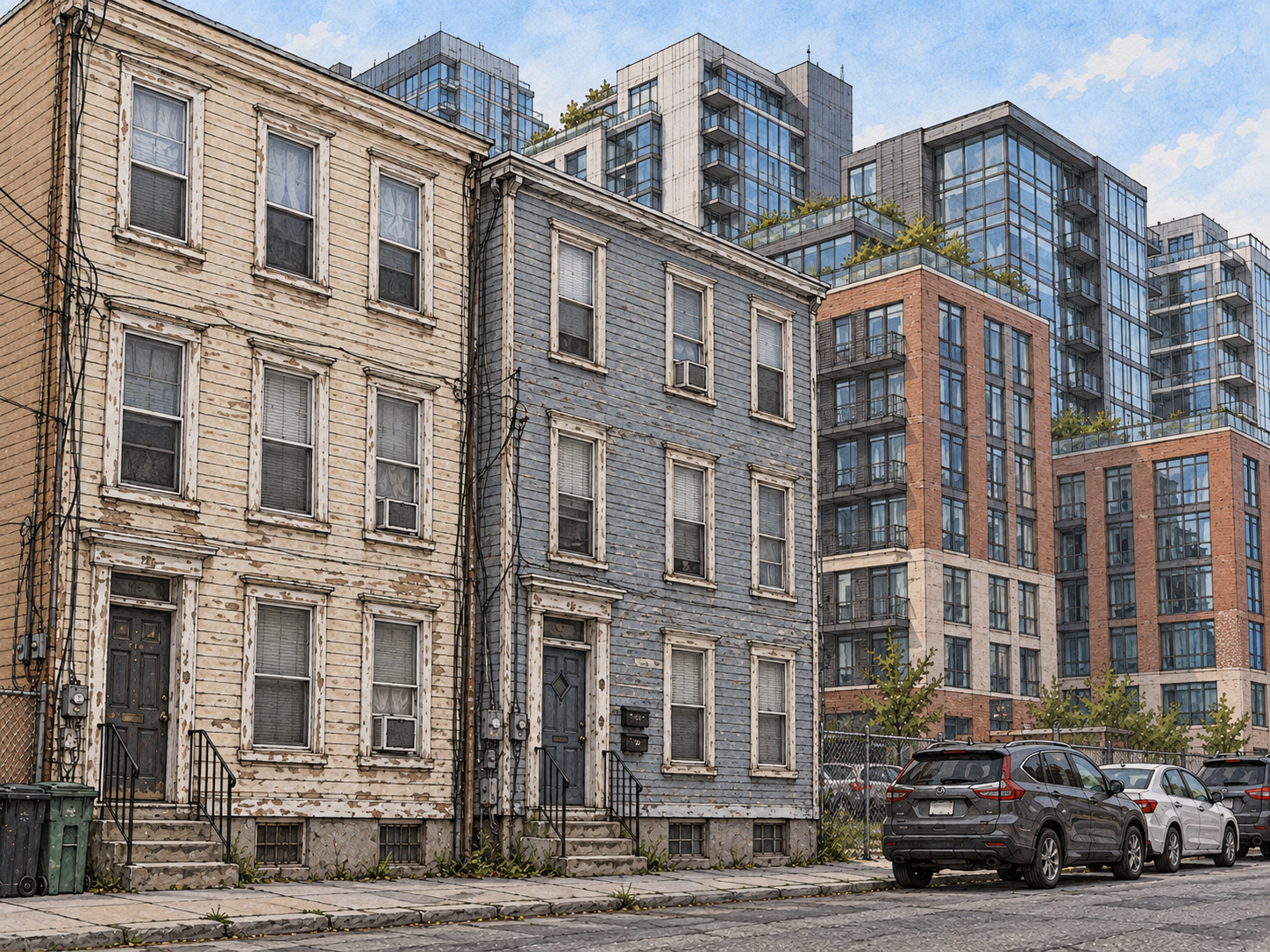
One Mile, Two Bostons
About ten years ago, when my son had recently graduated from college, he lived with two roommates on the third floor of an old South Boston three-decker near Broadway.
For three young men just beginning their adult lives, the location was almost ideal. The Broadway Red Line station was nearby. They could walk to restaurants and bars. Downtown was minutes away. They could get to work without a car and live in an actual Boston neighborhood rather than commute into one.
The apartment itself was considerably less ideal. It was behind the police station and a gas station, and it was loud. When you looked out one of the windows, you looked down on a dumpster. This was not luxury South Boston.
And then there was the rat.
One day when I was visiting, I looked out that window and saw a rat on the ground carrying away a slice of pizza. Not nibbling on it. Carrying it. To this day, my son and I still joke about the South Boston pizza rat.
The three roommates were each paying about $800 a month, so they were pooling roughly $2,400 a month for the third-floor apartment. It wasn't glamorous, but it gave three young adults a way to live in Boston when they weren't earning Boston-luxury-condominium money.
Then the property was sold, and my son had to move.
Eventually, the old housing disappeared. The three-decker and the neighboring property gave way to a nine-unit condominium development, built in 2019. One penthouse unit sold for $1.72 million in 2020 and is now valued in roughly that same multimillion-dollar world.
I thought about that apartment — and, yes, the pizza rat — when I read new research about just how economically divided Greater Boston has become.
The dividing line runs through South Boston
A new MassINC Policy Center analysis finds that Greater Boston is among the country's most economically segregated metropolitan areas. The research also found that Massachusetts has experienced a larger increase in income polarization since 2020 than any other state.
Perhaps nowhere is that divide easier to see than South Boston.
Around West Broadway, areas where median family income exceeds $250,000 sit only blocks from areas where the figure is roughly $60,000. Nearly 1,500 people live in the West Broadway public housing development, practically within sight of some of Boston's most expensive new real estate.
These aren't two communities separated by twenty miles of highway. They occupy the same neighborhood.
One story in the reporting captures the divide almost perfectly. A South Boston teacher discovered that one of his students lived in nearby public housing and told the student that they were neighbors.
The student laughed and said, “I'm not your neighbor.”
That may be the entire story of modern South Boston in four words.
Southie didn't always look like this
For generations, South Boston was synonymous with working-class Boston. Families lived in three-deckers and tightly packed houses. Children grew up on the same streets where their parents and grandparents had lived. The waterfront was industrial rather than luxurious.
Then Boston changed, and South Boston changed with it. The waterfront became the Seaport. Warehouses and parking lots became office towers, hotels, restaurants and expensive residences. Young professionals were drawn to South Boston by its proximity to downtown, its beaches and the Red Line. Property values climbed, and rents followed.
South Boston was still overwhelmingly working-class when its public housing developments were built in the 1930s and 1940s. The transformation of the waterfront accelerated decades later, particularly in the early 2000s, and redevelopment spread westward through the neighborhood.
None of that makes development inherently bad. Boston needs more housing. Old buildings sometimes need to be replaced. Safer streets, new businesses, better parks and investment in neglected properties can improve people's lives.
But something else can happen at the same time. A neighborhood can become wealthier while becoming less economically mixed.
That's what the new numbers force us to notice.
What happened to the apartments in between?
My son's old apartment has stayed with me because it wasn't public housing. It wasn't subsidized affordable housing. And it certainly wasn't luxury housing.
It was ordinary housing.
That category may be more important to Boston than we realize.
The old three-decker was the kind of building that formed the backbone of Boston's working-class neighborhoods for generations. As a rough historical comparison, an older South Boston three-decker around 1990 might have sold somewhere in the low six figures, perhaps around $125,000, depending enormously on condition and location. That isn't the documented 1990 sale price of my son's particular building, but it gives some perspective on how dramatically the economics of the neighborhood have changed.
By 2016, three young men could still combine their resources and rent one floor for about $2,400 a month. Today, one condominium on essentially the same piece of South Boston can be worth many times what an entire three-decker might once have cost.
The old building was noisy. It wasn't particularly attractive. It had a dumpster outside, and I have already introduced you to one member of the local wildlife.
But it provided something enormously valuable: access.
Three young people just out of college could live near the Red Line, walk to restaurants, get themselves to work and begin building their adult lives in Boston. That's different from three young people being able to enjoy Boston only after commuting from wherever they can still afford to live.
This isn't an argument for rats
Nobody should have to live with rats, unsafe wiring, bad plumbing, deteriorating buildings or unhealthy housing conditions. The answer to bad affordable housing should be better affordable housing.
It shouldn't automatically be housing that the people who used to live there could never afford.
A shabby apartment can be renovated. It can get better windows, new plumbing, safer electrical systems, insulation and a decent kitchen. But when ordinary rental housing disappears and what replaces it sells for $1 million, $1.5 million or $2 million per unit, something more fundamental has happened.
The property hasn't simply been improved. It is serving a different population, and a rung has disappeared from the housing ladder.
Boston needs the middle
We often talk about housing as though there are only two categories: affordable housing, usually meaning subsidized or income-restricted housing, and market-rate housing.
But real cities have always depended on an enormous world between those two labels.
They need the old apartment over the store, the three-decker shared by roommates and the homeowner renting the second floor to a young couple. They need apartments that aren't perfect but don't require a household income of $250,000 either.
Boston needs homes for teachers, nurses, restaurant workers, musicians, firefighters, young families, recent college graduates, retirees and thousands of other people who make a city function. It also needs people at different stages of their lives and different levels of income living close enough to actually know one another.
Economic segregation isn't simply about who can afford which house. It changes schools and businesses. It changes friendships. It changes which children know one another, which parents meet one another and which people ever encounter the lives of people who earn far more or far less than they do.
Eventually, two people can live a few blocks apart and one can tell the other, with complete sincerity, I'm not your neighbor.
What does prosperity mean if we stop sharing it?
There is an uncomfortable contradiction in the South Boston story. A neighborhood can become safer, wealthier and more desirable while becoming less accessible. A deteriorating property can become a beautiful new building while eliminating the kind of housing that allowed people without enormous incomes to live there.
Both things can be true at once.
That's why the question isn't simply whether development is good or bad. The better question is: What kind of neighborhood are we building?
Do we want a Boston where households earning more than $250,000 increasingly cluster on one side of the economic divide while public-housing families live on the other? What happens to everyone in between?
Where does the nurse live? Where does the first-year teacher live? Where does the young person starting an entry-level job live? Where does the restaurant worker live? Where does the retired person who spent forty years in the neighborhood live?
And where do three kids just out of college split the rent while they figure out their lives?
The apartment that disappeared
I don't miss my son's apartment. I'm fairly certain he doesn't miss it either, and neither one of us is mourning the pizza rat.
But I understand something about that apartment today that I didn't fully appreciate when he was living there.
It gave him a way into Boston.
When an old three-decker disappears, we can count the new units that replace it. We can calculate their sale prices, measure the increase in assessed property value and celebrate new investment.
What is harder to measure is the opportunity that disappeared with the old building.
If every rough little apartment becomes a luxury condominium, every inexpensive storefront becomes an upscale restaurant and every ordinary piece of property becomes primarily an investment opportunity, Boston may become wealthier.
But it may also become a city divided between people who can afford extraordinary prices and people whose housing is protected precisely because they cannot.
The middle gets squeezed out.
Maybe that's why the MassINC numbers feel so startling when you look at South Boston: more than $250,000 on one side and about $60,000 on the other. One mile. Two Bostons.
And somewhere in the middle was once a noisy third-floor apartment where three young men paid about $800 apiece, looked down on a dumpster and occasionally watched a rat run away with dinner.
Sometimes the history of a changing city isn't found in a monument.
Sometimes it's found in the apartment that isn't there anymore.
Join the GoBoston community
GoBoston.com is where I publish stories about Boston — its history, neighborhoods, development, restaurants, sports, transportation, people and all the little things that make this city what it is.
But I also want a place where those stories can turn into conversations. That's what GoBoston on Substack is for.
I don't want it to be simply another newsletter arriving in your inbox. I want it to become an interactive Boston community where people who care about this city can share what they know with one another.
If you remember what used to stand on a particular corner, tell us. If your family has a Boston story, share it. If you have an old photograph that helps explain how a neighborhood changed, bring it into the conversation. If something is happening in your neighborhood that the rest of Boston should know about, tell us about that too.
You may have lived here your entire life, moved away years ago, arrived recently or be planning your first visit. If you're interested in Boston history, Boston news, neighborhoods, restaurants, sports, transportation, development or simply the wonderfully specific things that make Boston Boston, there is a place for you there.
Join the GoBoston community on Substack. Comment, share your memories, suggest stories and meet other people who are just as interested in Boston as you are.
Boston has always been more interesting when everybody at the table gets to tell a story.
Sources
The Boston Globe, September 23, 2026, reporting on new MassINC Policy Center research into economic segregation and income polarization in Greater Boston, including the West Broadway/South Boston income divide.
MassINC Policy Center, research on economic opportunity, segregation and income inequality in Massachusetts.
Boston property, development and real-estate records for the Silver Street redevelopment and subsequent condominium sales.
Historical Greater Boston housing data used only to provide context for the approximate 1990 three-decker comparison.