
New Balance Has Decided Boston Is Part of the Brand
The company spent decades putting an N on sneakers. Now, as New Balance grows around the world, it is putting Boston itself at the center of the story.
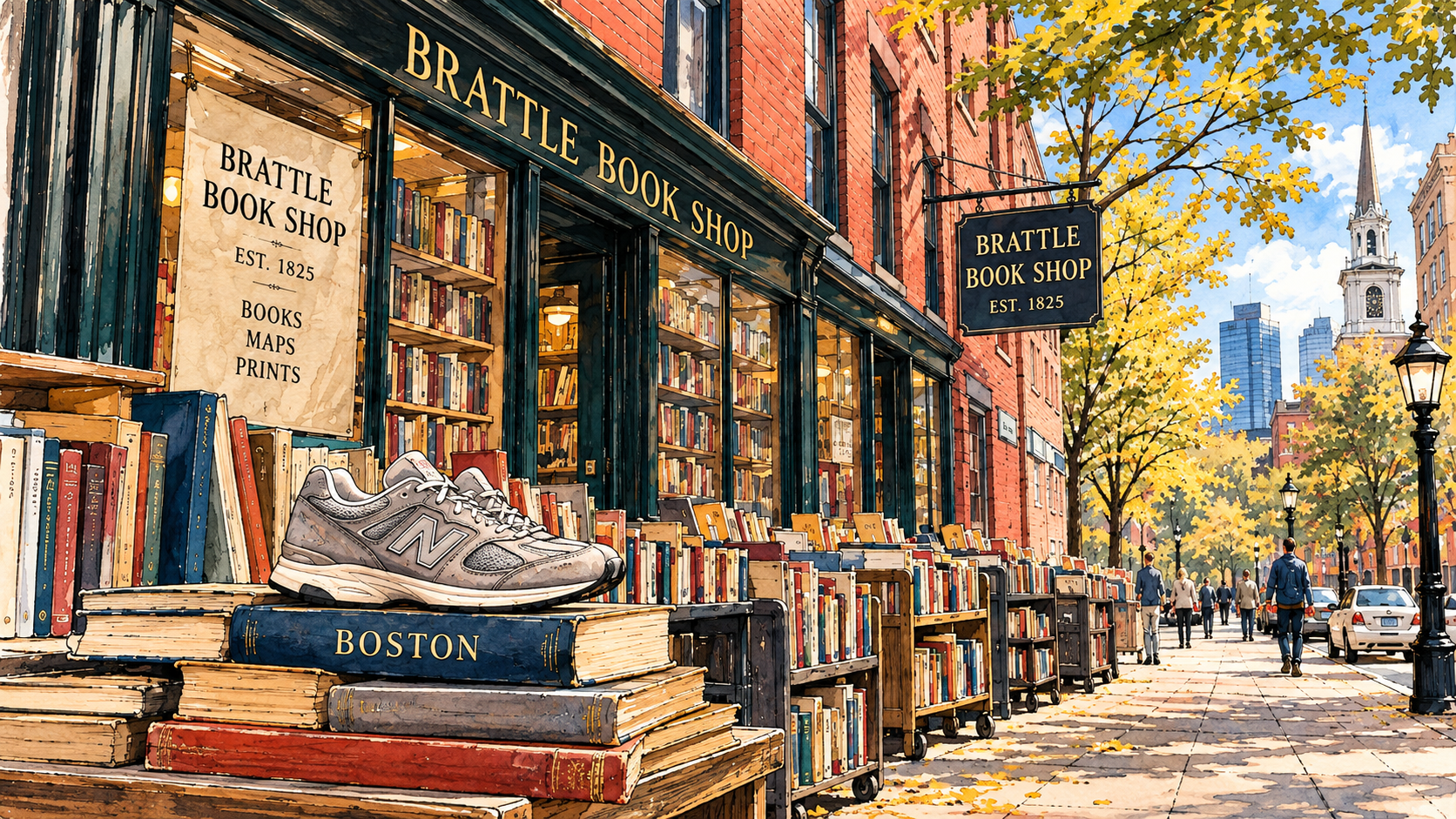
New Balance Boston Branding — Brattle Book Shop
A few days ago, I wrote about New Balance defending the letter N in its trademark fight with Decathlon. My point was that the N isn't just a design element. That N is Boston history.
Now New Balance appears to be making essentially the same argument in a much bigger way.
The Boston-based company is launching campaigns that don't simply happen to be photographed here. They are deliberately built around Boston people, Boston institutions, Boston history and Boston character. And for the first time, New Balance says it is taking one of those Boston-centered campaigns truly global.
That is worth paying attention to, because New Balance seems to have decided that Boston itself has commercial value.
From Brattle Book Shop to the world
One of the most interesting choices is the Brattle Book Shop. Not a stadium. Not a superstar athlete. Not a sleek new building in the Seaport. A 201-year-old Boston bookstore.
Owners Ken Gloss and Joyce Kosofsky are featured wearing New Balance's Made in USA collection among the bookshelves and stacks of the Brattle, one of those places that feels almost impossible to separate from Boston itself.
That choice tells us something. New Balance could have created a campaign that looked global by making Boston disappear from it. Instead, it did almost the opposite. The company specifically wanted a Boston small business with deep local roots.
The company is selling sneakers, but what it is really borrowing from Brattle is something you cannot manufacture very easily: authenticity.
Then there is Ayo Edebiri
New Balance has taken a similar approach with actress and comedian Ayo Edebiri. Edebiri is from Dorchester, and instead of stripping away that local identity to make her a generic international celebrity, the campaign leans directly into it.
She was photographed with Boston imagery including a miniature three-decker and the Paul Revere House. She also returned to her alma mater, Boston Latin School, for photographs inside the classrooms and hallways.
Think about that combination: a global company, a globally known performer, a three-decker, the Paul Revere House and Boston Latin. It isn't Boston being used as scenery. Boston is the story.
Why now?
Probably because New Balance can afford to be very deliberate about what it wants its identity to be.
The company is in the middle of extraordinary growth. New Balance reported $9.2 billion in global sales in 2025, up 19 percent from the previous year. Sales have grown roughly 180 percent since 2020, and the company opened 80 new stores around the world in 2025 alone.
That makes what New Balance is doing especially interesting. Companies frequently become less local as they become more successful. The rough edges disappear, the regional accent gets cleaned up, and the neighborhood story gets replaced with something designed to work everywhere and offend nowhere.
New Balance appears to be going in another direction. The bigger the company becomes, the more it seems willing to say: We are from Boston.
Boston is difficult to manufacture
That may be because authenticity has become one of the most valuable things a brand can have.
You can build a new store almost anywhere. You can hire celebrities. You can buy advertising. You can manufacture nostalgia. But you cannot suddenly manufacture 120 years of history in Boston.
New Balance was founded here in 1906. Brattle Book Shop has been here for more than two centuries. Boston Latin dates to 1635. A Dorchester kid can grow up, become internationally famous, and still walk back into the halls of her Boston public school as part of a global advertising campaign.
Those things cannot be focus-grouped into existence. They happened here. And that matters.
The N means something
That's why this feels like such a natural sequel to the Decathlon story.
When New Balance fights to protect its N, it is protecting one of the most recognizable pieces of its identity. But increasingly, the N represents more than a shoe company.
Behind it is Brighton. Behind it is New England manufacturing. Behind it are runners training through Boston winters, sports teams, neighborhood institutions, old bookstores, three-deckers and a city whose personality has never been particularly interested in becoming generic.
New Balance has spent years selling Boston shoes to the world. Now it seems to understand something even bigger: Boston itself may be one of the most valuable things attached to the brand.
Not literally, of course. Boston belongs to all of us. But the history, place and personality attached to the New Balance name cannot simply be copied by another shoe company.
Maybe that's the real competitive advantage.
And that is part of the GoBoston story, too
This is one of the reasons I started GoBoston. There are plenty of places to find lists of Boston attractions, restaurants and hotels. I want GoBoston to do something more.
I want to tell the stories that explain why this place matters: the old business that somehow survives, the neighborhood that changes but leaves traces behind, the people who grew up here and carry Boston with them, and the peculiar institutions, traditions, arguments, buildings, streets and memories that make this city recognizable even when the skyline changes.
New Balance has apparently decided there is value in that same thing.
Not Boston as a backdrop. Boston as identity.
And somewhere between an old bookstore, a Dorchester kid and a very famous letter N, one of Boston's biggest global companies may have figured out exactly what makes it different.
It came from here.
Join the GoBoston Substack community as we explore the Boston behind the postcards — the neighborhoods, people, history and places that make this city what it is. — Joyce Strong, Word Busker from the Hub since 1953. Boston, technically Somerville, but close enough.