
The Hancock Tower Was Designed to Reflect Boston. Then the Windows Started Falling Out.
Fifty years after Boston’s glass skyscraper opened, the building still reflects the city around it — including an older Hancock Tower, a remarkable architectural idea, and one very memorable Boston construction disaster.
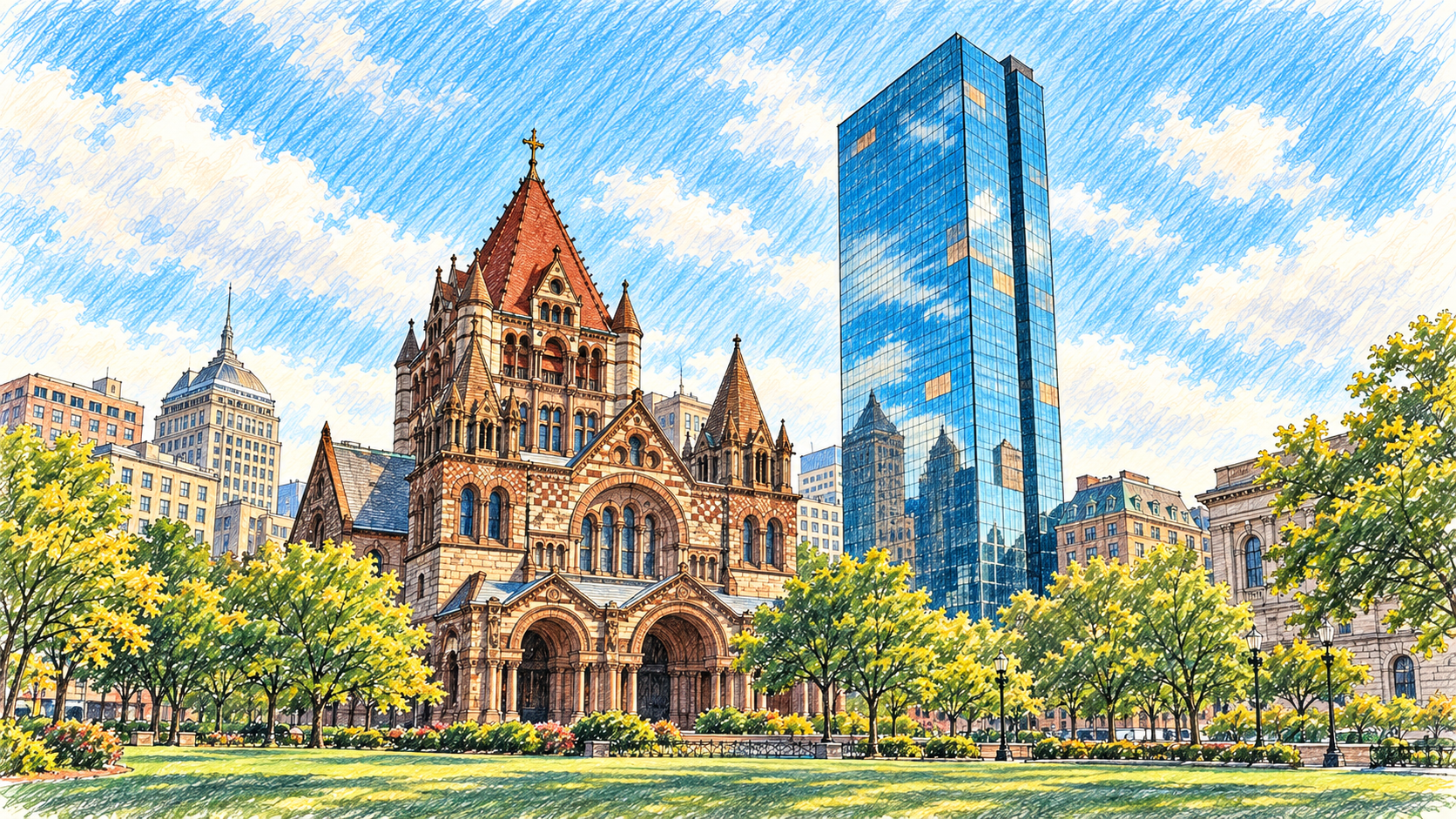
Illustration of John Hancock Tower as “Plywood Palace” — Boston, Massachusetts
I was writing Gettin’ Lost in Boston, my new song about the Boston I know and love, when one image immediately belonged in it: the old Hancock building reflected in the glass of the new Hancock Tower.
That reflection has always fascinated me. But if you were around Boston in the early 1970s, you may remember something else about all that beautiful glass.
The windows were falling out.
And almost exactly fifty years later, the timing of that memory feels perfect. The John Hancock Tower officially opened on September 29, 1976. Today it is officially called 200 Clarendon, but come on. For generations of Bostonians, it is still the Hancock.
What sometimes gets lost in the wonderfully Boston story of the falling windows is that the glass wasn't simply an exterior treatment. The glass was central to one of the most creative ideas behind the entire building.
How Do You Put a Skyscraper Next to Trinity Church?
That was the problem.
In the 1960s, the John Hancock Mutual Life Insurance Company needed substantially more space and hired I. M. Pei & Partners. Henry N. Cobb became the lead designer of what would become a 60-story, roughly 790-foot skyscraper at the edge of Copley Square.
But this wasn't an empty piece of land somewhere outside the city.
Directly beside it stood H. H. Richardson's Trinity Church, one of Boston's architectural treasures. Across Copley Square stood the Boston Public Library. The idea of putting an enormous modern skyscraper into that setting generated fierce opposition.
Cobb's answer was not to make his skyscraper look historical.
He did almost the opposite.
Instead of a bulky rectangular tower planted squarely beside Trinity Church, Cobb created the Hancock's distinctive rhomboid form and positioned it at an angle. Its narrow side faces toward the church, making the enormous building appear slimmer from important viewpoints around Copley Square.
The placement also created open space beside Trinity Church and exposed views of the church's celebrated apse that had previously been difficult to see.
And then there was the glass.
The exterior was covered with more than 10,000 large reflective panes that caught the sky, clouds and buildings around them. Rather than presenting Boston with a huge solid wall, the tower could change constantly with the light. Sometimes it looked blue. Sometimes gray. Sometimes green. Under the right conditions, the enormous building could almost disappear into the sky.
Boston Reflected Back at Itself
That is the part that makes the Hancock much more interesting to me now.
The tower was designed to participate in its surroundings rather than simply sit beside them. Trinity Church could appear in its glass. The sky moved across it. The surrounding city became part of its façade.
And so did the old Hancock building, the Berkeley Building with its familiar weather beacon.
The old building and the new one are radically different pieces of architecture, built for different Bostons. Yet stand in the right place and one can appear reflected in the other.
That's the image that made its way into Gettin’ Lost in Boston.
Two Bostons, occupying the same view.
Then the Glass Started Falling
Unfortunately, the brilliant architectural idea developed a fairly serious practical problem.
The windows started breaking.
During construction, panes cracked and failed. During a winter storm on January 20, 1973, dozens of enormous glass panels came off the building. Each pane measured roughly four feet by eleven feet and weighed about 500 pounds.
As the problems continued, damaged glass was removed and openings were temporarily covered with plywood painted dark to approximate the appearance of the glass.
Boston being Boston, people immediately supplied nicknames.
The Plywood Palace.
The Woodpecker Palace.
Eventually, all 10,344 panes of the original curtain wall had to be replaced. At one point in 1973, nearly 2,400 panes had been removed while architects, engineers, manufacturers and lawyers tried to figure out exactly what had gone wrong.
For those of us who remember Boston then, this was not an obscure architectural problem. It was news. It was conversation. It was part of the city's life.
I remember it.
My Own Hancock Boston
I also have my own connection to these buildings.
I worked for John Hancock in the old Hancock building and later worked for a consulting company in the new tower. So when I look at the two buildings together, I'm not simply looking at two entries in an architectural guide.
I'm looking at pieces of my own Boston.
That's one of the things I keep discovering as I build GoBoston.com. A building isn't only its architect, construction date and square footage. A neighborhood isn't simply a collection of streets.
Places accumulate our lives.
Somebody had a first job there. Somebody met a spouse there. Somebody looked out of that window every afternoon. Somebody remembers what used to stand where the condominium building is now. Somebody still gives directions by telling you to turn where something used to be.
And somebody remembers when the windows were falling out of the Hancock Tower.
From Plywood Palace to Boston Icon
There may be no better ending to the story than what happened next.
The building survived the engineering problems and the ridicule. The replacement glass worked. The skyscraper that some Bostonians originally feared would overwhelm Copley Square gradually became inseparable from it.
In 1977, the American Institute of Architects gave the Hancock Tower a National Honor Award. Decades later, in 2011, the AIA gave it its Twenty-five Year Award, recognizing architecture that had stood the test of time.
Think about that transformation.
Boston went from watching plywood replace falling glass to embracing the building as one of the defining shapes of its skyline.
And Henry Cobb's original idea survived all of it.
The tower still reflects Boston.
Fifty Years Later
On September 29, 2026, the Hancock Tower turns 50.
I can't think of a better building for Boston to celebrate because its story is so Boston: ambitious, controversial, inventive, problematic, mocked mercilessly, repaired, and eventually loved.
And maybe that's why those two Hancock buildings belonged in my song.
The old Hancock appears in the glass of the new one. The past is still there, reflected in what came next.
That's Boston.
And that's part of what my song, Gettin’ Lost in Boston, is about. 🎶
Old brick mirrored in new glass
Yesterday reflected in today
Gettin’ lost in Boston
Is how you find your way

Gettin’ Lost in Boston, Lyrics by Joyce Strong, Firelight Records
Come Build GoBoston With Me
GoBoston isn't meant to be another website telling you the ten things you should do when you arrive in town. I'm building a living collection of Boston — the places we visit now, the places we remember, the stories behind them, and the people who have watched this city change.
I'm also building a GoBoston community on Substack at https://goboston.substack.com. Come join us there. That's where we can talk about these stories, add our own memories, argue about what Bostonians will actually call a building regardless of what the sign says, and keep telling the story of this city together.
And if you remember the Hancock when it was the Plywood Palace, I especially want to hear from you.
What do you remember?
Sources
Pei Cobb Freed & Partners, John Hancock Tower project history and design documentation.
Architectural Record, “Some Reflections on the John Hancock Tower,” originally published June 1977.
The Boston Globe, reporting on the Hancock Tower's window failures and 50th anniversary.