
Banned in Boston: When Censorship Was the City's Most Famous Export
How Boston's moral guardians tried to silence writers, turned forbidden books into bestsellers, and gave America a warning that still matters today.
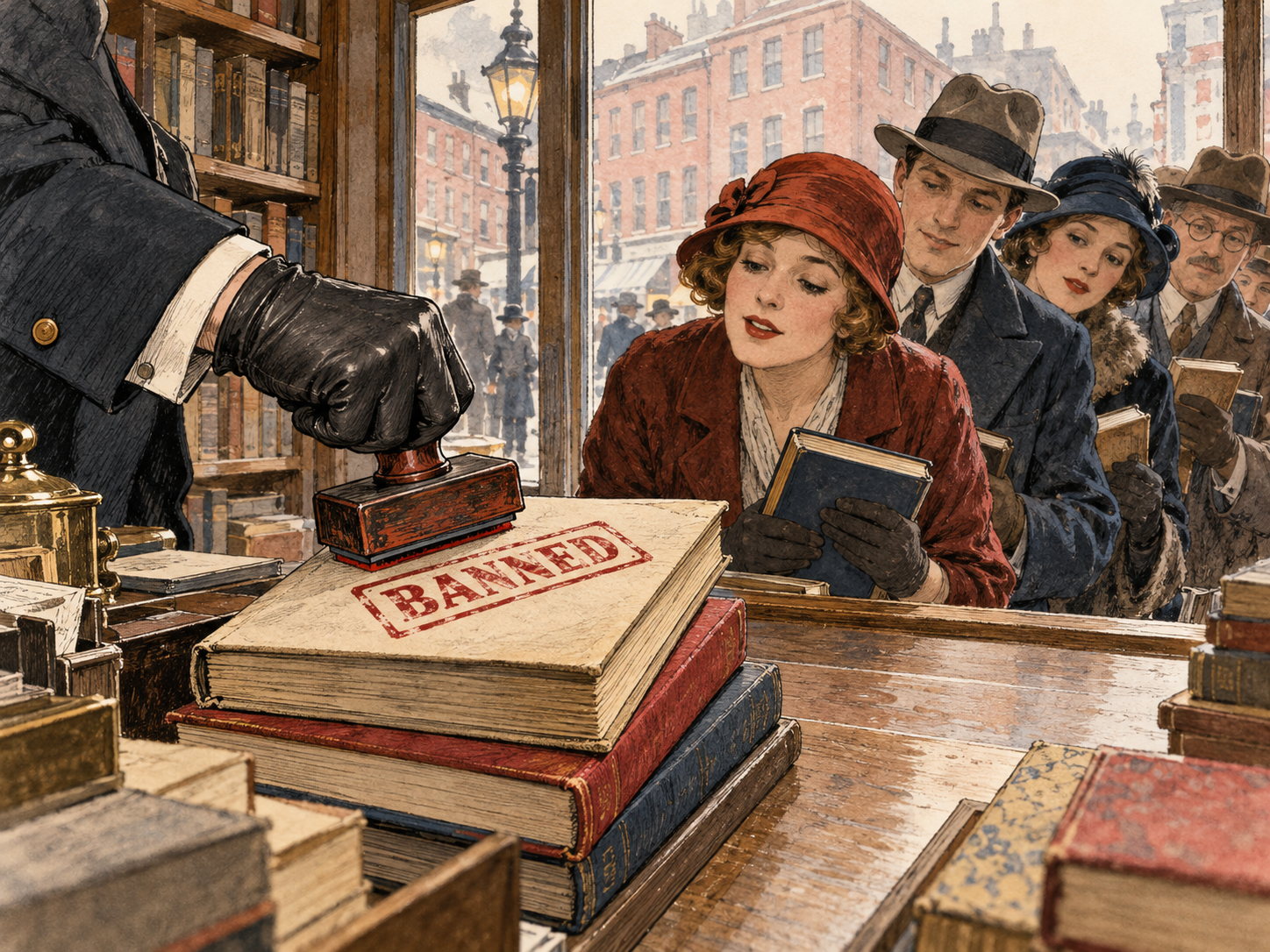
Banned in Boston: When Censorship Was the City's Most Famous Export
There was a time when three little words could turn an ordinary book into a national sensation.
Banned in Boston.
Publishers discovered that few things made Americans more curious about a book than learning that Boston didn't want them to read it. What began as a warning from the city's moral guardians became an irresistible advertisement.
The censors wanted to make books disappear. Instead, they helped make them famous.
And here we are, a century later, during Banned Books Week 2026, watching another generation of Americans fight over who gets to decide what the rest of us may read.
The People Who Decided What Boston Could Read
Boston's reputation for censorship was no accident. Beginning in the late nineteenth century, an influential organization originally called the New England Society for the Suppression of Vice—and later the Watch and Ward Society—set out to protect the city from what its members considered immorality.
Its leadership drew heavily from Boston's wealthy, socially prominent establishment. These were not simply people expressing personal disapproval of a novel or theatrical production. They were people with influence over booksellers, publishers, police, and prosecutors.
They understood something about power: You don't necessarily have to outlaw an idea if you can make people afraid to distribute it.
Booksellers could be pressured into withholding books. Publishers could face legal trouble. Theaters could be forced to modify performances or risk interference. Even the Boston Public Library maintained a restricted collection of works considered objectionable, popularly known as the Inferno.
Imagine that. A public library with books the public could not freely access.
Among the works caught in Boston's censorship campaigns were Walt Whitman's Leaves of Grass, Voltaire's Candide, and Giovanni Boccaccio's The Decameron.
Today we recognize them as major works of literature. Boston's guardians of morality saw threats to public virtue.
The books survived. The censors' reputation did not fare nearly as well.
The Day H. L. Mencken Decided to Fight Back
On April 5, 1926, journalist and literary critic H. L. Mencken arrived on Boston Common with copies of The American Mercury, the magazine he edited.
The Watch and Ward Society had objected to a story called Hatrack, written by Herbert Asbury, which appeared in the magazine.
Mencken had no intention of quietly accepting the society's judgment.
Instead, he arranged a very public confrontation.
A crowd of thousands gathered as J. Frank Chase, a leading figure in the Watch and Ward Society, purchased a copy of the magazine from Mencken. Mencken was promptly arrested.
It was supposed to demonstrate the power of Boston's censors.
The following day, Mencken won in court.
Think about the spectacle. A group determined to prevent the public from encountering an objectionable story had staged a dramatic event that brought enormous public attention to the very publication it wanted suppressed.
Mencken understood publicity. His opponents apparently understood it rather less well.
The confrontation did not immediately end censorship in Boston, but it became an important moment in the decline of the Watch and Ward Society's authority.
Once people discover they can challenge an intimidating institution and win, that institution becomes a little less intimidating.
Banned in Boston Became a Selling Point
The phrase eventually developed a life of its own.
Publishers and entertainers recognized that Boston's disapproval could create fascination far beyond Massachusetts. Something considered too scandalous for Boston suddenly became something audiences elsewhere wanted to experience.
The label acquired an almost comic quality. A reputation intended to protect the city's moral standing instead made Boston nationally famous for prudishness.
The irony is delicious, but the larger lesson is serious.
Trying to suppress an idea can make people more determined to encounter it.
And a government, institution, or private organization that appoints itself the guardian of acceptable thought risks revealing more about its own fear of ideas than about the danger of the ideas themselves.
A Century Later, the Books Are Still Under Attack
This week, the American Library Association is observing Banned Books Week, October 4–10, under the theme Let Books Be. Protect the Freedom to Read.
The timing could hardly be more relevant.
On October 5, PEN America released its latest findings: 11,982 instances of school book bans during the 2025–2026 school year, affecting 7,370 different titles. That is the highest annual total PEN America has recorded since it began tracking school book bans in 2021.
These are instances of restrictions or removals under PEN America's methodology, not 11,982 different books universally prohibited throughout the United States. That distinction matters.
So does the larger trend.
Books addressing race, sexuality, identity, history, and difficult experiences have faced particular scrutiny. The debate involves legitimate questions about age-appropriate educational materials and parental involvement. But those questions are not the same as granting political authorities broad power to remove perspectives they dislike.
Parents should be able to guide their own children's reading. That does not automatically give one group of parents the right to decide what every other family may access.
And public education should teach students how to think critically, including how to examine ideas they find uncomfortable.
Boston Has Been Here Before
What makes the history of Banned in Boston so relevant is not that today's controversies are identical to those of the 1920s. They aren't.
It is the recurring pattern of power.
An institution claims it must protect the public. It identifies ideas that supposedly present a danger. It puts pressure on the people who distribute those ideas. And the boundary between protecting individuals and controlling information becomes increasingly difficult to ignore.
Boston learned that moral authority can become an excuse for censorship, and that censorship can become an embarrassment to those who practice it.
We ought to remember that lesson.
The great irony is that the books Boston once tried to suppress became part of its cultural history. The writers are still read, studied, and celebrated. The people who tried to silence them are remembered largely for having tried.
Once a Warning. Now an Invitation to Read.
That is why we're launching Banned in Boston, a new GoBoston collection devoted to the city's remarkable history of forbidden books, suppressed performances, literary controversies, and the struggle for freedom of expression.
We'll revisit the famous confrontations, explore the books that caused scandals, uncover the people who resisted censorship, and visit the places where these battles unfolded.
We'll also examine what that history tells us about the arguments taking place today.
Boston is a city that helped launch a revolution over liberty. It is also a city that once tried to tell its citizens which books were fit to read.
Both stories belong to our history.
And perhaps the best answer to a century of censorship is the simplest one:
Read the book. Consider the ideas. Decide for yourself.
Welcome to Banned in Boston.
Once a warning. Now an invitation to read.
Join My GoBoston Community
Boston has never been short on opinions, arguments, or people willing to challenge authority. That's part of what makes this city extraordinary.
If you enjoy discovering the stories behind Boston—the history, culture, controversies, and characters that shaped this remarkable city—I invite you to join me on GoBoston Substack.
It's free to subscribe, and you'll receive new stories as we explore the Boston you know, the Boston you thought you knew, and the Boston still waiting to be discovered.
Good stories deserve to be told. Great ideas deserve to be shared. And neither should ever be silenced.