
Boston-Born Karl Deisseroth Wins 2026 Nobel Prize in Medicine
The Harvard graduate shares the Nobel Prize for pioneering optogenetics, a revolutionary technique that allows scientists to control individual brain cells with light.
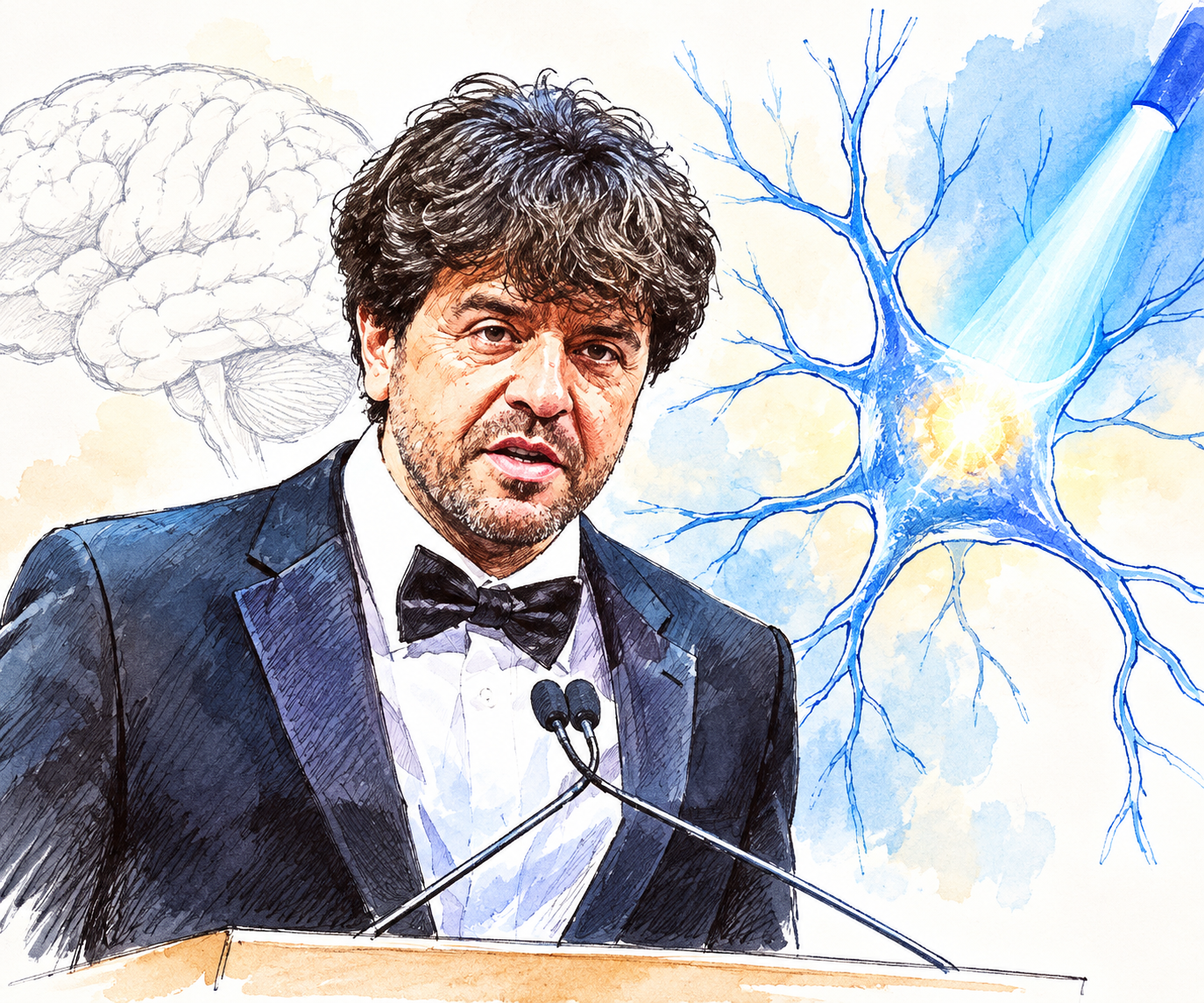
Boston-Born Karl Deisseroth Wins 2026 Nobel Prize in Medicine
A scientist born in Boston and educated at Harvard has won the 2026 Nobel Prize in Physiology or Medicine for helping create a technology that fundamentally changed the way scientists study the brain.
Karl Deisseroth, 54, shares this year's Nobel Prize with German scientists Peter Hegemann and Georg Nagel for their discoveries involving light-gated ion channels and optogenetics.
The Nobel Assembly announced the award Monday morning, October 5, saying their work opened a new era in neuroscience by allowing researchers to use light to switch the activity of individual nerve cells on or off in a living brain.
For Boston, the award has a distinctly local connection.
Deisseroth was born in Boston in 1971 and graduated summa cum laude from Harvard University in 1992.
Who Is Karl Deisseroth?
Deisseroth is now a professor of bioengineering and of psychiatry and behavioral sciences at Stanford University, as well as a practicing psychiatrist and Howard Hughes Medical Institute investigator.
But his academic path began in Cambridge.
After graduating from Harvard in 1992, he entered Stanford's joint M.D./Ph.D. program. He earned his doctorate in neuroscience and his medical degree and eventually built his career at Stanford.
His work would eventually help scientists tackle an enormous problem:
How do you determine which particular brain cells actually cause a behavior, memory, emotion or response?
Watching the brain isn't enough.
Researchers needed a way to reach into its enormously complicated circuitry and essentially flip individual switches.
Optogenetics gave them one.
What Is Optogenetics?
The simplest explanation sounds almost like science fiction:
Optogenetics allows scientists to control particular nerve cells using light.
The discovery began with something far removed from the human brain—a microscopic green alga.
Hegemann and Nagel's research helped reveal how a light-sensitive protein known as channelrhodopsin responds to blue light. When illuminated, the protein opens a tiny channel through a cell membrane, allowing electrically charged ions to pass through it.
That was intriguing because neurons also communicate through electrical activity.
Deisseroth and his colleagues realized the light-sensitive mechanism could potentially be harnessed to control nerve cells.
In 2005, his Stanford team demonstrated that neurons engineered to contain channelrhodopsin could be activated with pulses of blue light.
Researchers subsequently demonstrated the technique in living animals.
A biological light switch had effectively been created.
Why Is Optogenetics So Important?
The human brain contains tens of billions of neurons interconnected through extraordinarily complicated networks.
Scientists can observe that certain regions become active during particular behaviors or experiences. But seeing two things happen together doesn't prove that one causes the other.
Optogenetics changed the experiment.
Researchers can target particular populations of neurons, activate or suppress them, and then observe what happens.
That has allowed scientists to investigate neural circuits involved in memory, movement, fear, reward and behavior, while helping researchers better understand conditions including depression, anxiety, schizophrenia, Alzheimer's disease and Parkinson's disease.
The technology is now used in laboratories around the world.
The Nobel Assembly describes it as a tool that has helped researchers begin unraveling some of the brain's most fundamental mysteries. WBUR
The Story Comes Back to Cambridge
Deisseroth isn't the only important Massachusetts connection to optogenetics.
MIT professor Ed Boyden worked in Deisseroth's Stanford laboratory during the formative development of the technology.
Boyden subsequently established his own laboratory at MIT in Cambridge and became one of the major researchers advancing technologies for understanding and manipulating the brain. A 2013 Nature profile described Boyden working alongside Deisseroth and Feng Zhang during the early experiments that demonstrated neurons could be made responsive to light.
Deisseroth himself has also been recognized previously by Harvard. His honors include the 2019 Warren Alpert Prize at Harvard for work involving optogenetics.
That gives today's Nobel Prize an unusually strong Greater Boston thread:
Boston. Harvard. Stanford. MIT. And now Stockholm.
From a Tiny Green Alga to the Human Brain
Perhaps the most extraordinary part of the Nobel story is how unlikely its pieces initially appear.
Scientists wanted to understand how a tiny green alga responds to light.
They discovered a light-sensitive protein.
Researchers figured out how to put that mechanism into neurons.
Those neurons could then be activated with light.
And a discovery involving one of life's simplest organisms became a tool for exploring one of the most complicated objects known to science:
the human brain.
The Nobel Assembly awarded Deisseroth, Hegemann and Nagel the 2026 Nobel Prize in Physiology or Medicine for what it formally describes as their “discoveries concerning light-gated ion channels and optogenetics.”
The three scientists will share the prize of 12 million Swedish kronor, approximately $1.2 million.
And Boston gets a particularly satisfying piece of the story.
Karl Deisseroth was born here.
He studied across the river at Harvard.
More than three decades later, he is a Nobel laureate for helping scientists illuminate—quite literally—the mysteries of the brain.
More from GoBoston
For more Boston stories, history, neighborhoods, events and the people who make this city remarkable, follow GoBoston on Substack.
Sources
The Nobel Prize, The Nobel Prize in Physiology or Medicine 2026, October 5, 2026.
Stanford Medicine, Stanford University professor Karl Deisseroth wins 2026 Nobel Prize in physiology or medicine, October 5, 2026.
Associated Press/WBUR, Boston native among 3 scientists to win Nobel medicine prize for research into brain activity, October 5, 2026.
Reuters, US and German scientists win Nobel medicine prize for work on light and brain, October 5, 2026.
Stanford University, Karl Deisseroth faculty profile and curriculum vitae.