
The Pizza Shop Turning Boston’s Leftover Bread Into Dinner Is Moving Into a Piece of Boston Restaurant History
Scrappie’s is taking over the former Figs space on Beacon Hill — with pizza dough made partly from bread Boston restaurants might otherwise throw away.
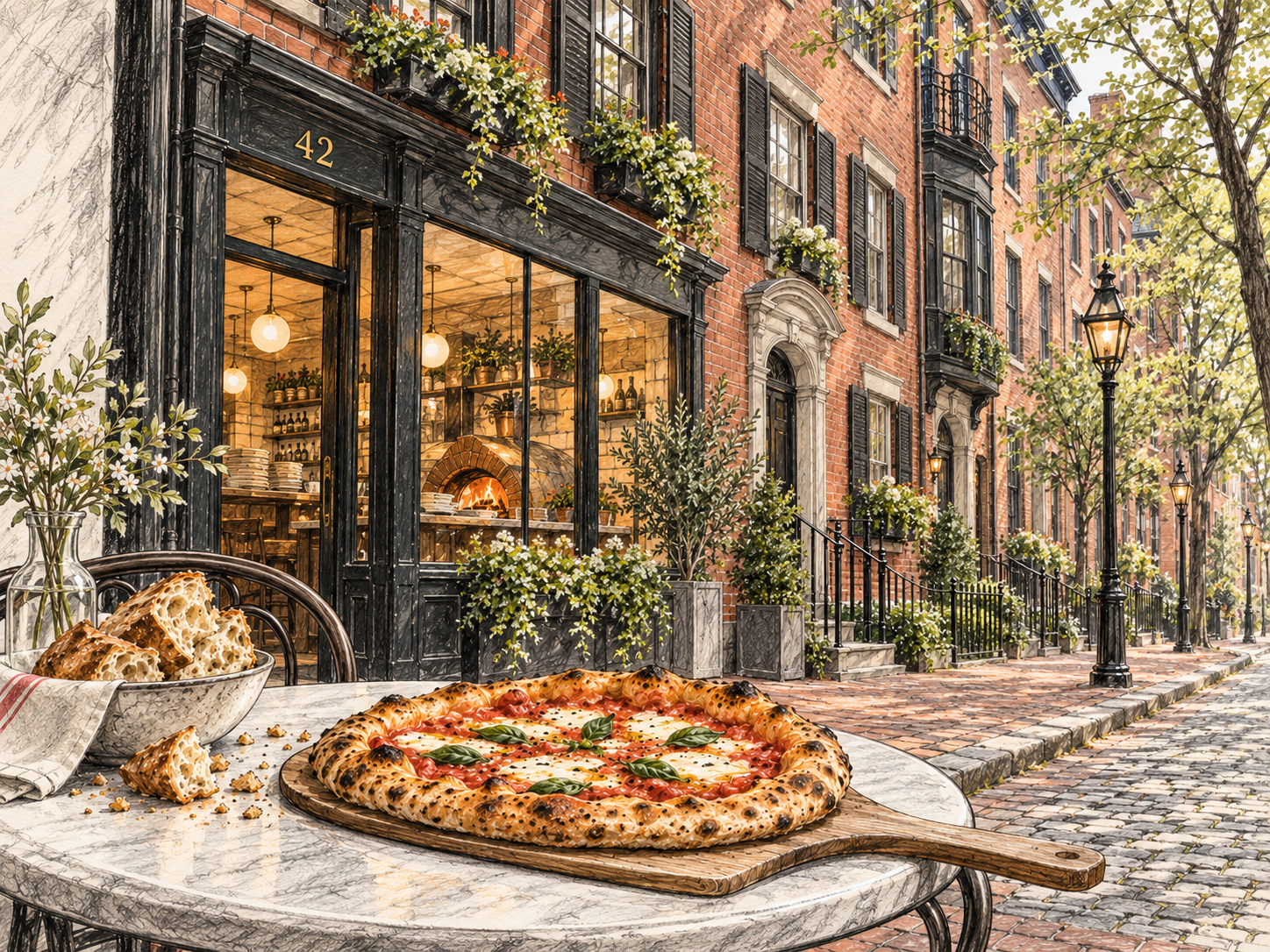
Scrappie’s is taking over the former Figs space on Beacon Hill — with pizza dough made partly from bread Boston restaurants might otherwise throw away.
There is something wonderfully Boston about the story unfolding at 42 Charles Street.
For years, the Beacon Hill storefront was home to Figs, part of chef Todd English’s Boston restaurant empire and a familiar name from an earlier chapter of the city’s dining history.
Now a very different kind of pizza operation is moving in.
Scrappie’s, created by 29-year-old Andrew Blau, is turning surplus bread from Boston restaurants into pizza dough — and the little pop-up that became notoriously difficult to get into is preparing to become a permanent Beacon Hill restaurant.
The address makes the story even better.
Some of the bread Blau has been rescuing has already come from restaurants on Charles Street.
In other words, the scraps are coming home.
From Restaurant Waste to Pizza Dough
Scrappie’s began with a deceptively simple question:
What if bread that restaurants were going to throw away could become part of something new?
Blau had learned about a Copenhagen company that turned discarded bread into pasta flour while he was working at Boston Beer Company and involved in sustainability efforts.
He wondered whether the same principle could work with pizza.
So he started experimenting.
He approached restaurants — including businesses around Charles Street — and asked whether they had surplus bread they planned to discard.
They did.
Blau dries that bread, mills it and incorporates the resulting flour into his pizza dough.
It sounds like the sort of sustainability experiment that might attract attention because of the idea.
But Scrappie’s developed something far more valuable than a clever concept:
People actually wanted the pizza.
The pop-ups started selling out.
And kept selling out.
Blau told The Boston Globe that Scrappie’s has been selling out since its earliest days, even as he continued refining both the dough and his pizza-making technique.
What began closer to a Neapolitan style has evolved into something between Neapolitan and New York pizza, with a deeply browned, crunchy exterior and an airy crust.
The sustainability story may have gotten people interested.
The pizza brought them back.
A Pop-Up Becomes a Neighborhood Restaurant
Scrappie’s began doing pop-ups in 2025 while Blau was also involved with Brick Street Bagels.
Until now, getting one of the pizzas has required some determination.
Limited production, limited operating days and strong demand turned Scrappie’s into the kind of Boston food experience where knowing when to order was almost as important as knowing what to order.
That changes with a permanent home.
Scrappie’s is taking over 42 Charles Street, the former Beacon Hill location of Figs, with plans to operate there under a one-year lease.
For Blau, the move also solves one of the fundamental problems facing small food businesses in Boston: the extraordinary upfront cost of building a restaurant.
The former restaurant space already contained much of the equipment needed to operate. Blau told the Globe that without that existing infrastructure — and favorable lease terms — opening his own location might not have been financially realistic.
That detail matters.
Because Scrappie’s isn't simply a story about pizza.
It is also a story about how difficult it has become for independent restaurants to establish themselves in Boston.
And Then There Is Figs
Anyone who has been eating around Boston long enough will recognize the significance of the address.
Todd English opened the original Figs in Charlestown in 1992, during the period when Boston’s restaurant scene was beginning to receive much broader national attention.
English had opened Olives a few years earlier, in 1989, and became one of Boston’s earliest celebrity chefs.
Figs was deliberately more casual: pizza, pasta and approachable food rather than formal fine dining.
The Beacon Hill location at 42 Charles Street became part of that story.
It survived changing dining trends, renovations and even a 2016 fire that closed the restaurant for nearly a year before it reopened in 2017.
Figs is now gone from the Charles Street storefront.
But pizza isn't.
It is simply arriving in a very different form.
Boston Restaurant History Has a Funny Way of Recycling Itself
That is what makes Scrappie’s arrival more interesting than another restaurant-opening announcement.
Think about the cycle.
Boston restaurants buy bread.
Some of that bread goes uneaten.
A young Boston entrepreneur notices the waste.
He collects it.
He dries it.
He mills it.
He makes pizza dough with it.
He starts selling pizzas through tiny pop-ups.
People race to buy them.
The pop-ups sell out.
And eventually the business created from Boston restaurants' discarded bread moves into the former home of one of Boston's best-known pizza restaurants.
Old Boston restaurant history becomes the home of a new Boston restaurant built, quite literally, from pieces of the restaurants around it.
You couldn't script the symbolism much better.
Charles Street Has Always Been More Than a Pretty Walk
Visitors often experience Charles Street as one of Boston's most photogenic streets — the brick sidewalks, historic architecture, small storefronts and immediate proximity to Boston Common and the Public Garden.
But Charles Street has long served another function.
It became Beacon Hill's principal neighborhood shopping and service street as the area developed, giving residents a commercial spine tucked beneath the residential streets climbing the hill.
That mixture remains part of what makes Charles Street interesting.
It isn't a manufactured shopping district.
People live above it and around it.
They buy groceries here, drink coffee here, eat dinner here and walk home.
Restaurants come and go, but the neighborhood keeps absorbing them into its history.
Scrappie’s fits that tradition remarkably well.
Instead of arriving as a national concept dropped onto a historic Boston street, it grew out of Boston itself.
Some of the raw material was already here.
What to Know About Scrappie’s
Where: 42 Charles Street, Beacon Hill, Boston
What: Pizza made with dough incorporating flour produced from surplus restaurant bread
Founder: Andrew Blau
Previously: Scrappie’s operated primarily through limited pop-ups
Former occupant: Figs
Opening: Scrappie’s is moving into the permanent Charles Street location in October 2026.
And if its pop-up history is any indication, Boston may be about to discover whether easier access to Scrappie’s pizza finally ends one of its defining traditions:
trying to get an order in before everybody else does.
For visitors, that makes Scrappie’s another reason to wander Charles Street rather than treating Beacon Hill as something to photograph on the way somewhere else.
For Boston, it is something better.
A neighborhood restaurant story in which yesterday’s leftovers become tomorrow’s dinner — inside a storefront that already has plenty of restaurant history of its own.
For more Boston neighborhood stories, restaurant openings and the places that make the city worth exploring, follow my GoBoston community at GoBoston on Substack.