
As Veterans Day approaches, Boston's remarkable memorial to the 54th Massachusetts Regiment offers a powerful contrast to Trump's proposed 250-foot triumphal arch near Arlington National Cemetery.
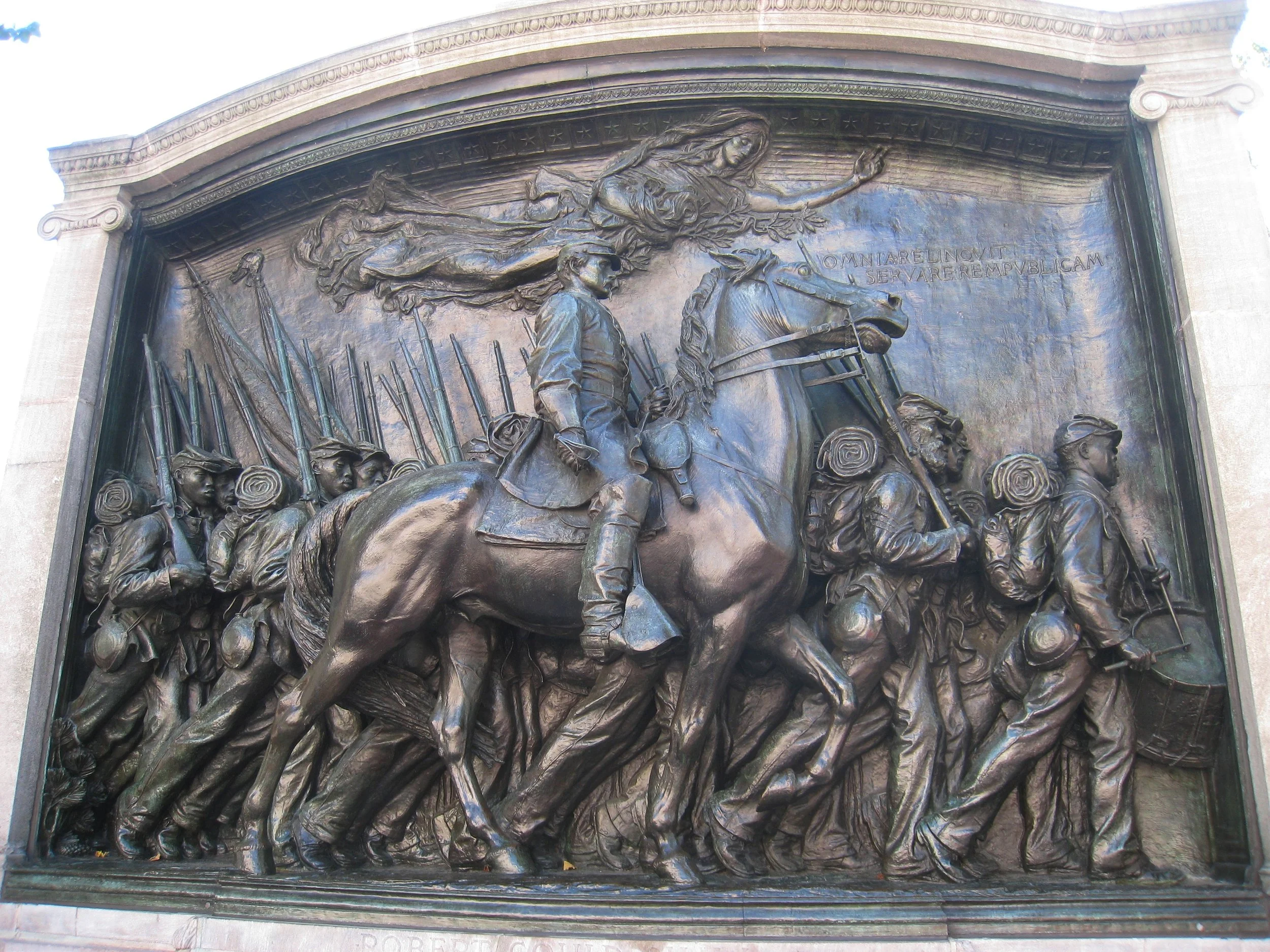
Bronze relief of Colonel Robert Gould Shaw on horseback alongside soldiers of the 54th Massachusetts Regiment at their memorial on Boston Common.
In 1897, sixty-five aging Civil War veterans marched through Boston to meet the young men they had once been.
They were survivors of the 54th Massachusetts Regiment, one of the first Black military regiments organized in the North during the Civil War.
On Boston Common, directly across from the Massachusetts State House, a new bronze memorial depicted their younger selves marching toward war.
The sculptor, Augustus Saint-Gaudens, watched as the veterans passed his work. Many were bent with age. Some were disabled. Others had white hair and carried flowers.
The men in the sculpture remained forever young.
Saint-Gaudens described the extraordinary moment as the old soldiers returning from war while their younger selves marched in the opposite direction.
Imagine standing there that day, watching men confront their own history.
More than a century later, their monument remains one of Boston's most powerful reminders of courage, sacrifice, and America's unfinished struggle for equality.
And this Veterans Day, its message has taken on new relevance.
The Soldiers Who Marched Out of Boston
On May 28, 1863, the 54th Massachusetts Regiment marched through Boston as crowds gathered to watch the soldiers depart for the Civil War.
The regiment had been organized under Massachusetts Governor John A. Andrew following the federal government's authorization of Black enlistment.
Its commanding officer was Colonel Robert Gould Shaw, a young white officer from a prominent abolitionist family.
The men of the 54th were fighting for the Union and for a future in which Black Americans could enjoy the freedom and citizenship denied to so many of them.
Their service came with extraordinary risks. Confederate authorities threatened severe punishment for captured Black Union soldiers and their white officers.
On July 18, 1863, the regiment led an assault on Fort Wagner in South Carolina.
Shaw was killed, along with many of his soldiers. Others were wounded or captured.
Among the survivors was Sergeant William H. Carney, who rescued the regiment's American flag despite suffering serious wounds. He later became the first African American awarded the Medal of Honor.
The 54th's courage helped change public attitudes about Black military service and encouraged the enlistment of more than 180,000 African Americans in Union forces.
The regiment continued fighting after Fort Wagner and returned to Boston in September 1865.
Its story would eventually become known to millions through the 1989 film Glory.
A Monument Nearly Fourteen Years in the Making
Boston commissioned Augustus Saint-Gaudens to create a memorial honoring Shaw and the 54th Massachusetts.
The sculptor spent nearly fourteen years completing it.
Unlike conventional military monuments that feature a single heroic commander, this sculpture places Shaw on horseback alongside the Black soldiers marching into battle.
Saint-Gaudens hired dozens of Black men as models so that the soldiers would have individual faces rather than appear as anonymous figures.
The finished bronze relief measures approximately eleven feet high and fourteen feet wide.
On May 31, 1897, thousands gathered for its dedication.
The sixty-five surviving veterans of the 54th led the procession. Sergeant Carney carried the American flag. Veterans of other Black Massachusetts regiments joined them.
The soldiers laid a wreath of lilies of the valley before the memorial.
Among the speakers was Booker T. Washington, whose words that day remain strikingly relevant.
He said the monument stood "for effort, not victory complete."
And he challenged Americans to finish the work those soldiers had begun.
The Civil War had ended more than thirty years earlier. Slavery had been abolished. Yet discrimination, segregation, and racial violence continued.
The memorial celebrated bravery while reminding the country of promises still unfulfilled.
Harriet Tubman's Visit to Boston Common
Eight years later, on Memorial Day in 1905, Harriet Tubman stood before the same monument.
Tubman had risked her life guiding enslaved people to freedom through the Underground Railroad. During the Civil War, she served as a nurse, scout, and military leader for the Union.
She also knew members of the 54th Massachusetts and had cared for wounded soldiers following the assault on Fort Wagner.
By 1905, she was an elderly woman.
The Boston Herald reported that she gazed at the memorial for a long time and shed a tear for those who had died.
The Boston Globe recorded something even more extraordinary.
Looking at the sculpted face of Colonel Shaw, Tubman remembered the morning she had last seen him alive.
She had given him breakfast before the battle in which he was killed.
Forty-two years later, standing on Boston Common, she remembered that morning.
Few monuments can claim a more personal connection to the history they preserve.
Another Monument, Another Vision
Now, in November 2026, a very different military monument is at the center of a national controversy.
Trump wants to construct a 250-foot triumphal arch at Memorial Circle in Washington, D.C., near Arlington National Cemetery and the Lincoln Memorial.
The administration has presented the project as a celebration of America's military history and the nation's 250th anniversary.
New renderings show an enormous granite-and-gold structure decorated with military imagery and winged figures.
The proposal has prompted objections from veterans, preservationists, aviation experts, and officials in Washington and Virginia.
Three Vietnam veterans are among those challenging the project in federal court. They argue that the enormous arch would intrude upon the solemn setting of Arlington National Cemetery and diminish the experience of visiting the graves of America's military dead.
The administration maintains that the project is authorized and appropriate as a military tribute.
On November 5, the National Capital Planning Commission approved the proposal by an 8–4 vote.
Hours later, U.S. District Judge Tanya Chutkan temporarily blocked construction for fourteen days while legal challenges proceed.
The controversy is unfolding just days before Veterans Day.
And it raises a question that Boston's own history helps illuminate.
What makes a monument worthy of the people it claims to honor?
What Boston's Memorial Teaches Us
The Shaw Memorial is a masterpiece of American sculpture. But its enduring significance comes from the lives it represents.
Its soldiers have faces. Their history is documented. Their courage came at a terrible cost.
Some survived and returned to Boston. Others never came home.
Their monument has remained a gathering place for veterans, civil rights advocates, historians, artists, and visitors for nearly 130 years.
It has witnessed ceremonies, commemorations, protests, and conversations about the meaning of freedom.
The proposed triumphal arch in Washington presents a different vision of military commemoration, one centered on monumental scale, national triumph, and architectural grandeur.
Supporters see it as a celebration of American military achievement. Opponents question its location, size, legal authorization, and impact on Arlington National Cemetery.
The veterans challenging it are asking that their concerns be heard before construction proceeds.
That debate deserves public attention, especially during a week devoted to honoring military service.
Boston's memorial reminds us that the most powerful tributes can begin with something very simple: remembering the people.
Visit the Shaw Memorial on Boston Common
The Robert Gould Shaw and 54th Massachusetts Regiment Memorial stands along Beacon Street, directly across from the Massachusetts State House.
It is one of the most important stops on Boston's Black Heritage Trail and an essential part of the city's Civil War history.
Visitors can examine the faces of the soldiers, learn about the regiment's remarkable service, and reflect on the meaning of the monument.
The memorial is outdoors and free to visit.
For anyone exploring Boston around Veterans Day, it is a place worth taking time to see.
And perhaps to remember the words spoken at its dedication in 1897:
"For effort, not victory complete."
America's work was unfinished then.
The responsibility to honor those who served, preserve their history, and listen to veterans remains with us today.
Plan Your Visit
Robert Gould Shaw and 54th Massachusetts Regiment Memorial
Location: Boston Common, Beacon Street, opposite the Massachusetts State House, Boston, MA
Admission: Free
Nearby attractions: Massachusetts State House, Boston African American National Historic Site, Black Heritage Trail, Beacon Hill, and the Freedom Trail.
Getting there: Park Street and Government Center MBTA stations are within walking distance. Check current service advisories before traveling.
Explore the memorial's history with the National Park Service.
Discover More of Greater Boston
Looking for historic places to visit, local events, holiday celebrations, and things to do around the city?
Explore our regularly updated What's Happening in Boston guide.
Join the GoBoston Community
Boston's history belongs to everyone who has lived it, studied it, or discovered it.
Do you know a veterans memorial in your neighborhood with a story worth telling? Did someone in your family serve in the military?
We'd love to hear your memories, questions, and recommendations.
Join the conversation on GoBoston Substack, where readers share their experiences and help keep Greater Boston's stories alive.