
Kendall Square Built the Future. But Did It Forget to Build a Neighborhood?
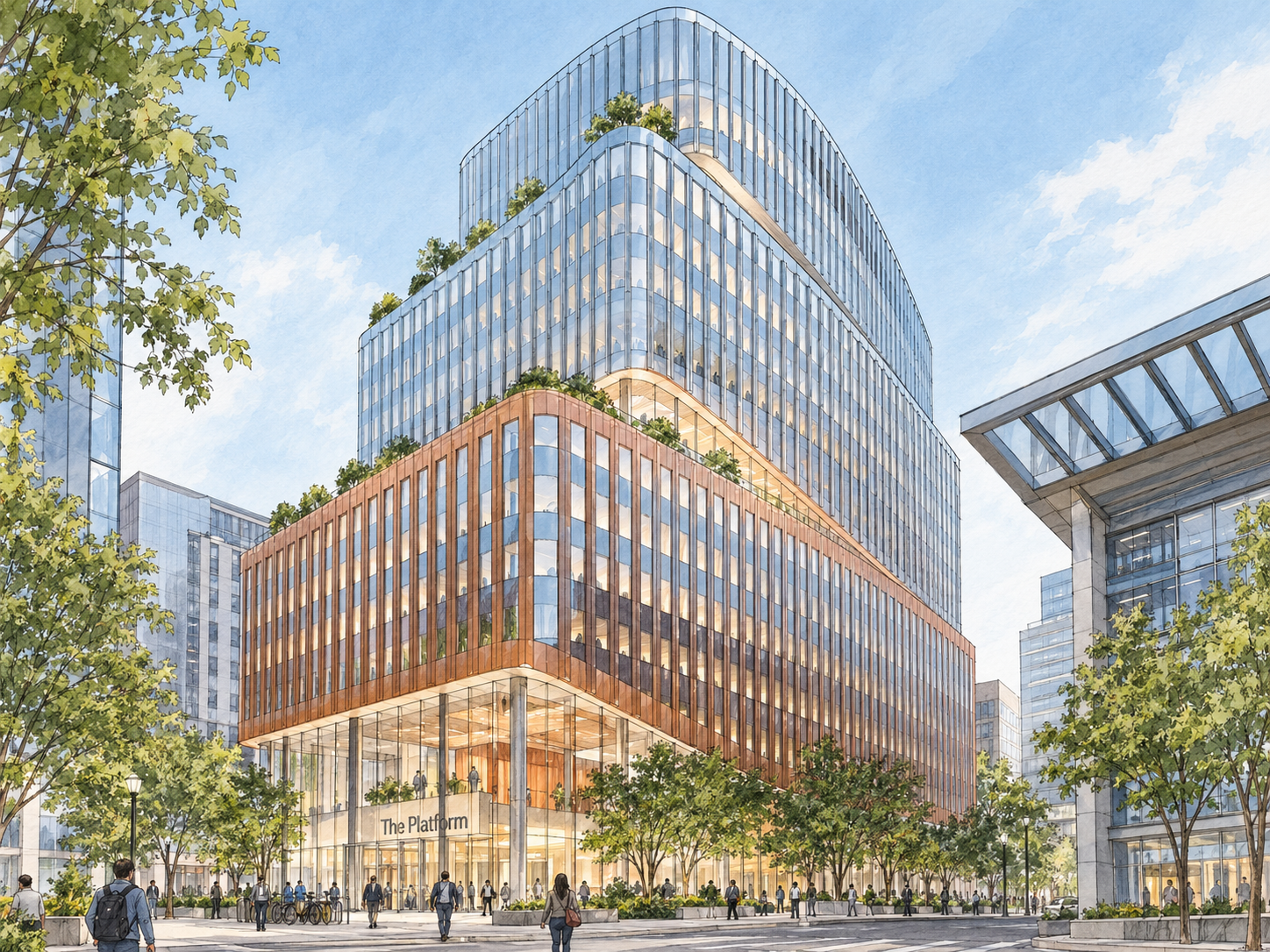
Artist AI Rendition of The Platform, Kendall Square, Cambridge, Massachusetts — Boston, Massachusetts
A new performing arts center is about to bring music, dance, theater and something Kendall Square has often lacked: a reason to stay after work.
For decades, Kendall Square has been busy building the future.
Biotechnology. Pharmaceuticals. Artificial intelligence. Research laboratories. Startups. Some of the most expensive commercial real estate in Greater Boston.
What Kendall Square has not always been particularly good at building is a neighborhood.
That may be about to change.
A new 45,000-square-foot performing arts center called The Platform is preparing to open inside the 585 Kendall development in Cambridge. The original plan called for an opening celebration today, September 19, but Global Arts Live's current schedule now lists a members' grand-opening celebration for November 6 and a free public opening day on Saturday, November 7.
And the delay of a few weeks doesn't change the larger story.
Kendall Square is getting something it has famously needed: a cultural center built for people who don't necessarily have a lab badge around their necks.
From factories to laboratories
Kendall Square wasn't always biotech country.
Its location near rail lines and the Charles River helped make it an industrial district in the 19th and early 20th centuries. MIT moved from Boston's Back Bay to Cambridge in 1916, but factories, warehouses and manufacturing still defined much of the neighborhood.
After World War II, manufacturing declined. Companies left. Buildings emptied. By the 1970s, parts of Kendall Square were a mix of vacant land, parking lots and fading industrial buildings.
There was even a grand plan for NASA.
In the 1960s, Cambridge cleared roughly 29 acres as part of an urban-renewal effort after NASA announced plans for an Electronics Research Center in Kendall Square. The federal government later changed course, leaving Cambridge with cleared land and another question about what Kendall Square was supposed to become.
The answer eventually came from science.
Then biotech arrived
Cambridge adopted groundbreaking regulations governing recombinant DNA research in 1976. Biogen opened its first U.S. research facility in Kendall Square in the early 1980s. Other biotechnology companies followed.
MIT was next door. Harvard wasn't far away. Boston's medical institutions were close. Scientists, entrepreneurs and venture capital began concentrating within a remarkably small geographic area.
The transformation accelerated.
Today, Cambridge describes Kendall Square as one of the world's leading centers for biotechnology research and innovation. What had once been an industrial district became one of the most important scientific neighborhoods anywhere.
But there was a catch.
People came to Kendall Square to work
For years, Kendall Square had a strange rhythm.
Thousands of people poured into the neighborhood every morning and poured back out again at the end of the workday.
The labs were extraordinary. The street life wasn't.
Even the Kendall Square Association, formed in 2008 as the neighborhood's transformation accelerated, identified the need for more opportunities for people to connect and for more vibrant activity at street level.
Restaurants eventually arrived. Housing followed. New public spaces helped. The neighborhood became far more interesting than the sea of office buildings and parking lots many longtime Bostonians remember.
But Kendall Square has never had the cultural identity of Harvard Square, Central Square or Davis Square.
You went to Kendall because you worked there, had a meeting there or were visiting MIT.
You didn't necessarily say, "Let's go to Kendall Square tonight."
The Platform is an attempt to change that.
Enter The Platform
The new center is being developed as part of the 585 Kendall project and operated with Global Arts Live, the Cambridge nonprofit that has spent more than three decades bringing music and dance from around the world to Greater Boston stages.
The Platform will include a 400-seat Takeda Theater, a 125-seat cabaret-style stage, a rehearsal studio, public gathering space, an indoor garden, café and bar. Global Arts Live says the center is expected to host more than 400 public events annually across its spaces.
That's a very different kind of experiment for Kendall Square.
Instead of another laboratory, this one involves musicians, dancers, families, neighbors and people gathering simply because they want to be there.
Independent artists and nonprofit organizations will also be able to use the performance spaces at subsidized rates, and Global Arts Live has said 25 rentals annually will be offered free to community groups and artists.
That matters in a region where smaller arts organizations are constantly battling the cost of rehearsal and performance space.
Kendall's new experiment
The programming gives a sense of what is coming.
The opening weekend will include the vertical dance company BANDALOOP, whose dancers perform suspended from buildings. The public opening on November 7 is scheduled to include live music, family activities and two BANDALOOP performances.
The months that follow include Haitian folkloric dance, contemporary ballet, Ukrainian music, jazz, klezmer, tap, global folk traditions and experimental performance.
Boston-based Jean Appolon Expressions will bring Haitian dance and live drumming to the Takeda Theater. BalletX brings contemporary ballet. Ezekiel's Wheels Klezmer Band will share the stage with ZACHOR Dance Projects. Subject:Matter will bring Boston tap dance and jazz.
That may be exactly what Kendall Square needs.
Because neighborhoods are not built only from buildings.
They're built from the things that happen between them.
The human stuff
Kendall Square has spent decades proving what can happen when scientists, universities, investors and companies are concentrated within a few blocks of one another.
It helped create an innovation ecosystem that cities around the world have tried to copy.
But innovation alone doesn't make a neighborhood.
People do.
So do cafés where nobody is holding a meeting. Music spilling out onto the sidewalk. A family heading to a Saturday performance. Dancers rehearsing downstairs while scientists work upstairs. Someone lingering over a drink because there's somewhere else to go next.
That's what makes The Platform interesting.
The story isn't simply that Kendall Square is getting a new theater.
It's that after spending decades building one of the most technologically sophisticated places on Earth, Kendall Square may finally be investing just as deliberately in the human stuff.
And maybe that's the next experiment worth watching.
Visit The Platform
The Platform
Kendall Square, Cambridge
Global Arts Live currently lists its public opening day for Saturday, November 7, 2026, beginning at noon, with live music, family-friendly activities and performances by BANDALOOP. The event is scheduled to be free and open to the public.
Join the GoBoston Community
Boston and Cambridge are always changing, and some of the best stories aren't simply about what's opening. They're about why a place became what it is — and what might be coming next.
That's what we're building at GoBoston: a place to discover Greater Boston, share the places and stories you love, and help build a community of people who actually care about this city.
Join the GoBoston Substack community, share your own Boston and Cambridge discoveries, and come explore the city with us.