
Before Rothko Was Rothko, He Painted Gloucester
Nearly a century before his paintings sold for millions, a young Mark Rothko came to Cape Ann and painted the harbor. Now one of those paintings has come home.
Mark Rothko, Painter, Gloucester, Massachusetts Cape Ann
Before Mark Rothko painted those enormous floating rectangles of color that would make him one of the most recognizable artists of the 20th century, he painted Gloucester.
Not the idea of Gloucester. Gloucester itself—the harbor, the wharves, the beaches and the people stretched out along the shore.
He was young, still figuring out what kind of artist he was going to become, and spending his summers on Cape Ann with two other painters who were doing much the same thing.
Nearly a century later, one of those paintings has come home.
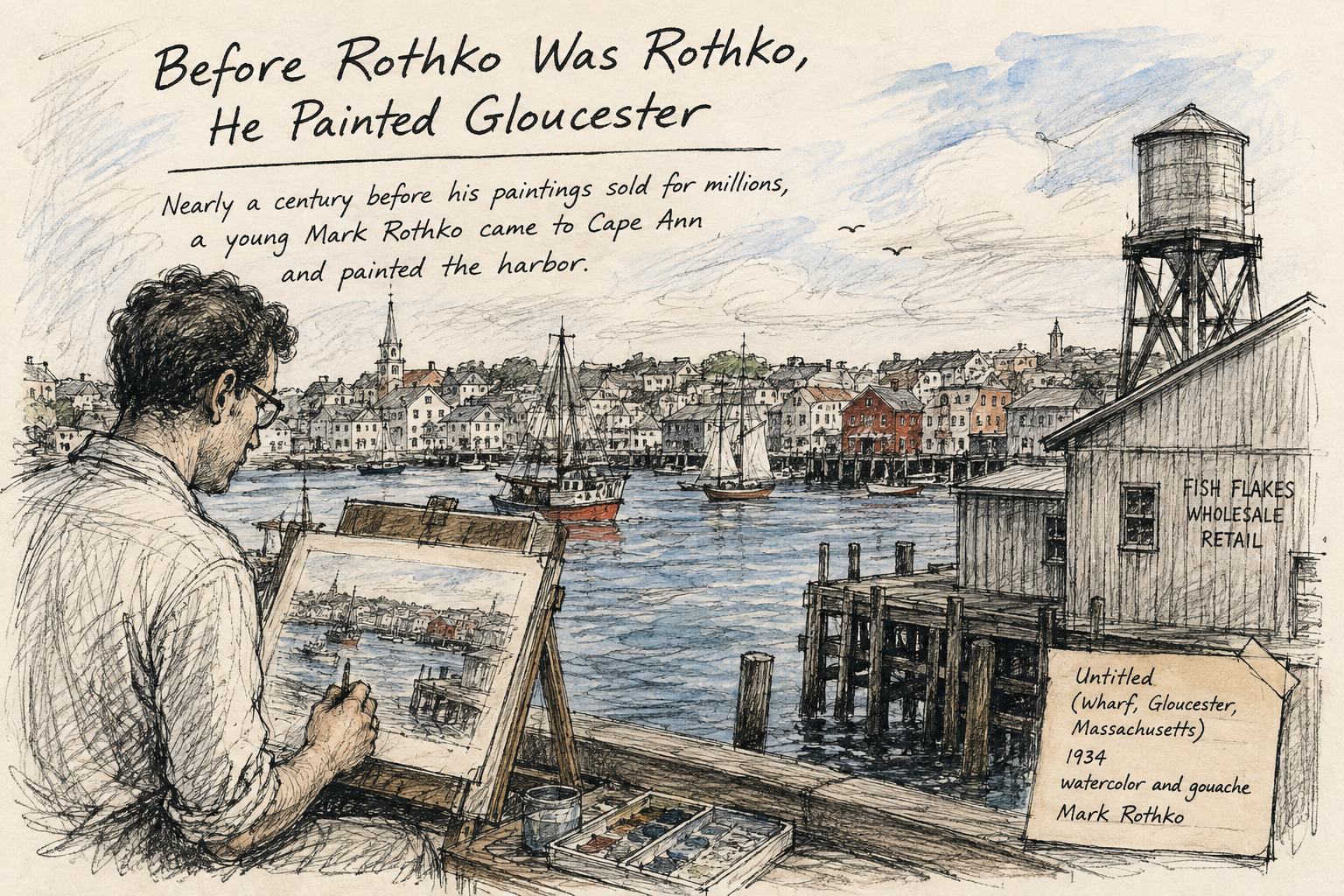
On Thursday, August 20, Rothko's son, Christopher Rothko, donated his father's 1934 watercolor and gouache, Untitled (wharf, Gloucester, Massachusetts), to the Cape Ann Museum's permanent collection.
It's a painting of Gloucester's Inner Harbor from East Gloucester. And here's the part I love: some of what Rothko saw and painted nearly 100 years ago is still there.
Before the Famous Rothko
Say the name Mark Rothko and most people who know his work picture color: huge canvases, blocks of red floating over maroon, orange against yellow, black sinking into gray. You don't necessarily look at a mature Rothko painting as much as stand in front of it and let it happen to you.
His paintings eventually became some of the most valuable works of modern art in the world.
But that's not the Rothko who came to Gloucester.
In 1932, painter Milton Avery invited Rothko and Adolph Gottlieb to Cape Ann. Avery was 18 years older than the two younger artists and already had years of experience behind him. He wasn't exactly their teacher. He was something more interesting: their example.
Exhibition curator Eliza Rathbone describes Avery as a mentor who didn't tell the younger painters what to do. He simply worked—and showed them that it was possible to build a life around making art.
So they worked too.
They became friends and painted together on Cape Ann during summers stretching across decades, roaming Gloucester and its shoreline looking for things worth putting on paper and canvas.
Gloucester Was Their Studio
Imagine them walking around Gloucester in the 1930s: fishing boats in the harbor, working wharves, granite, beaches, piers, water changing color with the light. People swimming and sunning themselves. Fish washed onto the shore.
This wasn't a Gloucester constructed for tourists. It was a working seaport, and the artists painted what they saw.
Avery painted people watching the 1932 solar eclipse from Good Harbor. Gottlieb became fascinated enough with dead fish on the beach that some ended up appearing in his work. Rothko painted bathers, people playing handball on the beach and the harbor itself.
That can be startling if the Rothko in your head consists entirely of those enormous abstract canvases. There are actual people in these paintings. There are boats and buildings and horizons.
There is Gloucester.
You Can Almost Watch Rothko Becoming Rothko
And that's what makes these early paintings so interesting. The famous Rothko isn't there yet, but maybe you can see him coming.
The three artists weren't simply recording Cape Ann like photographers. They were learning what color could do, what shape could do, and what could be removed from a scene without losing the feeling of it.
Over time, the paintings changed. The literal harbor mattered less. Color mattered more. Forms became simpler, and the landscape began giving way to abstraction.
Avery, Gottlieb and Rothko would ultimately go in different directions, but the Cape Ann Museum's current exhibition argues that those summers together were an important part of their development.
The exhibition brings together 82 works, including dozens borrowed from museums and collections around the country, tracing that evolution from recognizable Cape Ann scenes toward the mature work for which the artists became known.
And Then There's the Painting That Came Home
Rothko's 1934 Gloucester watercolor has been part of his son Christopher's personal collection.
Until now.
The painting shows the Inner Harbor from East Gloucester. There are fish flakes on a pier—wooden platforms once used to dry fish—and a water tower perched above a wharf structure. Across the water is Gloucester's main waterfront.
Christopher Rothko could have kept it. He could have sold it.
Instead, he gave it to Gloucester.
He said the gift reflects his own affection for the city and, he believes, the feelings his father developed during his stays there. He also said something particularly lovely about the painting: despite being created almost a century ago, it captures details of Gloucester Harbor that people can still recognize today.
There's something satisfying about that.
A painting made here, carried away, preserved by the artist's family and, almost a century later, returned to the place that helped create it.
Gloucester Has Been Doing This to Artists for a Long Time
Rothko wasn't the first important artist to discover something in the light around Cape Ann. Not even close.
Fitz Henry Lane. Winslow Homer. John Sloan. Marsden Hartley. Stuart Davis. Edward Hopper.
Artists have been coming here for generations. The combination of rocky coastline, working harbor, fishing industry and northern coastal light turned Cape Ann into one of America's great artistic landscapes.
In 2023, the Cape Ann Museum explored another of those relationships with Edward Hopper & Cape Ann: Illuminating an American Landscape. Now it's Rothko, Avery and Gottlieb.
Different artists. Different generations. Same patch of Massachusetts coast.
There must be something in that light.
Three Friends by the Sea
Maybe my favorite part of this story isn't even about art.
It's about friendship.
Avery, Gottlieb and Rothko remained friends throughout their lives. They painted together, talked about art, went to the beach, played handball and raised families. The younger men learned from Avery, and eventually their experiments with abstraction influenced him in return.
We tend to look backward at famous people as though their futures were inevitable. Of course Mark Rothko became Mark Rothko.
Except it wasn't inevitable.
There was a time when he was simply a young painter spending the summer in Gloucester with his friends, carrying his supplies around Cape Ann and trying to figure out what he wanted to put on paper.
That's the Rothko I find particularly interesting.
The one who didn't know yet.
Go See the Rothko Before Rothko
And right now, you can.
The Cape Ann Museum's exhibition Avery, Gottlieb & Rothko: By the Sea runs through September 27, 2026, at the museum's newly renovated downtown campus at 27 Pleasant Street in Gloucester.
The exhibition includes early Cape Ann works alongside mature paintings that show where the three artists eventually went. After Gloucester, the exhibition travels to The Phillips Collection in Washington, D.C., in October—the first exhibition organized by the Cape Ann Museum to travel to a national museum.
But Rothko's Gloucester harbor painting isn't leaving for good.
That one belongs to Gloucester now.
So go look at it. Then walk outside and head toward the harbor. Look at the water, the wharves and the light, and imagine a young Mark Rothko standing somewhere nearby almost a century ago, looking at much the same thing.
He couldn't have known where those paintings would eventually take him.
But maybe Gloucester helped him find the way.