
Could the Democrats Come Back to Boston?
Boston just made the final three for the 2028 Democratic National Convention. The last time Democrats came here, America met Barack Obama.
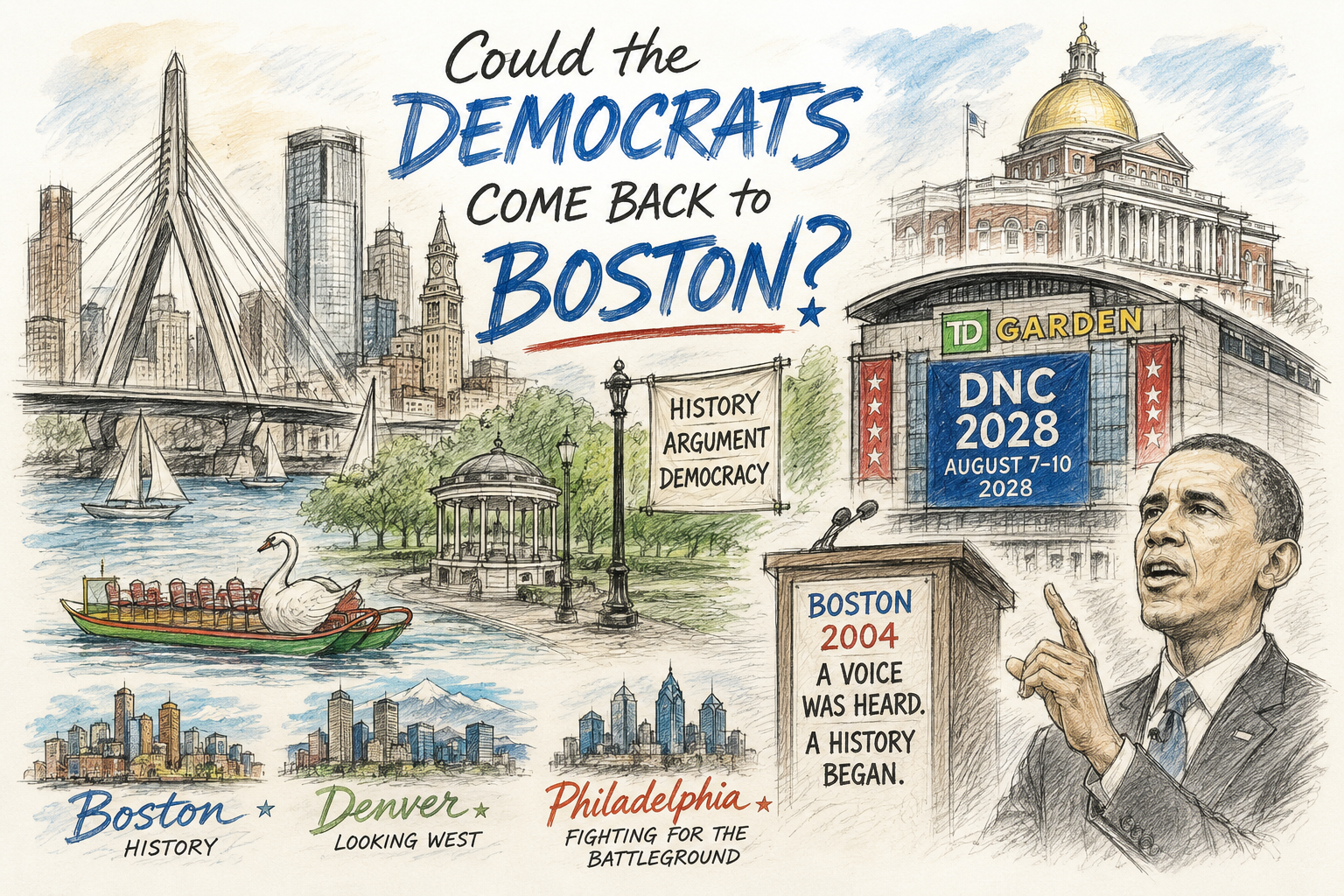
Boston is back in the running.
The Democratic National Committee announced Thursday that Boston, Denver and Philadelphia are the three finalists to host the 2028 Democratic National Convention, eliminating Atlanta and Chicago after the DNC's site-selection process. The convention is scheduled for August 7–10, 2028, with the winning city expected to be announced later this year. (AP News)
For Boston, landing the convention would mean thousands of delegates, journalists, political operatives, donors, protesters and visitors descending on the city—and four days when much of the political world's attention would be focused on Massachusetts.
But Boston has been here before.
And the last time it happened, something extraordinary occurred.
The Night America Met Barack Obama
The year was 2004.
Democrats came to Boston to nominate Massachusetts Senator John Kerry for president. The convention was held at the FleetCenter, the building we now know as TD Garden.
On the second night, a 42-year-old Illinois state senator and U.S. Senate candidate walked onto the stage to deliver the keynote address.
His name was Barack Obama.
Political insiders were beginning to notice him, but much of America had never heard him speak. GBH's Adam Reilly, who covered the convention, later recalled how unfamiliar Obama still was to many of the people gathered in Boston that week. (GBH)
Then Obama started talking.
He told the story of his Kenyan father and Kansas-born mother, of immigration and opportunity, and of an America that he argued was bigger than its political divisions.
Then came the line that would follow him:
“There’s not a liberal America and a conservative America; there’s the United States of America.”
Four years later, Barack Obama was the Democratic nominee for president.
And four years after that night in Boston, he was elected president of the United States. (The American Presidency Project)
Boston Wants Another Turn
Twenty-four years later, Boston is asking Democrats to come back.
When DNC officials visited in May, Mayor Michelle Wu and Gov. Maura Healey didn't shy away from selling Boston's history as part of the package. They invoked Massachusetts' revolutionary past and presented Boston as a city with both the infrastructure to host a modern political convention and a history deeply connected to America's arguments over democracy and freedom. (GBH)
Boston has some practical advantages, too.
The city is compact and walkable. It has public transportation, major hotels, universities, hospitals, restaurants and a concentrated downtown. TD Garden sits directly above North Station rather than miles outside the city.
And Boston knows something about handling crowds.
The Boston Marathon arrives every April. Championship parades can fill downtown streets. Fenway, the Garden and major conventions routinely bring large numbers of visitors into a relatively small city.
But choosing the site of a political convention isn't simply an exercise in counting hotel rooms.
The three finalists represent three very different political arguments.
Boston, Denver or Philadelphia?
Philadelphia sits in Pennsylvania.
That alone is an argument.
Donald Trump carried Pennsylvania in 2024, and it's difficult to imagine a 2028 Democratic strategy that doesn't involve fighting intensely for the state. Putting the convention in Philadelphia would plant the party's flag directly inside one of America's most important battlegrounds.
Denver offers another story. Democrats held their 2008 convention there—the convention where Barack Obama formally accepted the presidential nomination four years after his Boston keynote helped launch him onto the national stage.
And then there's Boston.
Massachusetts isn't going to be the great electoral prize of 2028. It's one of the most reliably Democratic states in the country. Colorado also leans Democratic, while Pennsylvania remains the obvious battleground among the three finalists. (AP News)
Boston's argument has to be different.
It has history.
It has political symbolism.
It has universities, organized labor, technology, medicine, finance and some of the deepest Democratic fundraising networks in the country.
And it has a city whose identity is wrapped around the American argument itself.
Revolution happened here.
Abolitionists organized here.
Immigrants transformed the city.
Labor fought here.
Civil-rights battles happened here.
And Americans have been arguing loudly about politics here for centuries.
But Look Who Isn't on the List
The DNC didn't just choose Boston, Denver and Philadelphia.
It eliminated Atlanta and Chicago.
And Atlanta Mayor Andre Dickens is furious.
Dickens accused the DNC of turning its back on Atlanta, the South and Black voters, arguing that Democrats cannot claim they want to rebuild their coalition while overlooking a city and region critical to that coalition.
The DNC has not publicly explained why Atlanta and Chicago failed to make the final three. (Axios)
Whatever one thinks of Dickens' argument, it raises a larger question.
A convention city isn't merely a building where delegates gather.
It's a message.
Philadelphia: We're fighting for the battleground.
Denver: We're looking West.
Boston: We're returning to the city where Democratic history once changed direction.
All three tell a story.
The DNC now has to decide which story it wants to tell.
What Would a Convention Mean for Boston?
A national political convention isn't simply four evenings of speeches and balloons.
There would be security zones, street closures and transportation headaches. There would be protests. Hotels would fill. Restaurants and bars would fill. Thousands of journalists would arrive. The Secret Service and law enforcement would transform parts of downtown.
Anyone who remembers the 2004 convention probably remembers that side of it, too.
But conventions also bring enormous attention to their host cities.
For four days, Boston wouldn't merely be the backdrop.
Boston would be part of the story.
Imagine delegates and journalists spilling out around North Station.
Imagine the Freedom Trail, North End, Beacon Hill, Seaport, Fenway and Boston Common filled with visitors.
Imagine the television shots of the harbor and skyline between speeches.
And imagine another presidential nominee walking onto a Boston convention stage 24 years after a young Barack Obama walked onto one and introduced himself to America.
Boston Has Seen What One Convention Can Do
John Kerry was supposed to be the story of Boston's 2004 convention.
He was the Massachusetts senator coming home to accept his party's nomination for president.
Kerry lost to George W. Bush that November.
But Boston's convention produced another political story entirely.
A young politician from Illinois walked onto a stage.
Most Americans didn't know his name.
By the time he walked off, a lot more did.
Four years later, Barack Obama accepted the Democratic presidential nomination in Denver.
Now Boston and Denver are finalists again, this time alongside Philadelphia.
We don't know who the Democratic presidential nominee will be in 2028.
We don't know whether Boston will win the convention.
And we certainly don't know whether someone will walk onto that stage and deliver another speech people will still be talking about decades later.
But Boston has a chance to find out.
Maybe the Democrats are coming back to Boston.
And maybe, somewhere in that 2028 convention program, there's another name most of us don't know yet.