
Bunker Hill Is Still Giving Up Its Secrets
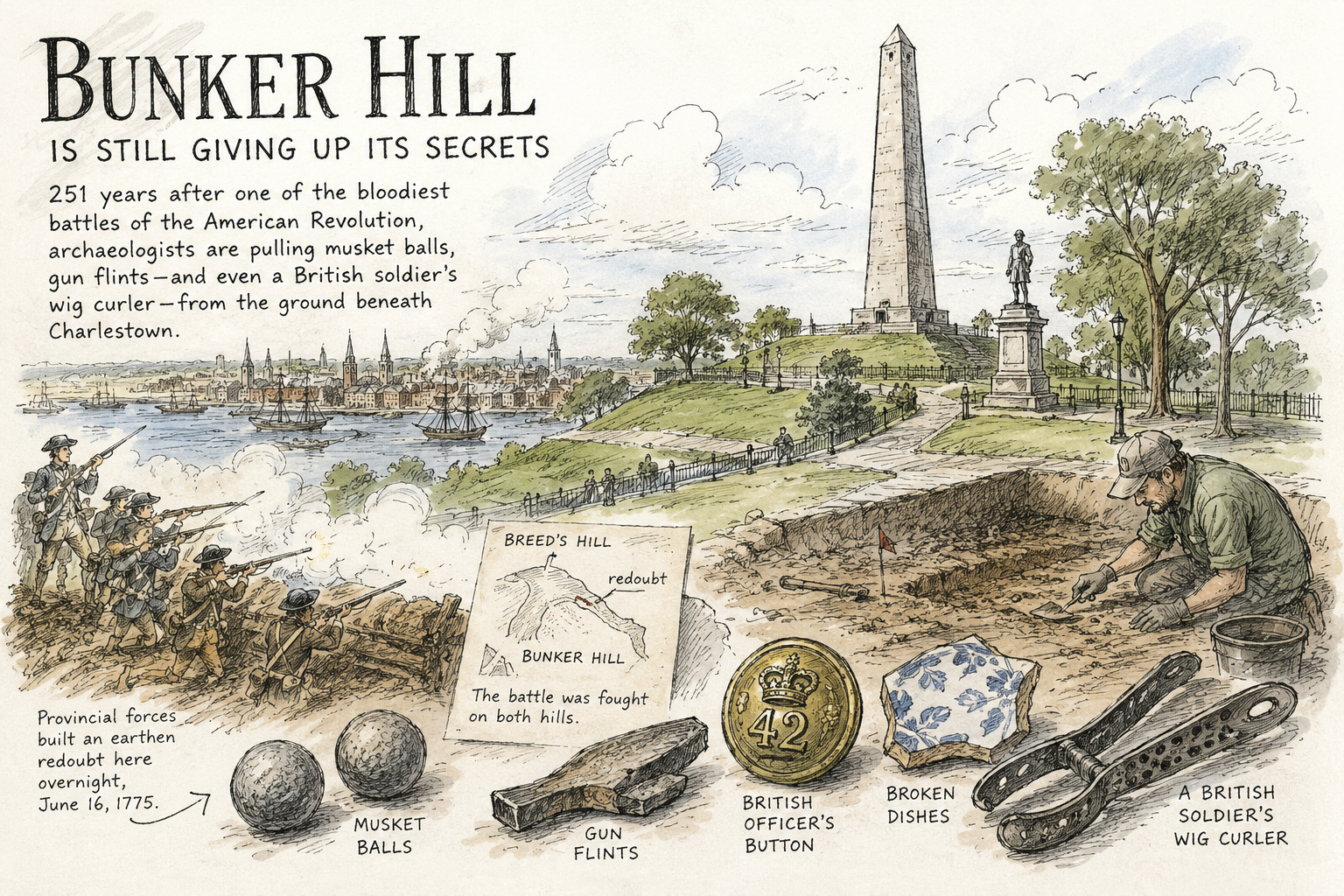
251 years after one of the bloodiest battles of the American Revolution, archaeologists are pulling musket balls, gun flints—and even a British soldier’s wig curler—from the ground beneath Charlestown. What they’re finding may change parts of the story we thought we knew.
Bunker Hill, Boston, Massachusetts
If you stand at the Bunker Hill Monument today, it is hard to imagine what was happening beneath your feet 251 years ago.
There was no 221-foot granite obelisk. No manicured lawn. No Freedom Trail leading visitors up through Charlestown.
There was dirt.
And on the night of June 16, 1775, there were hundreds of exhausted New England militiamen digging into it.
Using picks and shovels, the men worked through the night to construct an earthen fortification on the Charlestown heights. By sunrise, British commanders across the Charles could see what they had done.
Something had changed overnight.
The Americans had dug in.
And now, more than two and a half centuries later, Boston archaeologists have found what appears to be some of that same ground—and the things the soldiers left behind.
The dirt remembered
Boston City Archaeologist Joe Bagley and his team recently went looking for remnants of the earthen redoubt constructed before the Battle of Bunker Hill.
Finding it isn't as simple as uncovering a stone wall.
The fort was essentially built in a matter of hours: dig a trench, pile the excavated earth beside it, and use the resulting wall for protection. Over time, the wall disappeared. The battlefield changed. Eventually, the enormous Bunker Hill Monument was built above it.
But the trench remained underground.
Archaeologists searched for changes in the density and color of the soil that might reveal where it had been.
And they found them.
Inside were musket balls. Gun flints. Broken dishes. Personal objects. Fancy buttons that may have belonged to British officers.
And then there was the wig curler.
Yes. A wig curler.
A rather large one.
British soldiers occupying the captured position after the battle were expected to maintain their white military wigs. Somewhere amid the mud, blood, weapons and aftermath of one of the Revolution's most brutal early battles, a British soldier apparently still had to worry about his curls.
It is a wonderfully human little object.
History usually gives us generals and casualty numbers. Archaeology occasionally gives us the guy trying to fix his hair.
The finds are now being cleaned, catalogued, photographed and analyzed. Specialists will examine the ammunition and gun flints in hopes of determining who fired them, what weapons they came from and perhaps even what they struck.
Bagley says that work could refine—and possibly reset—parts of the story people have been telling about Bunker Hill for 250 years. (GBH)
Wait. Wasn't it actually Breed's Hill?
Every Boston schoolchild eventually encounters this bit of Revolutionary War trivia:
The Battle of Bunker Hill wasn't really fought on Bunker Hill.
It was fought on Breed's Hill.
That's true.
Sort of.
The geography is more complicated than the punch line.
On the night of June 16, Provincial forces moved onto the Charlestown Peninsula. Their objective was to occupy the high ground before the British could.
They constructed their main earthen redoubt on the smaller hill closer to Boston that we now call Breed's Hill, while defensive positions extended across the surrounding landscape toward Bunker Hill.
Both hills were part of the battlefield.
The National Park Service describes Provincial forces as occupying a fortified position that stretched across portions of both Bunker and Breed's Hills. So while the famous redoubt stood on Breed's Hill, calling the entire conflict the Battle of Bunker Hill isn't quite the historical blunder it's sometimes made out to be. (National Park Service)
Then the British came
By morning, British commanders knew they couldn't simply leave the Americans sitting above them.
British warships bombarded the position, but the cannon fire failed to dislodge the Provincials.
More than 2,000 British regulars were ferried across the water toward Charlestown.
Then they advanced uphill.
The Americans waited.
The fighting lasted only about two hours.
The British attacked repeatedly. Provincial defenders inflicted devastating casualties before finally running desperately short of ammunition. British soldiers and Marines eventually climbed into the redoubt, where the fighting became close and brutal.
The surviving Americans retreated.
Technically, Britain won.
But it was an extraordinarily expensive victory.
Roughly 2,400 British soldiers and Marines took part, and about 1,000 were killed or wounded. The National Park Service puts the British casualty total at 1,054, compared with roughly 450 Provincial casualties. (National Park Service)
The message was unmistakable.
These farmers, tradesmen and militiamen could stand against one of the world's most powerful professional armies.
The Revolution was no longer an argument.
It was a war.
And Charlestown burned
There is another part of the Bunker Hill story that can disappear behind the monument.
A town was destroyed.
Charlestown sat directly beneath the battlefield. Residents fled as fighting approached. Provincial soldiers fired from some of the abandoned buildings, and British forces set the town ablaze.
By the time the fighting ended, much of Charlestown lay in ruins.
People who had awakened that morning with homes had nowhere to return to.
The Battle of Bunker Hill wasn't simply two armies fighting on an empty hillside. It tore through a living community. (National Park Service)
Then the British moved into the fort
And this is where those objects coming out of the earth become especially interesting.
After capturing the position, British forces occupied it.
The archaeological team found evidence from that occupation mixed into the soil filling the old trench—broken dishes apparently taken from nearby houses, officers' buttons and other objects associated with the King's troops.
The researchers initially expected that the trench might have remained open much longer.
Instead, the soil tells another story.
Rain began washing the hastily piled earthen wall back into the trench relatively soon after the battle.
With the dirt came objects lying around the fort.
Musket balls.
Gun flints.
Buttons.
Dishes.
And one soldier's wig curler.
Layer by layer, the battlefield was burying its own evidence. (GBH)
Boston built a monument. The ground kept the rest.
Fifty years after the battle, the Marquis de Lafayette laid the cornerstone for the Bunker Hill Monument.
The granite obelisk took more than 17 years to complete and was dedicated in 1843. It still rises 221 feet over Charlestown, marking the location of the Provincial redoubt. (National Park Service)
But monuments tell history differently than dirt does.
A monument gives us the story a later generation chose to remember.
The ground gives us what people dropped.
That's why this archaeological work matters.
The Battle of Bunker Hill has been studied, painted, memorialized and taught for generations. We know who commanded. We know approximately where troops stood. We know who ultimately controlled the field.
Yet beneath one of Boston's most recognizable historic sites, physical pieces of June 17, 1775 are still waiting.
And some may tell us things the history books couldn't.
A fired musket ball can reveal a direction.
A gun flint can identify a weapon.
A layer of soil can tell archaeologists when a defensive trench began collapsing.
A button can put a particular kind of soldier in a particular place.
And even a wig curler can remind us that the figures we reduce to redcoats in paintings were actual human beings camping on a devastated battlefield, eating, sleeping, dressing and waiting to find out what came next.
More than 250 years after Boston helped ignite a revolution, we're still digging up the story.
Sometimes literally.
Go See It
The Bunker Hill Monument and Bunker Hill Museum are in Charlestown and are part of Boston National Historical Park and the Freedom Trail. The monument stands on Breed's Hill, at the site of the Provincial redoubt.
So the next time you stand beneath that granite obelisk, look down.
Somewhere under your feet, Boston may still have a few secrets left. (National Park Service)