
Boston’s Museum of Science Is About to Change. Here’s What to Know Before You Go.
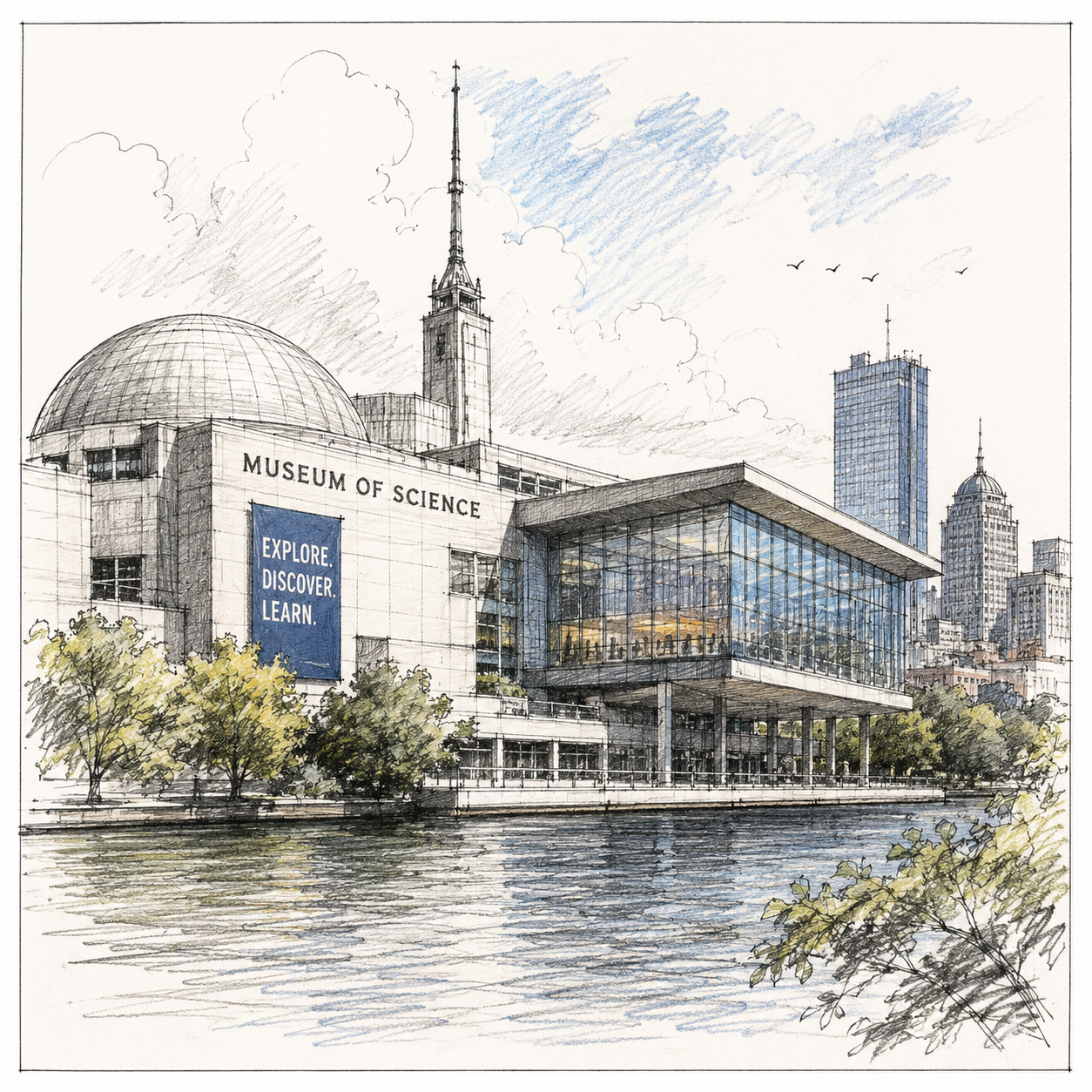
Museum of Science, Boston, Massachusetts
A $155 million new space opens October 10, but the Museum of Science has been reinventing itself—and teaching generations of Boston kids to ask questions—for nearly 200 years.
If you grew up around Boston, there's a decent chance you remember the lightning.
You sat in the Theater of Electricity waiting for somebody to fire up that enormous Van de Graaff generator, and then—crack.
Lightning inside the building.
Maybe you remember leaning back beneath the dome of the planetarium.
Maybe it was an IMAX movie on that enormous curved screen.
Maybe you went on a school field trip and spent half the day touching things adults ordinarily told you not to touch.
The Museum of Science has been doing that to Boston kids for generations.
Now one of Boston's most familiar institutions is about to change again.
On October 10, 2026, the Museum of Science will open the William and Charlotte Bloomberg Public Science Common, a new 10,000-square-foot space overlooking the Charles River.
The project is backed by a $155 million gift from Bloomberg Philanthropies—the largest gift in the Museum's history.
But the more interesting story begins long before Bloomberg.
Before It Was the Museum of Science
The Museum traces its roots all the way back to 1830, when it was founded as the Boston Society of Natural History.
Think about that date for a minute.
Andrew Jackson was president.
Boston was still decades away from filling in much of the Back Bay.
There was no Fenway Park.
No Green Line.
No Zakim Bridge.
No Museum of Science sitting over the Charles.
The institution originally focused on natural history, collecting and studying specimens much like other scientific societies of the 19th century.
Then Bradford Washburn came along.
Washburn became director in 1939 and helped transform the old natural-history institution into something very different: a place where ordinary people could experience science rather than simply look at collections.
The first wing of the Museum's new Science Park home opened in 1951.
And what a location Boston gave it.
Halfway Between Boston and Cambridge
The Museum sits at 1 Science Park, practically straddling the worlds of Boston and Cambridge with the Charles River beside it.
That's not a bad place to build a science museum.
MIT is upriver.
Harvard is across Cambridge.
Massachusetts General Hospital is nearby.
Universities, hospitals, biotechnology companies, engineers, researchers and students surround the place.
The Museum describes its location as a connection point between Boston and Cambridge.
Now it's about to take much greater advantage of that view.
The New Room Has One Hell of a Window
The new Bloomberg Public Science Common will have floor-to-ceiling glass and 270-degree views of the Charles, Boston and Cambridge.
But this isn't simply an expensive observation room.
The space is designed to change depending on what's happening inside it.
Movable walls.
Retractable seating.
Six movable LED video walls.
Immersive sound.
Livestreaming capabilities.
Real-time data visualization.
A technology called Deep Space that can project high-resolution imagery across walls and floors.
The Museum says the room could take visitors across the surface of Mars, into the deep ocean or even inside a living cell.
One morning it might hold a small discussion among scientists.
Later, schoolchildren could be watching a robotics demonstration.
That evening, hundreds of people could be there for a public event about artificial intelligence, climate change, genetics, public health or space.
In other words, the Museum isn't just adding another exhibit.
It's building a place for Boston's enormous scientific community to talk directly to the rest of us.
And There's a Very Boston Story Behind the Name
The William and Charlotte Bloomberg Public Science Common is named for Michael Bloomberg's parents.
That might sound like the usual naming-rights arrangement until you hear the backstory.
Bloomberg grew up in Medford.
As a boy, he has said he traveled by trolley, subway and bus to visit the Museum of Science on Saturday mornings.
His parents encouraged that curiosity.
Decades later, their son became the founder of Bloomberg L.P., mayor of New York City and one of the world's wealthiest philanthropists.
And he apparently never forgot those trips to the Museum.
Bloomberg Philanthropies previously helped renovate the Charles Hayden Planetarium and funded the William and Charlotte Bloomberg Science Education Center.
Now comes the $155 million gift and a space bearing his parents' names.
There's something rather wonderful about that circle.
A kid from Medford rides public transportation into Boston because he wants to learn how the world works.
Many decades later, he helps build a place intended to encourage other kids to ask the same questions.
Don't Skip the Old Stuff
All this new technology doesn't mean you should walk into the Museum on October 10 and race straight for the shiny new room.
Some of the old Museum of Science experiences are still the reason to go.
See the lightning demonstration.
The Museum's enormous air-insulated Van de Graaff generator produces indoor bolts of lightning during the live Theater of Electricity presentation.
It's spectacular.
It's also the kind of science lesson you remember because somebody essentially made a thunderstorm indoors.
Go to the Charles Hayden Planetarium.
Boston has been looking up from here for generations, and the planetarium remains one of the Museum's signature experiences.
Try the Mugar Omni Theater.
The giant IMAX Dome wraps the movie around you rather than simply putting it on a screen in front of you.
And don't assume the Museum is only for little kids.
There are hundreds of interactive exhibits covering everything from engineering and biology to dinosaurs, space, mathematics and artificial intelligence.
You can easily spend several hours here.
What Does the Museum of Science Cost?
As of August 2026, regular Exhibit Halls admission is:
Adults: $33
Seniors 60+: $29
Children ages 3–11: $28
Children under 3: Free
The Museum is generally open daily from 9 a.m. to 5 p.m.
Planetarium and Omni shows are separate tickets. When added to Exhibit Halls admission, they currently cost $6 each.
Always check current prices, hours and show schedules before you go.
One Way to Save if You're Seeing More of Boston
If you're visiting Boston and the Museum of Science is only one stop on your itinerary, don't automatically buy every attraction separately.
The Museum of Science is currently included with the Go City Boston pass.
Go City offers an Explorer Pass, where you choose a set number of attractions, and an All-Inclusive Pass covering participating attractions over a selected number of days.
The current attraction list includes the Museum of Science along with places and experiences such as the Museum of Fine Arts, View Boston, the USS Constitution Museum, Freedom Trail tours and Boston sightseeing cruises.
Whether the pass saves you money depends on what you actually plan to visit, so do the math before buying.
GoBoston.com contains affiliate links. If you make a purchase through some links on this site, I may receive a commission at no additional cost to you. It helps support GoBoston.
How Much Time Should You Allow?
I'd give the Museum at least three hours.
You could spend considerably longer, particularly if you're adding an Omni film or planetarium show.
If you're traveling with children who want to investigate every button, lever and experiment they encounter, abandon any illusion that you're going to hurry through the place.
That's sort of the point.
Driving or Taking the T?
The Museum is at 1 Science Park, Boston, and has its own parking garage.
But you're in Boston.
Parking has a way of becoming part of the adventure—and not usually the good part.
The Museum is accessible by public transportation, with the Green Line's Science Park/West End station nearby. Check current MBTA service before your trip.
And here's a useful Boston tourism combination: Boston Duck Tours depart from the Museum of Science, so the Museum can work particularly well as part of a larger sightseeing day.
Is the Museum of Science Worth Visiting?
If you're visiting Boston with children, absolutely.
If you're an adult who likes science, technology, space, engineering or simply finding out how things work, don't write it off as a children's museum.
And if you grew up here?
Go back.
Stand in front of that giant Van de Graaff generator again.
Walk over to the windows and look out at the Charles.
Remember what the place looked like when you were ten.
Then look at what Boston is building there now.
A Museum About Curiosity Has to Keep Changing
That's really the part of this $155 million project that interests me.
Museums have a strange problem.
We depend on them to preserve things.
But a science museum devoted entirely to preserving the past would make no sense at all.
Science moves.
What we know changes.
The questions change.
The technology changes.
And the Museum of Science has been changing with them since a group of Bostonians founded the Boston Society of Natural History in 1830.
In 1951, it moved into a new kind of science museum at Science Park.
Generations of Boston kids came through.
Some stared at dinosaurs.
Some watched lightning fly through the air.
Some looked up at the stars.
One kid from Medford kept coming back on Saturday mornings.
Seventy-five years after Science Park opened, he's helping change the place again.
The William and Charlotte Bloomberg Public Science Common opens October 10.
I have a feeling another generation of kids is about to find something there they'll remember for the rest of their lives.
Love Boston? I write about the places, history, people and wonderfully strange stories that make this city what it is.
Join me on the GoBoston Substack at @goboston.
Sources
Museum of Science, Boston — Public Science Common announcement and visitor information
Museum of Science, Boston — Museum history and archives
Museum of Science, Boston — Hours and Pricing
Go City Boston — Current attractions and pass information
Boston Globe — William and Charlotte Bloomberg Public Science Common, August 19, 2026
Boston.com — Public Science Common preview, August 21, 2026