
Why Does Boston Carry Saints Through the Streets?
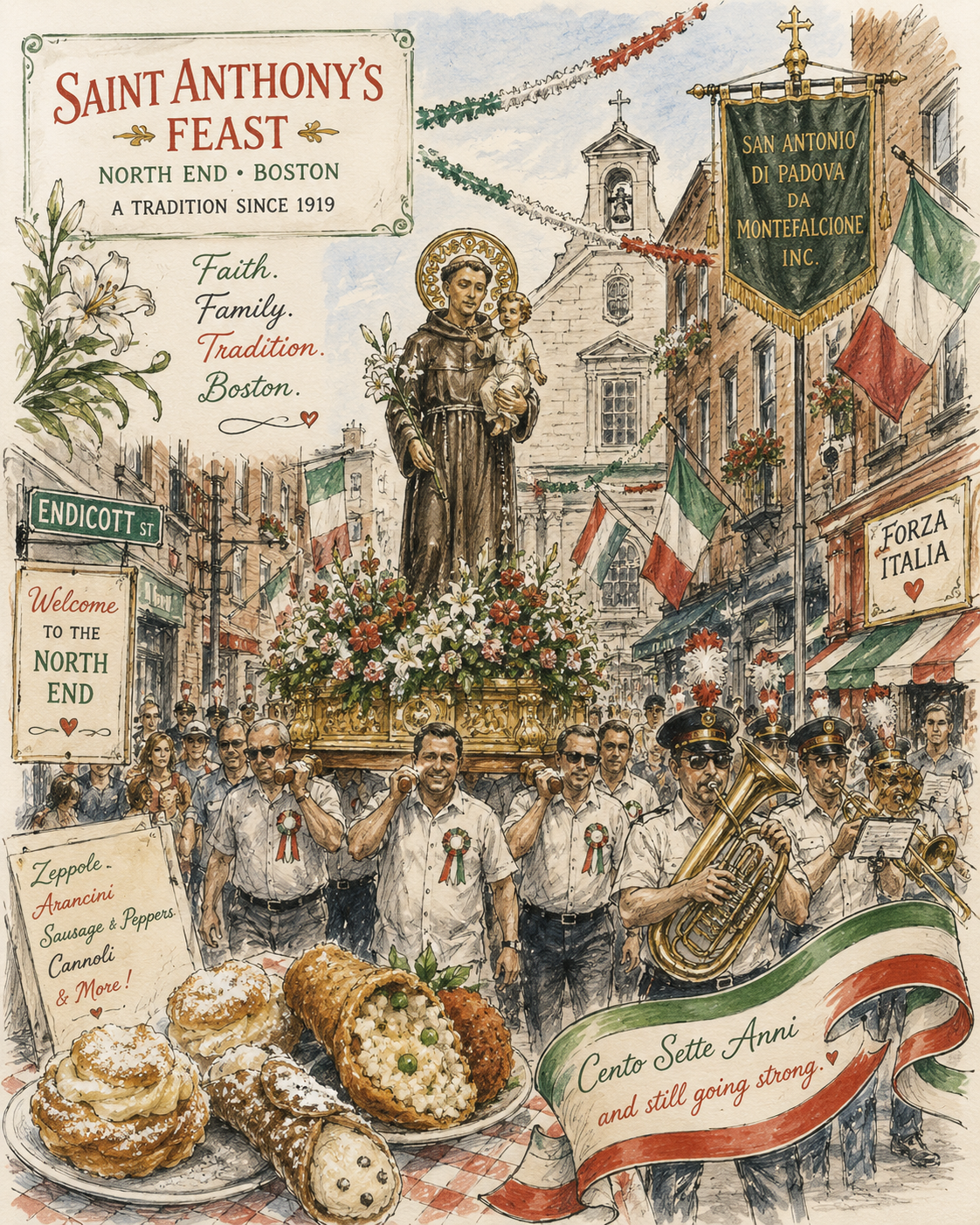
Saint Anthony’s Feast returns to the North End this week. Come for the arancini and zeppole. Stay for a Boston tradition that crossed an ocean more than a century ago.
Walk into Boston’s North End this weekend and subtlety will not be on the menu.
The streets will be dressed in green, white and red. Music will bounce between the brick buildings. There will be sausage and peppers, calamari, pizza, pasta, arancini, cannoli, gelato and zeppole competing for whatever room remains in your stomach.
Then, above the crowd, Saint Anthony will come down the street.
Not a person dressed as Saint Anthony.
A statue.
It will be carried through the North End for hours, accompanied by marching bands, devotees and generations of families who have been doing some version of this for more than a century.
If you've never seen a North End feast, you might reasonably wonder:
What exactly is going on here?
That's the fun part.
You're not merely walking into another Boston summer festival.
You're walking into a tradition that Italian immigrants packed up, carried across the Atlantic and recreated on the streets of Boston.
And this week, it happens again.
The Feast of All Feasts Is Back
The 107th Saint Anthony's Feast runs August 27–30, 2026, in Boston's North End.
It's billed by organizers as the largest Italian religious festival in New England, and its roots reach back to 1919, when immigrants from the small town of Montefalcione in southern Italy established the tradition in their new Boston neighborhood. (Saint Anthony's Feast)
They hadn't simply arrived in America with recipes.
They brought their saints.
Their religious traditions.
Their processions.
Their music.
Their sense of community.
And perhaps most importantly, their understanding that a feast honoring a saint was not something that needed to remain quietly inside a church.
You took it into the streets.
Why Saint Anthony?
Saint Anthony of Padua was a 13th-century Franciscan friar born in Portugal who became closely associated with Padua, Italy.
Today, plenty of people know him primarily as the saint you appeal to when you've lost your keys.
Saint Anthony, Saint Anthony, please come around...
But devotion to him goes considerably deeper than finding the thing you swear you left right there.
He became one of Catholicism's most beloved saints, associated with the poor, travelers and people seeking lost things.
In southern Italy, devotion to patron saints became woven into the life of individual towns.
Montefalcione, in the province of Avellino east of Naples, was one of them.
When immigrants from Montefalcione arrived in Boston during the great wave of Italian immigration in the late 19th and early 20th centuries, they brought those traditions with them.
In 1919, they formed the organization now known as San Antonio Di Padova Da Montefalcione, Inc.
More than a century later, their descendants are still putting on the feast. (Saint Anthony's Feast)
Think about that.
People left a small Italian mountain town, crossed an ocean, settled in a crowded American neighborhood and recreated a celebration from home.
Boston changed around it.
The North End changed enormously around it.
The feast stayed.
Boston's North End Wasn't Always Italian
This is one of my favorite things about the North End.
We think of it today as Boston's Italian neighborhood.
But the North End has been reinventing itself for centuries.
Puritans lived there.
So did wealthy colonial merchants.
Paul Revere lived there.
Later came waves of Irish immigrants and Eastern European Jews.
Then, beginning in large numbers in the late 19th century, Italians arrived.
By the early 20th century, the North End had become overwhelmingly Italian, with immigrants clustering not merely by country but often by the particular towns and regions they had left behind.
That helps explain why Boston didn't end up with one generic Italian festival.
Different immigrant communities brought different saints and feast traditions.
The Fisherman's Feast traces its roots to immigrants from Sciacca, Sicily.
The Feast of Saint Agrippina came from Mineo, Sicily.
Saint Anthony's came from Montefalcione.
These weren't simply neighborhood parties.
They were pieces of home.
So Why Carry a Statue Through the Streets?
Because the procession is the heart of the tradition.
Religious processions honoring saints have deep roots in Catholic Europe. A statue or image of the saint leaves the church or shrine and moves among the people.
The sacred comes out into everyday life.
In the North End, that means Saint Anthony doesn't remain tucked away in his chapel while everyone else eats zeppole outside.
He comes to the neighborhood.
On Friday, August 28, Society members carry the statue from its indoor chapel to the outdoor shrine during opening ceremonies.
On Saturday comes the Benvenutti Parade, welcoming visitors into the neighborhood.
Then Sunday is the big one. (Saint Anthony's Feast)
Ten Hours With Saint Anthony
The Grand Procession of Saint Anthony begins around noon Sunday, August 30, at the outdoor chapel on Endicott Street.
And then it keeps going.
For roughly 10 hours.
The statue travels through the streets of the North End accompanied by devotees, marching bands and crowds.
Eventually Saint Anthony returns to his chapel amid confetti and streamers. (Saint Anthony's Feast)
Ten hours is not a parade.
That's a relationship.
And that's probably the key to understanding the feast.
To an outsider, the statue may be an interesting piece of religious pageantry.
To families who have maintained this tradition across generations, Saint Anthony is personal.
The feast organization itself isn't merely an event company. Its stated mission includes devotion to Saint Anthony, preservation of Italian-American culture and history, and support for North End community institutions. (Saint Anthony's Feast)
And Then There Is the Food
Let's not pretend we're all going to the North End exclusively for a lesson in immigrant history.
There will be food.
A lot of food.
Feast organizers describe nearly 100 pushcarts and vendors offering Italian and Italian-American favorites.
Arancini.
Sausage, peppers and onions.
Calamari.
Pizza.
Pasta.
Quahogs.
Zeppole.
Cannoli.
Gelato. (Saint Anthony's Feast)
There is also a culinary pavilion with demonstrations throughout the weekend. The 2026 schedule includes North End chefs, pizza makers, cooking competitions and, wonderfully, separate appearances Saturday evening for Cooking with the North End Nonnas and Cooking with the North End Nonnos. (Saint Anthony's Feast)
I don't know who wins that competition.
I know better than to take sides.
The Religious Part Is Still Very Much Religious
It's easy for a visitor to experience Saint Anthony's Feast primarily as an enormous Italian street festival.
But the religious tradition hasn't disappeared underneath the cannoli.
An outdoor Mass is scheduled for 5 p.m. Saturday, August 29, followed by a blessing with relics of Saint Anthony and Saint Lucy and distribution of blessed Saint Anthony bread. (Saint Anthony's Feast)
That's worth knowing before you go.
This isn't a modern food festival onto which somebody pasted an Italian saint for atmosphere.
The food, music and celebration grew around a religious observance.
The saint came first.
What to Know If You're Going This Weekend
Saint Anthony's Feast runs Thursday, August 27 through Sunday, August 30, centered around Endicott, Thacher, North Margin and surrounding streets in the North End. (Boston.gov)
Admission is free. There are no legitimate admission tickets; feast organizers specifically warn that anyone attempting to sell entry tickets is running a scam. You pay individual vendors for food, drinks and other purchases, and not every vendor accepts credit cards. (Saint Anthony's Feast)
One important 2026 security rule: bags, outside beverages and containers aren't permitted in the feast area, and attendees and belongings may be subject to search. (Saint Anthony's Feast)
Driving into the North End would not be my first choice.
There will be parking restrictions and road closures beginning Wednesday, August 26, and continuing through Monday as the neighborhood sets up, celebrates and breaks everything down. (Boston.gov)
Take the T.
Walk.
And arrive hungry.
If You Can Only Go Once
I'd choose Sunday.
That's when you get the Grand Procession, which is the part that connects what you're seeing in 2026 most directly to what immigrants from Montefalcione created in Boston in 1919.
If Sunday doesn't work, Saturday gives you the outdoor Mass, the Benvenutti Parade, music, food and a full day of feast activity. (Saint Anthony's Feast)
But don't spend the entire visit looking for the shortest cannoli line.
Look around.
Look up at the decorations stretched between the buildings.
Listen to the bands.
Watch the people who aren't merely attending the feast but continuing it.
Because that's where the real Boston story is.
More Than a Century Later, They're Still Carrying Him
Boston is very good at preserving buildings.
We put plaques on them.
We rope things off.
We tell you George Washington stood here and Paul Revere did something over there.
But some history isn't sitting behind glass.
Some of it is still walking down Endicott Street.
That's what I like about Saint Anthony's Feast.
In 1919, immigrants from one little town in Italy wanted to keep a piece of home alive in Boston.
Their children kept it going.
And their grandchildren.
And their great-grandchildren.
Now it's 2026.
The neighborhood around them has become some of the most expensive real estate in Boston. Tourists fill Hanover Street. The old immigrant neighborhood has changed almost beyond recognition.
And this weekend, they'll pick up Saint Anthony again.
The bands will start playing.
The food will start frying.
The streets will fill.
And for four days in the North End, Boston becomes a little bit Montefalcione again.
Come join me on my GoBoston Substack and let’s talk about Boston!