
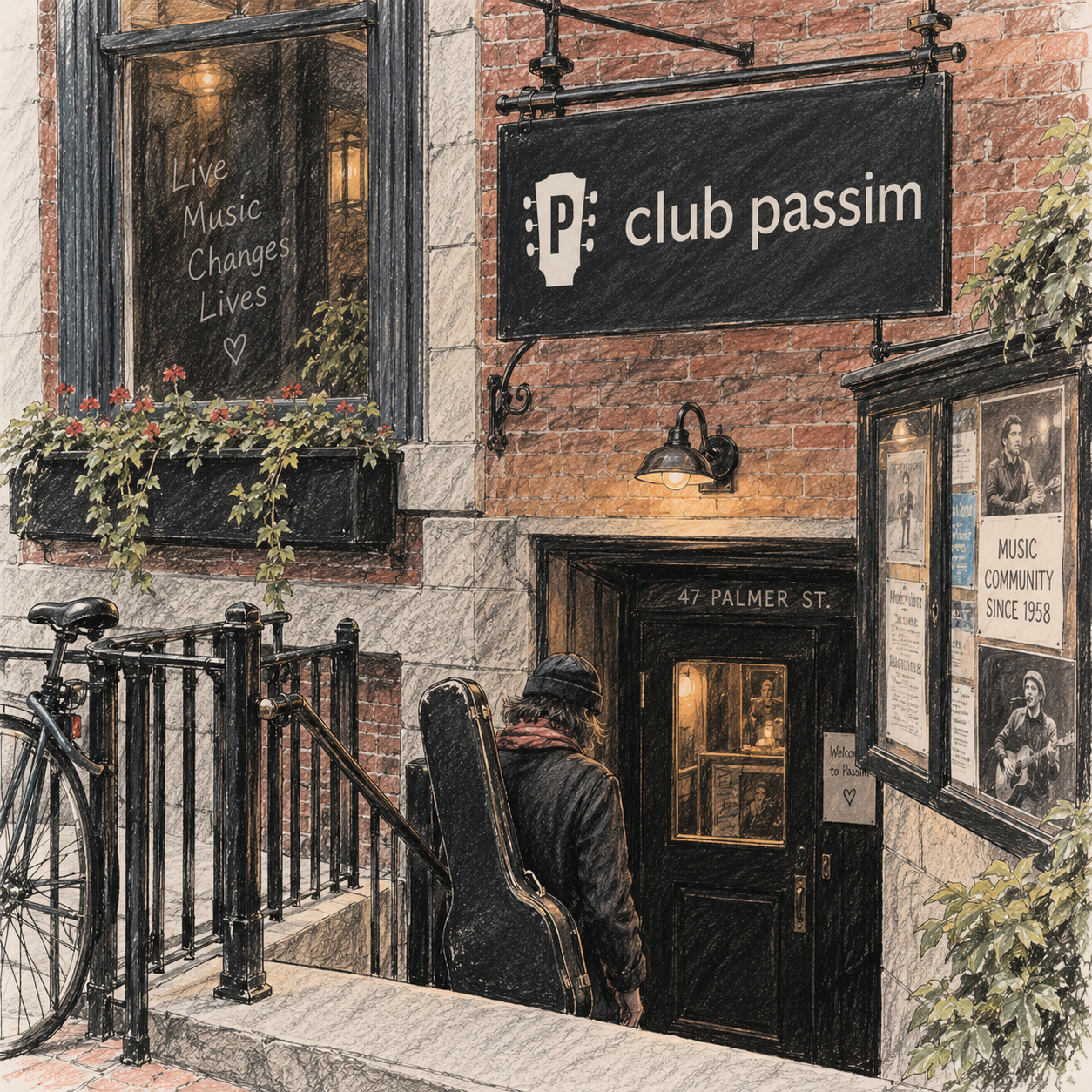
Club Passim, Harvard Square, Cambridge, Massachusetts
Boston still produces extraordinary musicians. Increasingly, it also produces a reason for them to leave.
I grew up just outside of Boston when you didn’t have to explain that this was a music town. You could feel it.
In the 1970s, there was music everywhere across Boston and Cambridge — Passim in Harvard Square, the Rat in Kenmore Square, Paul’s Mall and the Jazz Workshop on Boylston Street, along with bars, basements and little rooms where somebody was always playing something.
And there were the bands. The J. Geils Band. Duke and the Drivers. The James Montgomery Band. And, of course, Boston — the band that carried the city’s name around the world. These weren’t names I discovered later in some history of Boston music. They were part of the soundtrack of being young around Boston then.
Even Orpheus played at my high school. That was how close the music felt then — not distant, not packaged, but right there in the places where we were growing up.
Boston’s Tom Scholz was building that unmistakable sound right here after MIT, working with Brad Delp on recordings that would eventually become part of one of the biggest debut albums in rock history. The J. Geils Band became one of the acts that defined Boston rock, while Duke and the Drivers and the James Montgomery Band were fixtures of the local club scene.
Music wasn’t something happening somewhere else.
It was happening here.
Some of those places and musicians became legendary. Plenty didn’t. That was part of the point. You didn’t need a giant venue and a corporate sponsor to have a music scene. You needed a room, a few musicians, somebody willing to give them a night, and enough people who could still afford to live nearby to wander in and listen.
I was a city kid, and Boston and Cambridge were simply where we went. Harvard Square was alive with street musicians and characters, part of a music culture that could put an unknown performer in front of an audience without much more than a guitar and a place to play. Tracy Chapman, who like me went to Tufts, became a fixture in Harvard Square and the local folk scene while she was still a student there. A few years later, Fast Car would help make her famous around the world.
That’s the Boston music story I remember: you never quite knew who you might be listening to before the rest of the world knew their name.
I certainly didn’t know then that I would become a songwriter myself decades later. Now I’ve written and published more songs than I ever imagined I would, using technology that would have seemed like science fiction to that younger version of me. I can write from home, share new songs first with my readers on Joyce Strong on Substack, and send them out into a musical world that bears almost no resemblance to the one I grew up around.
The technology changed. What hasn’t changed is what musicians need around them: other musicians, producers, engineers, places to rehearse, little stages where they can be bad before they’re good and good before anybody important notices. Most of all, they need enough time and financial breathing room to find out what they might become.
And that’s what makes today’s Boston so frustrating.
We still have Berklee. We still have the New England Conservatory. We still attract extraordinary young musicians from around the world. Boston is remarkably good at finding talent, teaching talent and developing talent.
Then we make it almost impossible for that talent to afford to stay here.
The Boston Globe put a face on that problem this week with the story of Clark Lacossade, the Hyde Park rapper and producer known as Clark D. He began his career here, left for an internship in Atlanta in 2021 and intended to come home.
He didn’t.
Atlanta offered something Boston couldn’t: not simply cheaper housing, but an ecosystem in which trying to become a professional musician actually seemed possible. Since leaving, Lacossade has earned six Grammy nominations, released six albums and built an audience of about 120,000 monthly Spotify listeners.
His assessment of Boston was painfully simple: he wanted to make music at the highest level, and he didn’t believe he could do it here.
That’s a loss for Boston that is harder to measure than the closing of a restaurant or the departure of a corporate headquarters. But it is a loss.
We Produce the Talent. Then We Export It.
Boston has an unusual problem for a city of its size. We are extraordinarily good at attracting young creative people.
Berklee alone draws musicians from around the world. Students arrive here to sing, write, compose, produce, engineer and perform. Other musicians grow up in Dorchester, Roxbury, Hyde Park, Jamaica Plain, Allston and communities throughout Greater Boston.
Then comes the hard part: how do you remain an emerging artist in a city where housing can consume most of an emerging artist’s income?
The Globe reports that the average rent for a three-bedroom Boston apartment is now approaching $5,800 a month. Lacossade recalled sharing his first Atlanta apartment for $550 a month.
That difference isn’t just about rent. It’s the extra shift you don’t have to work, the afternoon you can spend recording, the money for an engineer, a rehearsal room or a van to get to a show. It’s the ability to take a poorly paid opening gig because it might lead somewhere.
Artists need some financial breathing room in the years when almost nobody is paying them very much to be artists. Boston has made that breathing room extraordinarily expensive.
And Then We Lost the Rooms
Housing is only part of it. Musicians need places to rehearse and places to play, and Boston has been losing both.
Thunder Road, ONCE Lounge and Hennessy’s are among the performance spaces that have closed. The loss of the Sound Museum’s longtime Allston-Brighton rehearsal complex after the property was purchased for lab development displaced hundreds of musicians.
That history makes the effort to bring Great Scott back particularly important. The beloved Allston club closed in 2020. A redevelopment approved last year is expected to bring it back in 2027, with a roughly 300-person Great Scott and a smaller O’Brien’s space incorporated into the project.
One club doesn’t make a music economy, but dozens of small clubs do. They’re where a new band plays before anybody knows its name, where musicians meet other musicians, where an artist learns how to hold a room with 75 people before trying to hold one with 7,500.
Lose enough of those places and you haven’t simply lost nightlife. You’ve dismantled the bottom rungs of the ladder.
Boston Knows It Has a Problem
There are people trying to fix this.
The Record Co., a Boston nonprofit, now serves more than 3,000 artists a month with recording, rehearsal and production space starting at $10 an hour. Its entire model is built around a reality the commercial market has failed to solve: musicians need professional space they can actually afford.
The city is also pursuing something unusually ambitious at 290 North Beacon Street in Brighton: publicly owned affordable rehearsal space combined with deeply affordable housing. Plans call for roughly 40,000 square feet of rehearsal and recording space, a direct response to the displacement of musicians from the former North Beacon Sound Museum property.
And statewide, arts advocates have been pushing a Creative Space Act that would give municipalities another mechanism to protect cultural properties before they’re swallowed by the real-estate market. Advocates say Massachusetts has lost creative workspace steadily for two decades, with more than half of that lost square footage disappearing during just the past ten years.
Those are important efforts. But they also tell us how serious the problem has become.
We’re now trying to create public policy to preserve something cities once produced much more naturally: cheap rooms where creative people could make things.
What Kind of City Does Boston Want to Be?
This isn’t really just a story about musicians. It’s a story about Boston.
We have become enormously successful at creating a city valuable enough that almost everybody wants a piece of it. Biotech wants it. Universities want it. Developers want it. Hospitals want it. Investors want it. High-income professionals want it.
That’s good — until success begins squeezing out some of the things that made the city worth wanting in the first place.
A city cannot live entirely on laboratories, luxury apartments, universities and office buildings. It needs the weird little club, the rehearsal room behind an unremarkable door, the singer working in a coffee shop while finishing an album, the band nobody has heard of yet. It needs the ageless songwriter who needs that one break to become the person we’re all going to brag was “from Boston.”
Maybe I notice all of this more now because I write songs myself. The tools have changed dramatically, and today I can create and publish music in ways that would have seemed impossible when I was wandering around Cambridge and Boston in the 1970s.
But technology can’t recreate what those old streets and little rooms gave us. They gave musicians somewhere to begin. They gave audiences somewhere to discover them. And they gave a city some of its character before anyone had figured out how much that character was worth per square foot.
Boston is still very good at creating musicians. I’d like it to remain a place where they can afford to become musicians, too.
Want more stories about the Boston we remember and the Boston we’re living in now? Join the GoBoston community on Substack.