
Massachusetts Is Vaccinating Wild Raccoons From the Sky. Here's Why.
Massachusetts is Vaccinating Raccoons From the Sky
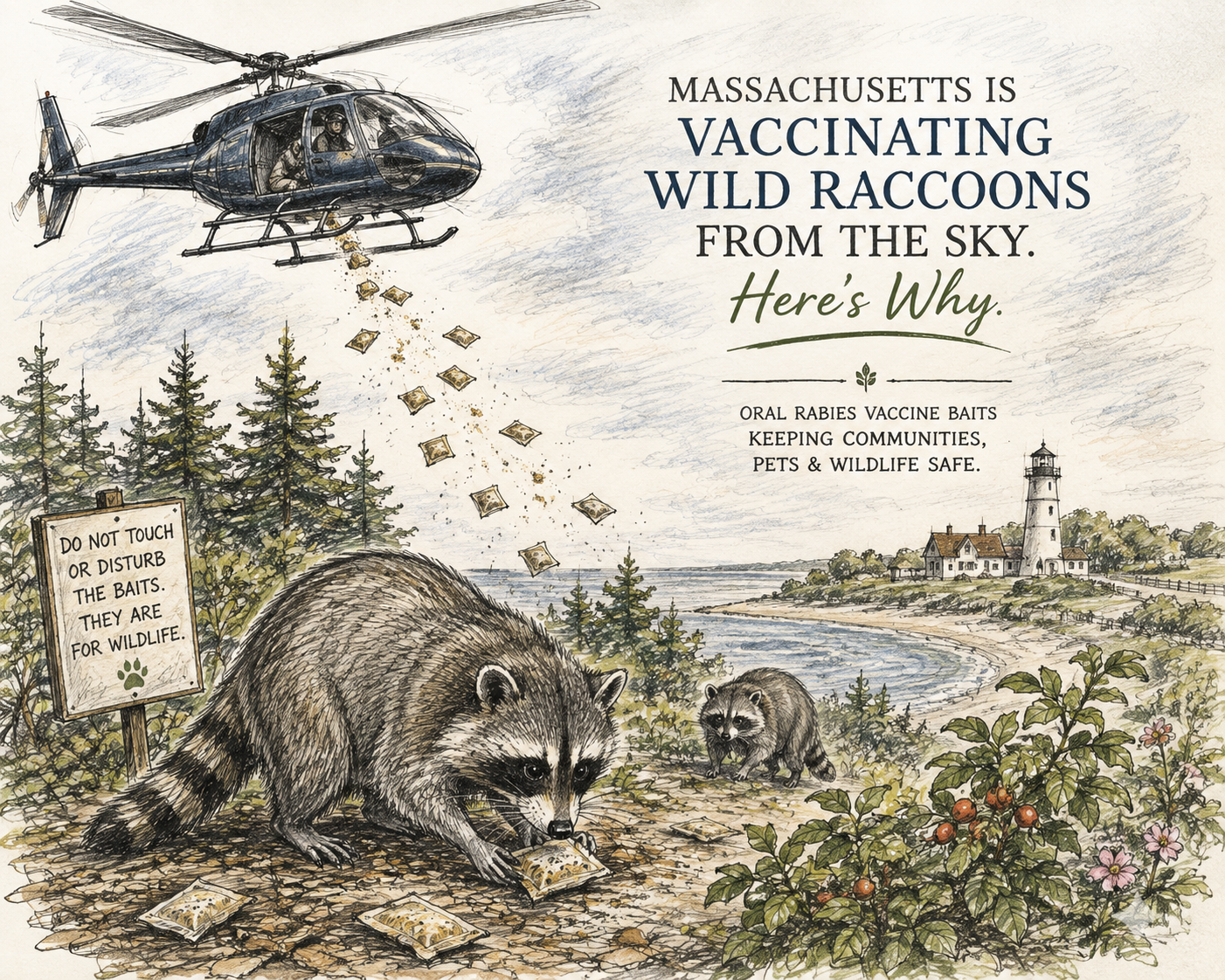
If you see a helicopter dropping little packets over parts of Cape Cod and southeastern Massachusetts this fall, don't panic. The raccoons are getting vaccinated.
Imagine you're walking through the woods on Cape Cod and find a little plastic packet that smells strongly of fish.
Or perhaps you're looking up and watching a helicopter drop things into the landscape.
This sounds like the beginning of a story in which nothing good happens next.
Instead, Massachusetts is vaccinating raccoons.
Not by catching them.
Not by lining them up at a veterinary clinic.
We're dropping rabies vaccines where raccoons can find them and vaccinate themselves.
And this fall, about 75,000 doses are headed for parts of Cape Cod and southeastern Massachusetts. (APHIS)
I had questions.
Starting with the obvious one.
How Do You Vaccinate a Raccoon That Has No Interest in Being Vaccinated?
You hide the vaccine in something a raccoon wants to eat.
The USDA's Animal and Plant Health Inspection Service uses an oral rabies vaccine called RABORAL V-RG.
The vaccine is contained inside a small plastic sachet about two inches long. The outside is coated with a fishmeal attractant.
In other words, to us it smells fairly awful.
To a raccoon, apparently, dinner has arrived.
When the animal bites into the packet, the vaccine is released into its mouth and can immunize it against rabies.
No appointment.
No needle.
No wrestling with an angry raccoon.
The raccoon vaccinates itself.
Frankly, there are human healthcare systems that could learn something from this efficiency.
And Yes, Some of Them Arrive by Helicopter
The 2026 Massachusetts operation is scheduled for mid-September through mid-October and will cover portions of peninsular and mainland Massachusetts.
The USDA says approximately 75,000 oral vaccine baits will be distributed using a combination of helicopters, vehicles and bait stations. (APHIS)
The Cape Cod program has historically concentrated on an area extending from the Cape Cod Canal toward Barnstable and Falmouth, along with communities on the mainland side of the canal and portions of southeastern Massachusetts. Local officials use different distribution methods depending on the terrain and population density. (Barnstable County)
Vehicles can place baits along wooded roadsides and other likely raccoon habitat.
Bait stations can target particular areas.
And helicopters can cover larger stretches of appropriate habitat efficiently.
Crews aren't supposed to scatter them indiscriminately. The Cape Cod program says driveways, lawns, buildings, schools and agricultural fields are avoided. (Barnstable County)
Somewhere below, presumably, a raccoon thinks it has had an unusually good day.
Why Raccoons?
Because wildlife has become the center of America's rabies problem.
The Centers for Disease Control and Prevention estimates that roughly 90 percent of reported rabies cases in the United States occur in wildlife. Raccoons, skunks, foxes and bats are among the animals most commonly involved. (APHIS)
Rabies is caused by a virus that attacks the central nervous system of mammals.
Once symptoms appear, the disease is almost always fatal.
That sounds terrifying because it is.
The reassuring part is that rabies is also preventable. People who may have been exposed can receive effective post-exposure treatment when they seek medical care promptly. Vaccinating dogs and cats creates another important barrier between infected wildlife and humans.
But there's an obvious problem.
You can require a rabies shot for someone's Labrador.
You cannot send every raccoon in Massachusetts a vaccination reminder.
So public-health officials decided to bring the vaccine to the raccoons.
Cape Cod Has Been Doing This for More Than 30 Years
This isn't some experimental idea Massachusetts dreamed up last week.
The Cape Cod Oral Rabies Vaccination Program began in 1994, making it one of the country's longest-running wildlife rabies-control efforts. (Barnstable County)
And for a while, it worked remarkably well.
The strategy was essentially to create a vaccinated wildlife barrier around the Cape Cod Canal. From 1994 until 2004, officials maintained that barrier in an effort to keep the raccoon variant of rabies from establishing itself on Cape Cod.
Then the virus got through.
In March 2004, the first raccoon-rabies case beyond the canal was detected.
By 2006, raccoon rabies had been found in every town on Cape Cod. (Barnstable County)
That's an important part of this story.
The vaccine campaign isn't about pretending rabies doesn't exist on the Cape.
It's about controlling it, reducing its prevalence and trying to prevent the disease from spreading or being reintroduced into areas where officials have pushed it back.
The Cape Cod and Southeast Massachusetts Rabies Task Force continues working with USDA Wildlife Services and the Massachusetts Department of Public Health on that effort. (Barnstable County)
Massachusetts Isn't Alone
There is a much bigger battle against raccoon rabies happening across the eastern United States.
The USDA's National Rabies Management Program has been distributing oral vaccine baits in cooperation with state and local governments since the 1990s.
The larger goal is ambitious: stop wildlife rabies from spreading into new territory and ultimately eliminate terrestrial rabies in the United States. (APHIS)
This year, USDA projects stretch from northern New England through New York and Pennsylvania and south into Appalachia and the Southeast.
Millions of vaccine baits are involved nationally.
The Massachusetts operation is one little piece of an enormous vaccination line.
Except our piece happens to involve Cape Cod raccoons eating fish-scented medicine dropped from helicopters.
Which makes ours more fun to explain.
What If You Find One?
Leave it alone if you can.
The baits are meant for wildlife.
But finding one isn't an emergency.
USDA says people and pets cannot get rabies from contact with the vaccine baits, and the vaccine is considered safe for many animals, including dogs and cats. (APHIS)
If a bait has landed somewhere inappropriate, Cape Cod officials recommend using a glove or towel to pick it up and moving it into nearby woods where children and pets aren't likely to find it. If there's nowhere appropriate to relocate it, it can be thrown away. (Barnstable County)
Then wash your hands.
If the liquid vaccine itself gets on your skin, wash the area thoroughly with soap and water and contact the Massachusetts Department of Public Health for guidance.
What If My Dog Eats One?
Your dog has not accidentally received a dangerous dose of raccoon medicine.
The USDA says the vaccine is safe for dogs and cats. Dogs that eat several baits can sometimes develop a temporary upset stomach, but long-term health problems aren't expected. (APHIS)
Cape Cod's program reports that even doses far exceeding the amount contained in a single bait have been tested in raccoons and dogs without ill effects. (Barnstable County)
Still, the bait wasn't put there for your Labrador.
If your pet gets hold of one, Barnstable County asks residents to report the contact.
And don't assume eating an oral wildlife bait substitutes for your pet's regular rabies vaccination.
It doesn't.
The Baits Don't Hang Around for Long
Here's another clever part of the program.
Officials aren't expecting tens of thousands of little fishy vaccine packets to remain scattered around Massachusetts indefinitely.
Cape Cod's Rabies Task Force says studies have found that most baits are eaten within four days and almost all disappear within a week. (Barnstable County)
That's because the people running the program know something important about raccoons.
If you put out something that smells like food, finding a raccoon willing to investigate it is generally not the difficult part.
This Is Public Health, Just Not the Kind We Usually See
Most of us think of vaccination as something that happens in a doctor's office or veterinary clinic.
Wildlife changes the equation.
You can't vaccinate your way out of a wildlife disease one captured animal at a time.
So instead, epidemiologists, wildlife biologists and public-health officials think geographically.
Where is the virus?
Where is it moving?
Where can enough animals be immunized to slow it down?
Then somebody gets in a helicopter with thousands of fish-scented vaccine packets.
It's an unusual reminder that protecting human health sometimes begins long before a person walks into a hospital.
Sometimes it begins in the woods.
If You See Something Strange Falling From the Sky...
The 2026 Massachusetts distribution is scheduled for mid-September through mid-October, so we're still a few weeks away.
If you're on Cape Cod or in parts of southeastern Massachusetts this fall and encounter one of the little packets, you now know what you've found.
Don't open it.
Don't take it home.
Don't let the kids play with it.
If it's where wildlife can get it, leave it there.
There's a raccoon somewhere who needs it more than you do.
And if you happen to see a helicopter dropping mysterious little objects into the Massachusetts woods?
For once, the explanation is both stranger and nicer than whatever you were imagining.
We're vaccinating the raccoons.
From the sky.
Not a bad day's work.